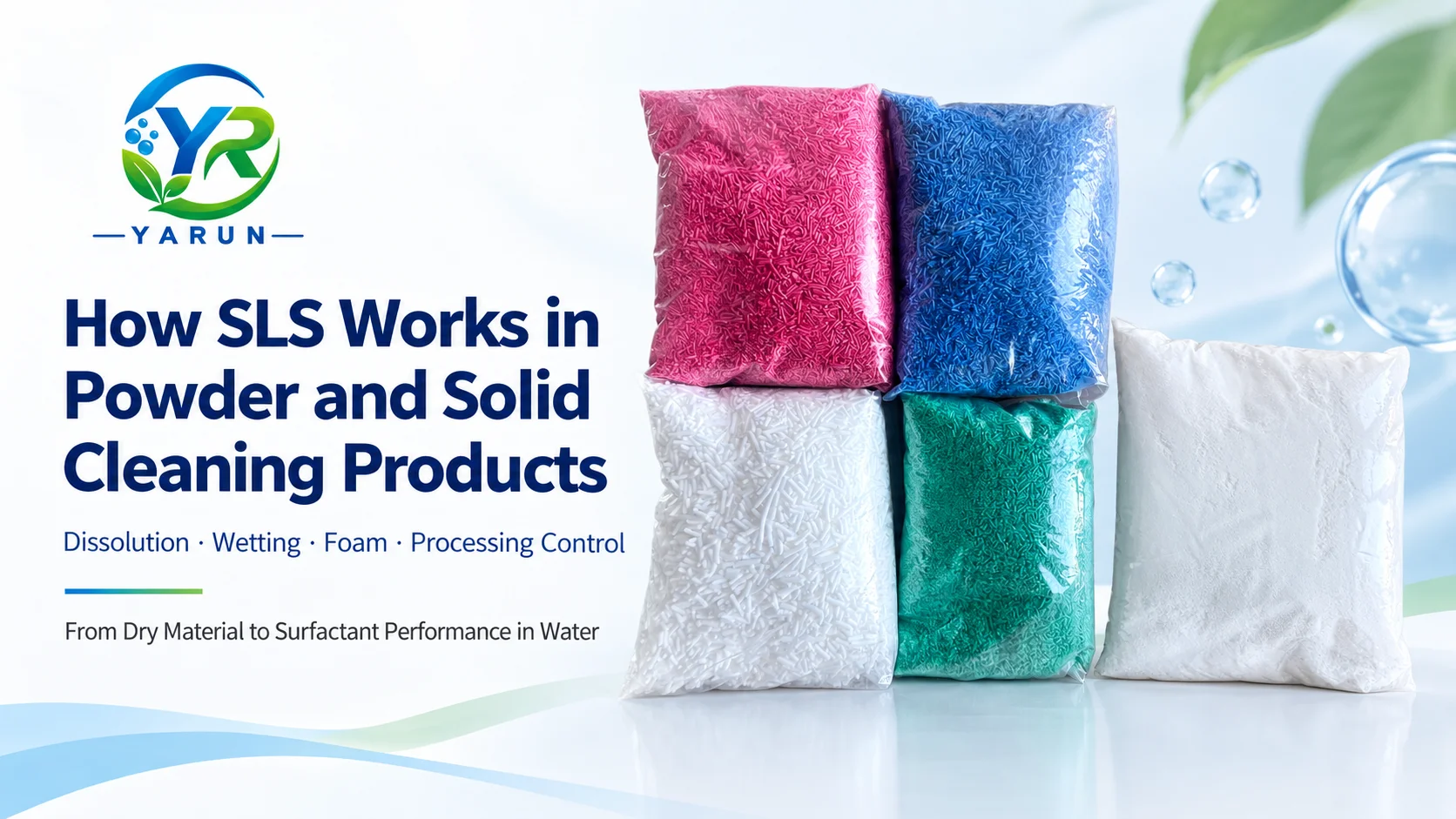
SLS is widely used in powder detergents, cleaning powders, tablets, blocks and other solid cleaning systems because alkyl sulfate surfactants can provide strong wetting, foaming and soil-dispersion performance.
But the most important mechanism does not begin with foam.
It begins earlier:
How does the dry surfactant become available in water?
A solid product can contain the correct surfactant grade and still perform poorly if water cannot penetrate the product, release the surfactant, disperse the particles and create a sufficiently uniform aqueous surfactant phase.
For manufacturers and procurement teams, the useful technical sequence is:
Dry product → Water contact → Particle wetting → Disintegration or release → Dispersion → Dissolution → Interfacial activity → Wetting / soil dispersion / foam
This article focuses on that full mechanism.
For a broader comparison of SLS with SLES, LABSA, AOS, CAPB and CDEA, first review YARUN's detergent surfactant selection guide.
1. What Does “SLS” Mean in This Article?
“SLS” is commonly used as a commercial surfactant term. For procurement and formulation decisions, the applicable product form, grade and specification should be confirmed from the current controlled product documentation.
YARUN currently supplies several commercial SLS forms and grades, including powder, needle and liquid products. These SLS products use CAS No. 151-21-3 under the current YARUN product identification standard. However, the applicable physical form, active matter, composition, handling characteristics and control specification may differ by grade. Buyers should therefore confirm the specific product grade, specification and batch documentation rather than relying on the abbreviation “SLS” alone.
From a formulation perspective, the relevant shared concept is that alkyl sulfate surfactants are anionic surfactants.
They contain:
- a hydrophobic alkyl chain;
- a hydrophilic sulfate-containing head group.
Once sufficiently available in water, this amphiphilic structure allows the surfactant to interact with water, air, oily soil, fabrics, particles and other interfaces.
The exact commercial grade still matters for:
- active matter;
- non-active components;
- particle form;
- moisture;
- handling;
- processing;
- storage;
- finished-product performance.
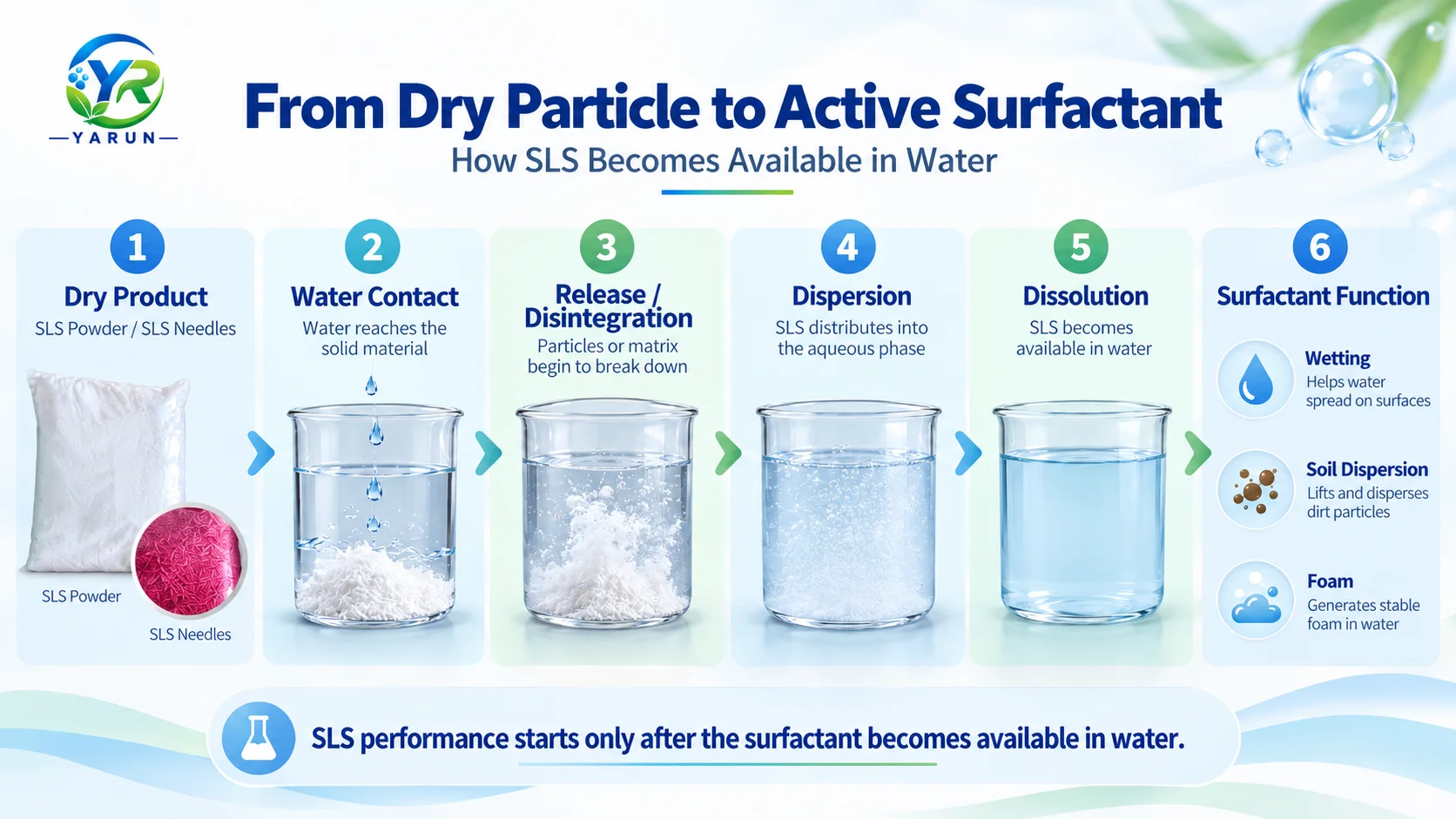
2. From Dry Particle to Active Surfactant: The Core Mechanism
A dry SLS-containing particle is only the starting point.
Before the surfactant can provide its intended wetting, soil-dispersion or foaming function, it must become sufficiently available in the aqueous phase.
A simplified sequence is:
Water penetration → Particle wetting → Release → Dispersion → Dissolution → Surfactant availability
For a loose detergent powder, this may happen relatively quickly if the particles disperse well.
For a tablet or compact block, additional steps are involved:
Water penetration → Matrix swelling or breakup → Particle release → Dispersion → Dissolution
This distinction is important.
A slow-dissolving tablet may contain a highly functional surfactant, but the surfactant cannot contribute fully until the solid matrix releases it.
Therefore:
Does SLS perform its full surfactant function while still dry?
No. Its key surfactant functions develop after sufficient dispersion or dissolution makes the surfactant available in water.
3. What Controls SLS Dispersion and Dissolution?
There is no universal dissolution time that applies to every SLS-containing product.
Important variables include:
- physical form;
- particle size;
- particle condition;
- water temperature;
- water volume;
- agitation;
- product dosage;
- other surfactants;
- builders;
- inorganic salts;
- binders;
- tablet compression;
- moisture pickup;
- storage history.
Physical Form
Powder and needle forms may behave differently during:
- feeding;
- blending;
- dispersion;
- water contact;
- dissolution.
This is a processing difference, not automatic evidence of a different fundamental surfactant mechanism.
Water Temperature
Temperature can influence the rate at which a solid formulation disperses or dissolves.
The correct test should therefore reflect the real use condition rather than an arbitrary laboratory temperature.
Agitation
Mechanical action can accelerate:
- dispersion;
- breakup of agglomerates;
- mass transfer;
- dissolution.
A product that disperses rapidly under strong laboratory stirring may behave differently in low-agitation consumer use.
Formula Matrix
Builders, fillers, salts and binders can alter how easily water reaches and releases SLS-containing particles.
For this reason, raw-material dissolution and finished-product dissolution are not the same test.
4. How SLS Changes Surface and Interfacial Behavior
Once sufficiently dispersed or dissolved, the surfactant can accumulate at interfaces.
These interfaces may include:
- air and water;
- water and oily soil;
- water and fabric;
- water and hard surfaces;
- water and solid particles.
The hydrophobic portion tends to associate away from the surrounding water, while the hydrophilic sulfate-containing portion interacts with the aqueous phase.
This lowers the energetic barrier to creating and maintaining interfaces.
Practically, this can support:
- faster spreading of wash water;
- improved wetting;
- easier contact with oily or particulate soil;
- foam-film formation;
- dispersion of removed soil.
The actual result still depends on the complete formulation and use conditions.
5. How Wetting Supports Cleaning
Wetting is one of the earliest useful effects of a surfactant.
Plain water may not spread efficiently across hydrophobic, oily or contaminated surfaces.
Once SLS becomes available at the interface, the wash solution can spread more effectively.
This can improve contact between the cleaning solution and:
- fabric fibres;
- oily residues;
- hard surfaces;
- powder particles;
- deposited soil.
Better wetting can help the overall cleaning system reach the soil more efficiently.
However:
Does better wetting automatically mean complete detergency?
No.
Finished cleaning can also depend on:
- builders;
- alkalinity;
- enzymes;
- chelating agents;
- co-surfactants;
- temperature;
- mechanical action;
- contact time.
Wetting is an enabling mechanism, not the entire cleaning process.
6. Micelle Formation and Soil Dispersion
As surfactant concentration in water increases, surfactant molecules can associate into aggregates commonly described as micelles.
In simplified terms:
- hydrophobic portions associate toward the interior;
- hydrophilic groups remain exposed to the surrounding water.
This organization can help the aqueous phase accommodate hydrophobic soil and oily material more effectively than water alone.
The important B2B point is not the theoretical micelle geometry.
It is the commercial consequence:
The surfactant must first become available in water before this type of soil-dispersion behavior can contribute effectively.
Therefore a formulation with delayed release or poor dissolution can delay not only foam, but also the surfactant's participation in soil removal and dispersion.
Micelles are only one part of the total detergent mechanism. Builders, co-surfactants, enzymes and process conditions can significantly influence the final result.
7. How SLS Generates Foam — and Why Foam Is Not a Cleaning Score
SLS-type anionic surfactants are known for strong foaming behavior.
Once surfactant is present at the air-water interface, it can help stabilize the liquid films surrounding incorporated air.
Foam performance depends on:
- surfactant concentration;
- other surfactants;
- agitation;
- air incorporation;
- water hardness;
- temperature;
- electrolytes;
- oils and soil;
- builders;
- rinsing conditions.
Commercial SLS products from major surfactant manufacturers are commonly positioned for wetting and foam-support applications, including powder and tablet cleaner formats.
But an important distinction remains:
Is high foam evidence of better detergency?
No.
High foam can provide:
- visible user feedback;
- cleaning perception;
- useful performance in manual washing.
But excessive foam can be undesirable in:
- machine washing;
- low-foam cleaning systems;
- selected industrial applications.
The correct target is not maximum foam.
It is the appropriate foam profile for the intended product and washing method.
8. How Water Hardness, Electrolytes, Temperature and Soil Change Performance
The same SLS grade can behave differently in two formulations because the surfactant does not operate in isolation.
Water Hardness
Dissolved calcium and magnesium can alter the behavior of anionic surfactant systems.
The finished formulation may therefore require builders, chelating systems or other formulation controls depending on the target water condition.
Electrolytes
Powder detergents often contain significant levels of inorganic salts and builders.
These ingredients can affect:
- dissolution;
- ionic environment;
- dispersion;
- foam;
- total surfactant behavior.
Temperature
Temperature can change:
- dissolution rate;
- product disintegration;
- soil properties;
- surfactant-system behavior.
Soil Loading
Oil and soil can suppress or change foam behavior.
A surfactant system that produces high foam in clean water may behave differently under realistic cleaning conditions.
This is why finished-product testing should include realistic use variables.
9. Powder vs Needles: What Physical Form Changes — and What It Does Not
Powder and needle forms may share the same broad anionic surfactant mechanism after sufficient dispersion or dissolution.
Physical form mainly changes the manufacturing and release stage.
It can affect:
- dust;
- dosing;
- flow;
- blending;
- segregation;
- visible particle appearance;
- water penetration;
- dispersion;
- dissolution;
- storage.
Needle-shaped material may offer a different handling profile from fine powder.
Colored needle grades may also provide visual differentiation in selected solid products.
But:
Does physical form automatically create a different cleaning mechanism?
No.
Physical form changes the route by which the material is handled and becomes available.
The applicable grade, composition and specification must still be confirmed separately.
For current commercial forms and grades, review YARUN's SLS forms and grades selection page, SLS Powder 92%, 93% and 95%, and SLS Needles 92%, 93% and 95%.
10. What Happens Inside Powder, Tablet and Cleaning Block Systems?
A loose powder, tablet and cleaning block do not release SLS in the same way.
Loose Powder
The main concerns may include:
- particle wetting;
- dispersion;
- agglomeration;
- caking;
- segregation;
- water contact.
Tablet
A tablet introduces additional variables:
- compression force;
- binder;
- disintegrant;
- porosity;
- water penetration;
- matrix breakup.
Cleaning Block
A block may be designed for slower release.
The correct performance target may therefore be very different from a fast-dissolving powder.
The product developer must distinguish between:
intentional controlled release
and
unwanted incomplete dissolution.
11. Why Can an SLS-Containing Product Dissolve Slowly or Leave Residue?
When residue or delayed foam appears, the surfactant itself should not automatically be blamed.
A structured diagnosis is more useful.
| Observed Result | Check First | Additional Variables |
|---|---|---|
| Slow foam development | Release and dissolution | Water temperature, agitation, dosage |
| Visible powder residue | Dispersion and soluble/insoluble components | Agglomeration, builders, water volume |
| Floating particles | Initial wetting | Particle condition, formulation matrix |
| Tablet remains intact | Water penetration and disintegration | Compression, binder, porosity |
| Inconsistent performance | Blend and process consistency | Moisture, segregation, dosing |
| Excessive residue after storage | Moisture and caking | Packaging, warehouse condition |
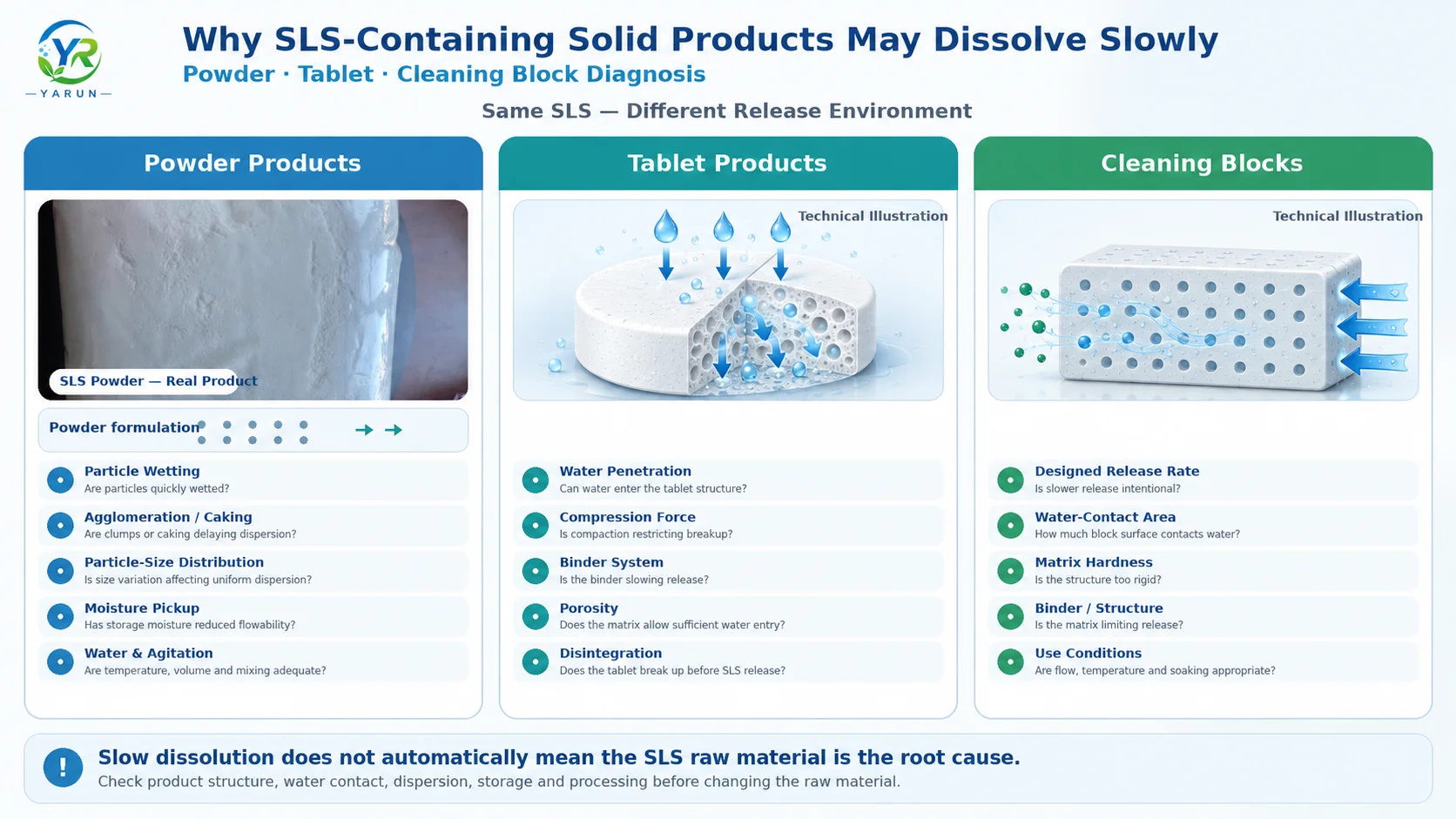
Why can an SLS-containing tablet dissolve slowly?
Because the result is controlled by the entire solid matrix.
Possible causes include:
- high compression;
- insufficient porosity;
- unsuitable binder;
- slow water penetration;
- poor disintegration;
- surrounding insoluble material;
- low water temperature;
- low agitation.
Increasing SLS alone may not solve the problem.
12. Does More SLS Automatically Mean Better Cleaning?
No.
Increasing surfactant level can increase available surfactant concentration, but finished cleaning is not determined by SLS dosage alone.
Possible consequences of increasing SLS may include:
- more foam;
- different rinsing behavior;
- different formula cost;
- altered balance with builders and other surfactants.
The final product still depends on:
- soil type;
- water;
- builders;
- alkalinity;
- enzymes;
- co-surfactants;
- dosage;
- washing method.
A controlled formulation trial is more useful than assuming that a higher surfactant dose will automatically improve the finished product.
13. How to Run a Controlled SLS Performance Test
A useful evaluation should begin with a defined baseline.
Then change one important variable at a time.
Control
Existing approved formula and process.
Trial A
Change SLS form only.
Trial B
Change grade while comparing on an appropriate active-matter basis.
Trial C
Change the incorporation, release or dissolution process only.
Record:
- SLS form and grade;
- raw-material batch;
- product dosage;
- batch size;
- blending process;
- water condition;
- water temperature;
- agitation;
- dissolution or release time;
- residue;
- wetting behavior;
- foam;
- finished appearance.
For tablets or blocks, also record:
- unit weight;
- compaction;
- disintegration;
- visible residue;
- release profile.
The objective is not to find the sample with the most foam.
It is to identify the system that provides the required performance repeatably.
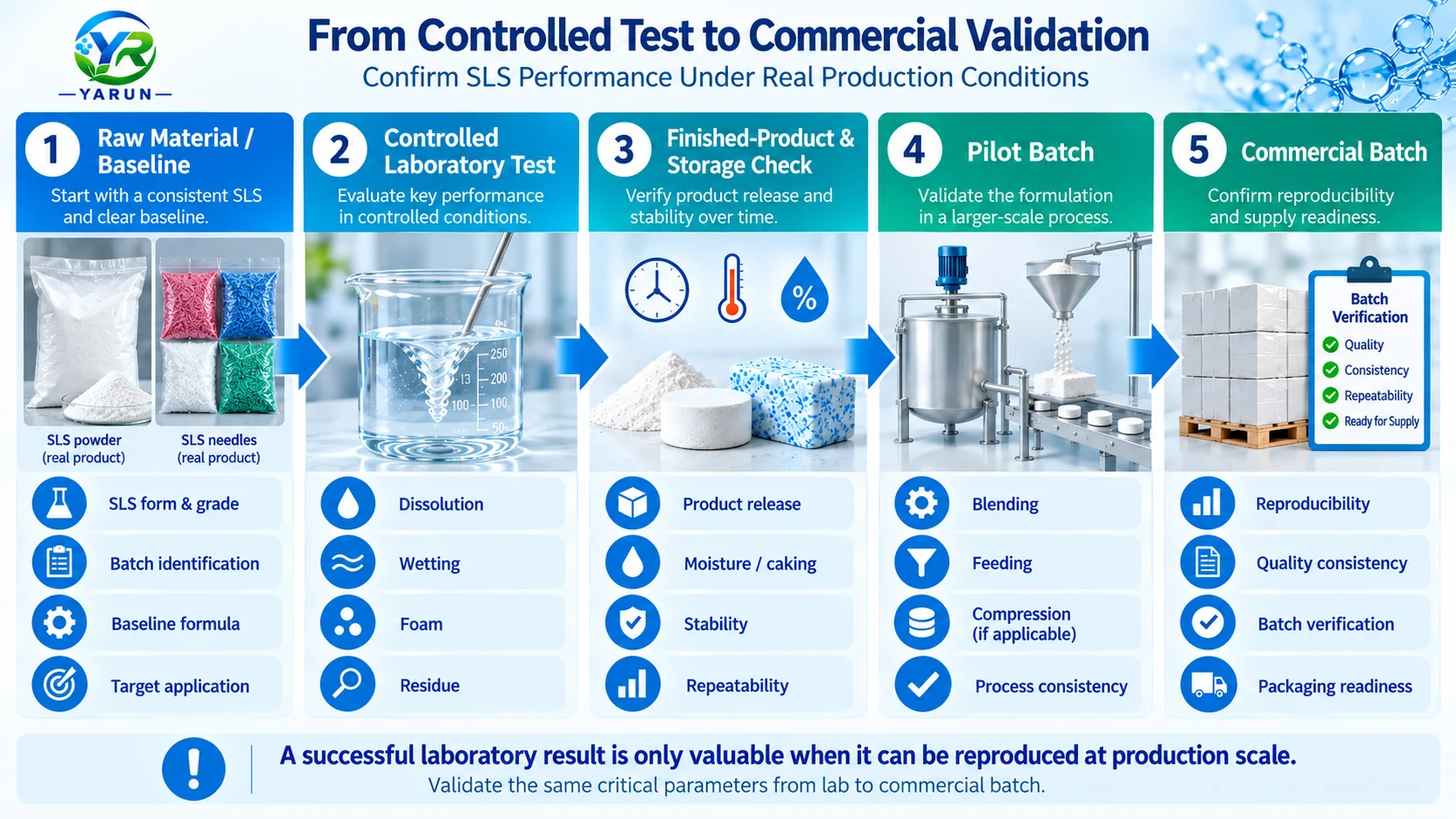
14. From Laboratory Result to Commercial Batch
Laboratory success must be verified in the intended manufacturing process.
Commercial scale changes:
- powder feeding;
- blending energy;
- residence time;
- segregation;
- moisture exposure;
- compaction;
- filling;
- packaging;
- transport.
A practical validation route is:
Raw Material → Controlled Formula → Finished-Product Test → Storage Check → Pilot Batch → Commercial Batch
Compare the same critical parameters at each stage.
A commercial result is only useful if it can be reproduced consistently.
15. Commercial and Procurement Implications
SLS should not be selected only by:
- active matter;
- physical form;
- raw-material price.
A more complete decision considers:
- active surfactant delivered;
- non-active material introduced;
- processing;
- dust and handling;
- dispersion;
- dissolution;
- finished-product residue;
- required dosage;
- storage;
- freight;
- rework risk;
- commercial-batch consistency.
Does the highest-active grade automatically give the best commercial result?
No.
A higher-active grade may reduce the quantity of raw material required, but that does not automatically make it the lowest-cost or best-processing option.
The correct comparison is:
Total functional cost + finished-product performance + processing reliability
Grade-specific numerical limits should be taken from the applicable approved specification and batch COA rather than generalized from a technical article.
Frequently Asked Technical Questions About SLS
Does SLS perform its full surfactant function while still dry?
No. Its main surfactant functions develop after sufficient dispersion or dissolution makes the material available in the aqueous phase.
Why does SLS produce strong foam?
When sufficiently available in water, anionic surfactant molecules can accumulate at the air-water interface and support foam-film formation. Actual foam depends on concentration, agitation, water, soil and the rest of the formulation.
Is high foam proof that an SLS detergent cleans better?
No. Foam is a formulation and user-experience characteristic, not a direct measurement of detergency.
Why can the same SLS grade behave differently in two formulas?
Because performance depends on the complete system, including water hardness, electrolytes, other surfactants, builders, temperature, dosage, soil and processing.
Are SLS powder and needles chemically different?
YARUN currently supplies several commercial SLS forms and grades, including powder, needle and liquid products. These SLS products use CAS No. 151-21-3 under the current YARUN product identification standard. However, the applicable physical form, active matter, composition, handling characteristics and control specification may differ by grade. Buyers should therefore confirm the specific product grade, specification and batch documentation rather than relying on the abbreviation “SLS” alone.
Why can an SLS-containing tablet dissolve slowly?
Possible reasons include water penetration, compression, binder system, matrix disintegration, surrounding ingredients, temperature and agitation.
Does more SLS always improve cleaning?
No. Increasing SLS changes surfactant concentration and may change foam, but total cleaning depends on the complete detergent system.
Should buyers always choose the highest-active SLS grade?
No. Compare active matter together with composition, processing, dosage, storage, freight, finished-product performance and total commercial cost.
Conclusion
The mechanism of SLS in a powder or solid cleaner does not begin with foam.
It begins with availability.
The product must first allow water to reach, release, disperse and sufficiently dissolve the surfactant.
Only then can SLS participate effectively in:
- interfacial activity;
- wetting;
- soil dispersion;
- micelle-related behavior;
- foam generation.
This is why a commercially successful SLS formulation requires more than selecting a high-active raw material.
Manufacturers should evaluate the complete path:
Raw Material → Dry Product Structure → Water Contact → Release → Surfactant Function → Finished Performance → Commercial Reproducibility
Request an SLS Dissolution and Processing Review
If you are evaluating SLS in a detergent powder, tablet, cleaning block or other solid cleaning product, send YARUN:
- finished-product format;
- target market;
- SLS form and grade currently used;
- current formula where available;
- product dosage;
- main dissolution or residue issue;
- foam requirement;
- processing method;
- tablet or block conditions where applicable;
- storage conditions;
- expected monthly requirement;
- destination port.
YARUN can help determine whether the next step should be:
- a form comparison;
- controlled sample evaluation;
- dissolution or processing review;
- specification comparison;
- or commercial quotation.
Request an SLS Dissolution and Processing Review
For current product options, review YARUN's SLS forms and grades and detergent surfactant raw materials.