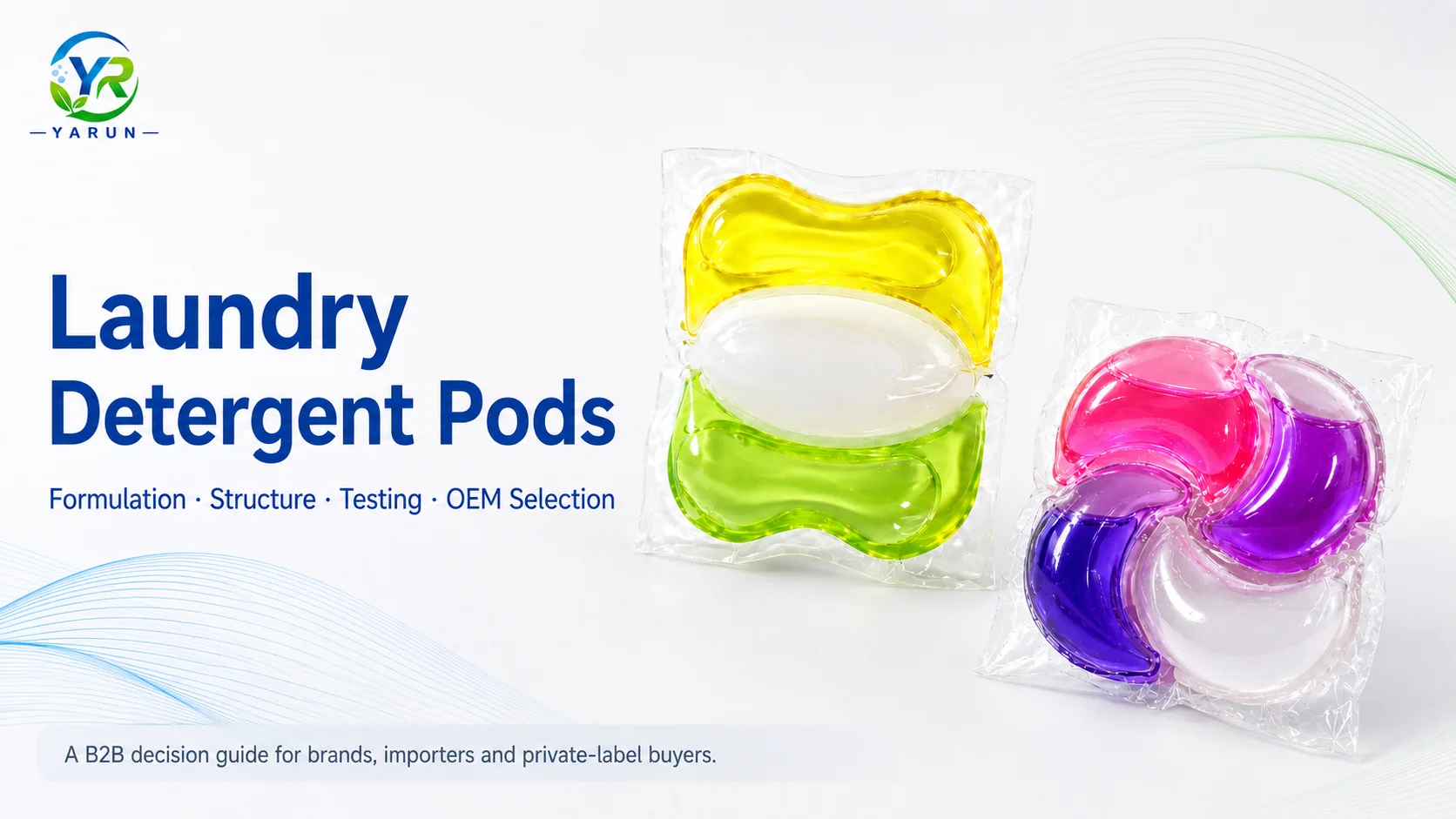
Laundry detergent pods are often compared by appearance, chamber count, pod weight and unit price. For a brand owner, importer or private-label buyer, however, these visible features represent only part of the commercial decision.
A reliable laundry pod is a complete system consisting of:
Concentrated detergent formulation
Water-soluble film
Chamber geometry
Fill-volume control
Forming and sealing process
Secondary packaging
Storage and transportation conditions
Intended washing conditions
A pod may look attractive when freshly produced but still develop leakage, tackiness, deformation, fragrance loss or incomplete dissolution during distribution and consumer use.
The correct sourcing objective is therefore not to select the pod with the most chambers or the lowest unit price. It is to select a product system that delivers the intended cleaning and sensory experience under defined conditions, fits the planned supply chain and can be evaluated for repeatability before commercial approval.
This guide explains how B2B buyers should compare laundry pod configurations, define testing requirements and prepare an OEM or private-label project.
1. What Is a Laundry Detergent Pod System?
A laundry detergent pod is a pre-measured dose of concentrated laundry formulation contained in a water-soluble film.
The film is designed to hold the formulation during production, packaging, transportation and storage, then release the contents during the intended washing process. This creates a demanding balance: the film must remain stable before use but dissolve adequately during use.
The complete pod system includes at least eight connected elements:
Formula: Surfactants, solvents, builders, enzymes, polymers, fragrance, colorants and other functional ingredients.
Film: The selected water-soluble film grade, thickness and mechanical properties.
Chamber design: The number, size, shape and arrangement of compartments.
Fill volume: The weight and distribution of formula in each chamber.
Forming and sealing: The conditions used to form, fill, seal and cut the pod.
Secondary packaging: The container or pouch protecting the pod after production.
Distribution environment: Temperature, humidity, transportation and warehouse exposure.
Consumer use: Machine type, wash cycle, water temperature, load size and pod placement.
A failure in one area may appear to be a problem in another. For example, leakage may be blamed on the film even when the initiating factor is excessive fill volume, a contaminated seal area, formula migration, mechanical stress or inadequate secondary packaging.
Laundry pods should therefore be developed and purchased as complete systems—not as isolated combinations of detergent and film.
2. Single-Chamber and Multi-Chamber Pod Designs
Chamber count affects product appearance, formulation flexibility, manufacturing complexity and cost. It should serve a defined product objective.
Single-Chamber Pods
A single-chamber pod places the complete formulation in one compartment.
This route may be appropriate when the project prioritizes:
Simple product architecture
Lower production complexity
Concentrated core cleaning performance
Faster product selection
Competitive cost
Fewer formula-separation requirements
A single-chamber pod is not automatically inferior. If the formula is compatible and meets the intended performance target, a simpler configuration may provide a better commercial fit for value-oriented markets.
Multi-Chamber Pods
Multi-chamber designs divide the product into two or more compartments.
Potential reasons for using multiple chambers include:
Separating selected ingredients before use
Combining liquid and solid functional systems
Supporting different visual identities
Creating clearer product positioning
Differentiating the product on retail or e-commerce platforms
Multi-chamber systems also introduce additional controls:
More internal seal areas
More complex forming geometry
Tighter fill-volume balance
Greater risk of localized film stress
More demanding formula compatibility
Higher production complexity
Potentially higher unit cost
More chambers do not automatically deliver better cleaning. Each configuration should have an identifiable product or commercial purpose.
3. Understanding 3-in-1 Multi-Chamber Routes
A 3-in-1 product generally communicates three principal consumer benefits. It should not automatically be interpreted as a single-chamber pod or as a fixed formulation.
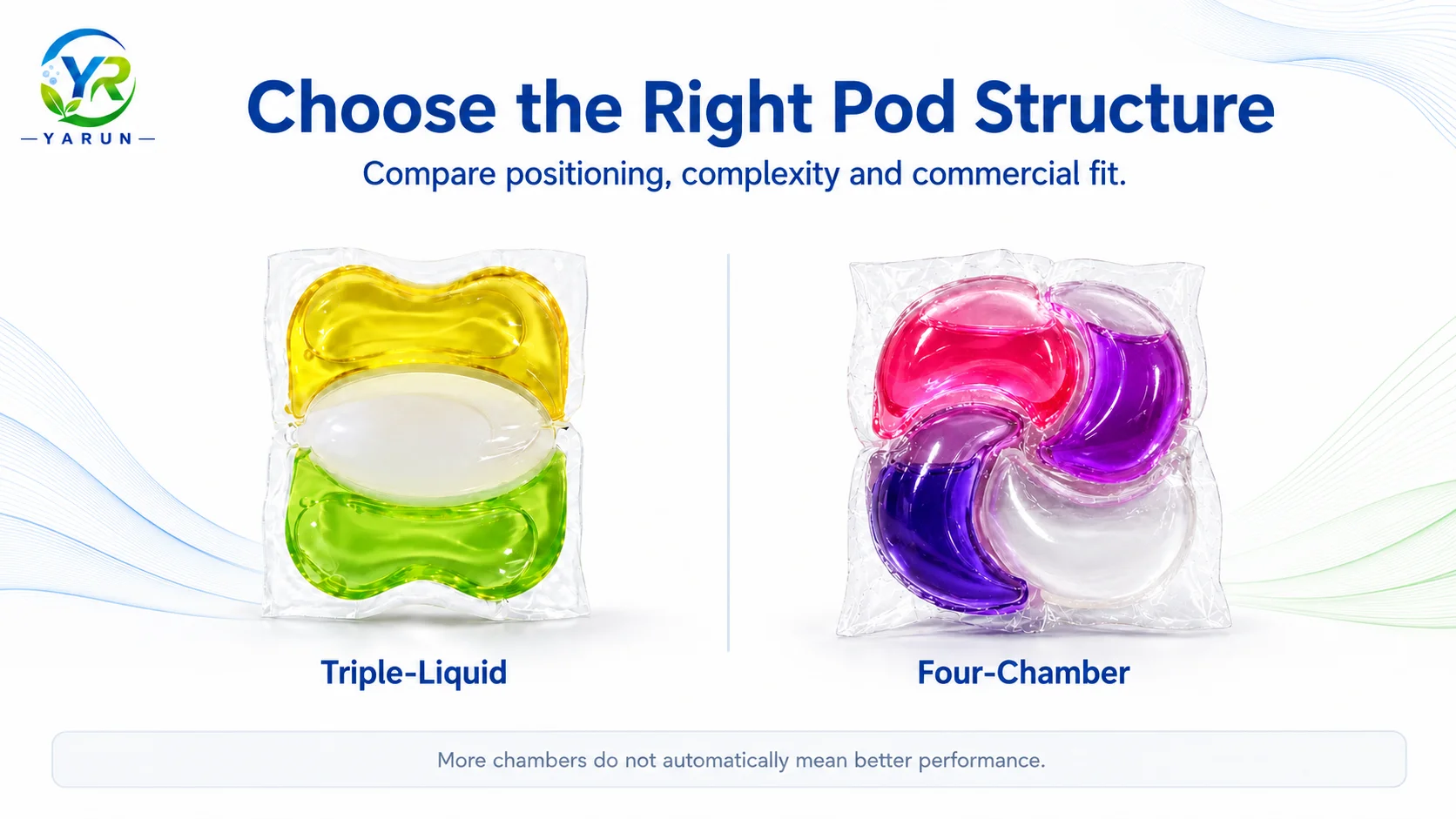
YARUN supports two confirmed configurable routes within its 3-in-1 Multi-Chamber Laundry Detergent Pods range.
Route A: Triple-Liquid System
This route uses three liquid compartments that can be developed around an agreed benefit structure such as:
Cleaning
Stain removal
Lasting freshness
The value of the design comes from the coordinated formulation system—not merely the existence of three colored liquids.
Current product materials confirm a 13 g reference configuration for the triple-liquid route. This is a reference product configuration rather than a universal specification. Final pod weight, weight tolerance, chamber fill ratio, film specification and packaging must be confirmed for each commercial project.
Buyers should confirm:
Intended function of the complete product
Formula compatibility
Fill ratio
Total pod weight
Seal-stability requirements
Fragrance-performance objective
Dissolution-test conditions
Commercial-batch acceptance criteria
The three liquid chambers should not automatically be described as three independently validated performance functions. Any final function or performance claim should be linked to the selected formulation and defined test conditions.
Route B: Dual-Liquid Plus Fragrance Beads
This route combines two liquid compartments with a solid fragrance-bead component.
It may suit projects seeking:
Visible product differentiation
A stronger sensory story
Combined cleaning and fragrance positioning
Private-label customization
A more distinctive retail presentation
Current product materials confirm a 10 g reference configuration for the dual-liquid plus fragrance-beads route. Final weight, liquid-to-solid distribution, fragrance-bead content, film specification and production tolerance depend on the selected product configuration and must be confirmed before commercial approval.
The solid component should not be treated as decoration. Its composition, placement, dissolution, fragrance contribution and compatibility with the complete pod system require project-specific evaluation.
Which 3-in-1 Route Should a Buyer Select?
A triple-liquid route may be suitable when the brand prioritizes liquid formulation architecture and balanced functional delivery.
A dual-liquid plus fragrance-beads route may be suitable when fragrance identity and visible differentiation are central to the product proposition.
The decision should be based on:
Target consumer
Intended claims
Retail positioning
Desired fragrance experience
Target cost
Packaging
Production feasibility
Sample performance
Available stability and dissolution information
4. When a Four-Chamber Route Makes Commercial Sense
A four-chamber pod provides additional space for formulation separation and visual differentiation. It may support a mid-range or premium product when the additional complexity creates recognizable commercial value.
YARUN’s current Four-Chamber Laundry Detergent Pods route can be evaluated for projects requiring more differentiated product architecture.
Current product materials show four-chamber reference configurations in the 12–15 g range, together with other configurable weight options. Final pod weight, chamber balance, film specification, weight tolerance and packaging should be confirmed for the selected OEM project.
The four-chamber structure is confirmed, but chamber count alone should not be treated as proof that four separate performance functions have been independently validated. Any functional claim must be connected to the selected formulation and defined test conditions.
A four-chamber configuration may be commercially appropriate when:
Selected ingredients benefit from physical separation
The product requires stronger shelf differentiation
The target price can support the added complexity
Fill balance can be controlled consistently
Packaging protects the more complex pod structure
The intended benefits can be evaluated under defined conditions
Buyers should not approve a four-chamber product based only on appearance.
The evaluation should determine:
What each chamber contains
Why separation is required
Whether the selected system remains acceptable during storage
Whether the pod dissolves under the intended test conditions
Whether commercial production can reproduce the approved specification
Whether the additional cost supports the target retail position
The correct comparison is not simply “three chambers versus four chambers.” It is the complete commercial value of each product route.
5. PVA and PVOH Film: Terminology and Selection
Water-soluble film used for laundry pods is frequently called PVA film in commercial discussions. PVOH, meaning polyvinyl alcohol, is commonly used as the more chemically precise abbreviation for this polymer family.
The terminology alone does not identify a suitable film grade.
Water-soluble films can differ in:
Solubility profile
Tensile strength
Elongation
Puncture resistance
Forming behavior
Sealing behavior
Chemical resistance
Moisture response
Recommended storage conditions
A film that performs well with one formulation may not perform the same way with another. Suitability must be evaluated with the complete concentrated formula and intended production process.
Film selection should consider:
Formula composition
Available water and moisture interaction
Solvents and humectants
pH and electrolyte system
Pod geometry
Forming depth
Seal design
Storage environment
Packaging barrier
Wash temperature and cycle
YARUN does not manufacture PVA or PVOH film. Where formula-and-film evaluation is required, YARUN coordinates the review with the relevant OEM partner according to the agreed project scope.
For a detailed analysis of tropical-market risks, see YARUN’s Laundry Pod PVA Film Stability in Tropical Markets.
6. Formula, Film and Chamber Compatibility
The concentrated formulation remains in direct contact with the film throughout the product’s commercial life.
Compatibility cannot be determined from one ingredient name. It depends on the complete formulation, film grade, storage period and surrounding environment.
Water and Water Activity
Total water content is an important formulation variable, but it does not describe the complete moisture relationship inside a concentrated pod.
Solvents, humectants, electrolytes and other ingredients affect how water behaves within the formulation. The acceptable formulation range should follow relevant material guidance and finished-product evaluation.
Surfactant System
Surfactants provide the primary cleaning and wetting functions, but their suitability depends on:
Type
Concentration
Counterions
pH
Solvent system
Electrolytes
Interaction with other ingredients
Film grade
Storage conditions
A conventional bottled-detergent formula should not be transferred directly into a pod without compatibility and concentration review.
Solvents and Humectants
These materials may help control viscosity, ingredient solubility, processing and low-temperature behavior. They can also influence moisture balance and film flexibility.
The objective is to create a formulation that remains processable and stable under its defined conditions without compromising required film performance.
Enzymes and Functional Additives
Enzymes, builders, polymers, fragrance, dyes and other additives should be evaluated as part of the complete system.
Their inclusion should be linked to:
Target stains
Wash conditions
Intended product claims
Formula stability
Market requirements
Cost
Available documentation
No ingredient should be included solely to make the specification appear more complex.
7. Define Performance Before Requesting Samples
A buyer should prepare the performance objective before comparing samples.
The product brief should define:
Target country
Customer type
Retail or wholesale channel
Washing-machine type
Typical wash temperature
Water conditions where known
Expected load size
Target stains
Foam preference
Fragrance direction
Fragrance-intensity target
Product positioning
Target dosage
Target retail price
Required packaging
Expected order volume
Without a defined brief, suppliers may submit visually similar products built for different cost and performance levels.
Sample A may contain a stronger fragrance but a different pod weight. Sample B may appear less expensive but require a higher dose per wash. Sample C may perform well when fresh but respond differently after warm or humid storage.
Controlled comparison begins with a common specification.
8. Essential Testing Before Commercial Approval
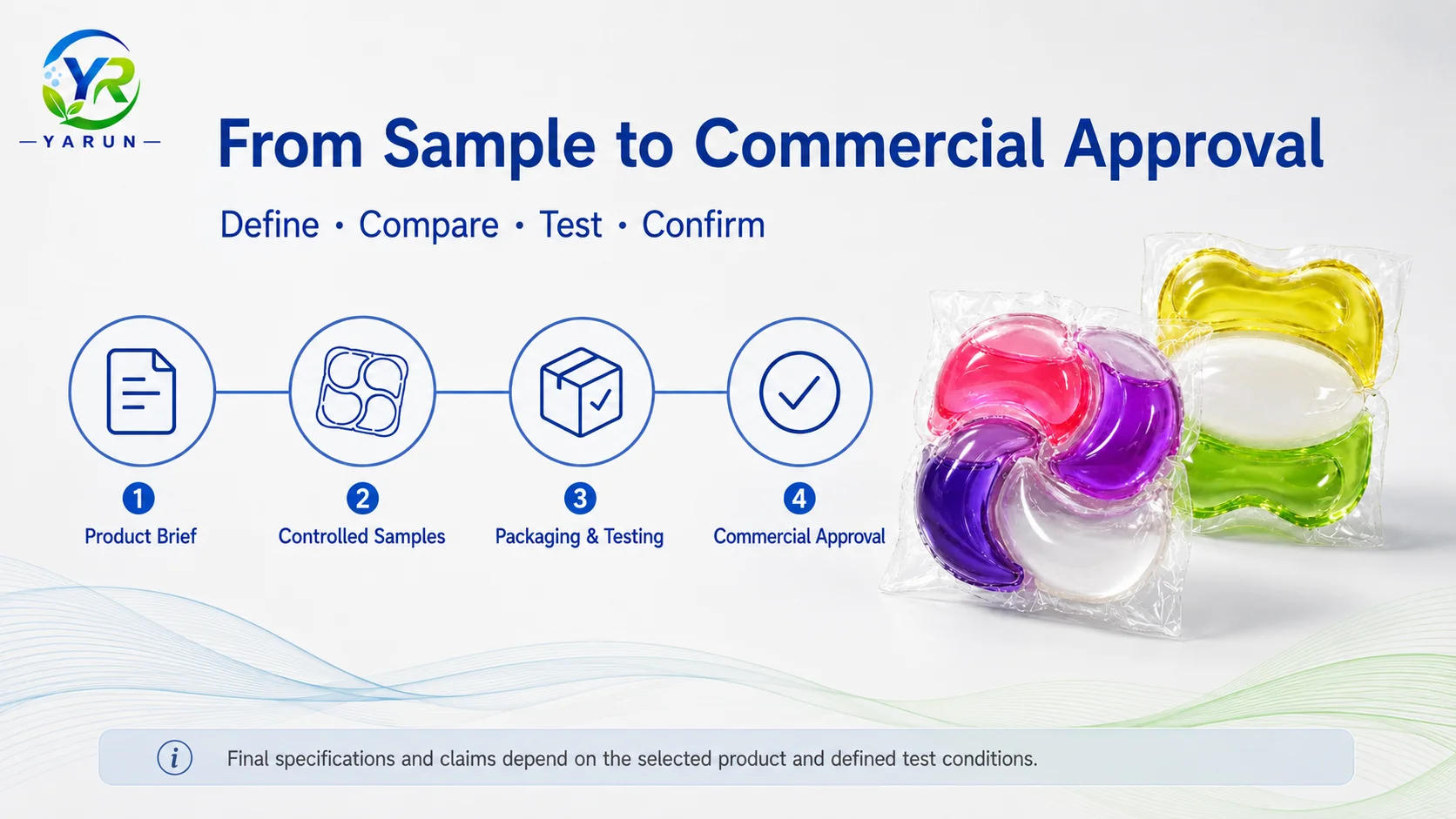
A new pod should not be approved from appearance, fragrance from the package or one fresh-product wash.
Testing should reflect the intended product lifecycle.
8.1 Initial Product Characterization
Record:
Product code
Sample version
Batch identification
Total pod weight
Weight variation
Dimensions
Chamber configuration
Fill distribution
Film appearance
Seal condition
Leakage observations
Odor
Formula appearance
Secondary packaging
This creates a baseline for later comparison.
8.2 Controlled Washing and Dissolution Testing
Use consistent test conditions for every sample.
Record:
Washing-machine type
Program
Water temperature
Water volume where available
Load size
Fabric type
Soil or stain type
Pod placement
Time to release
Visible residue
Film residue on the drum or fabric
Cleaning result
Fragrance result
A result produced in one machine, cycle or temperature should not automatically be treated as universal.
8.3 Stability Evaluation
The stability plan should include conditions relevant to:
Normal storage
Warm storage
Humid exposure
Temperature changes
Transportation
Repeated package opening
Target distribution duration
At defined intervals, evaluate:
Tackiness
Pods sticking together
Deformation
Seal condition
Leakage observations
Weight change where relevant
Color
Odor
Package condition
The conditions, duration and acceptance criteria should be defined before testing begins.
8.4 Dissolution After Storage
Fresh-product dissolution alone is insufficient.
After storage, repeat the washing and dissolution assessment under the same conditions used for the initial sample. This helps determine whether aging has changed the film, seal or formula-release behavior.
8.5 Mechanical and Transportation Assessment
Depending on the product and package, evaluation may include:
Drop testing
Compression
Vibration or transport simulation
Puncture assessment
Seal-strength checks
Pod-to-pod contact under load
Carton inspection
The purpose is not to produce a universal “transport-proof” claim. It is to identify weaknesses under conditions relevant to the planned distribution route.
8.6 Pilot and Commercial Batch Validation
A laboratory sample does not automatically demonstrate commercial repeatability.
Before full production, confirm:
Approved reference sample
Product specification
Pilot-batch result, where applicable
Fill-weight control
Chamber balance
Seal consistency
Packaging performance
Commercial-batch acceptance requirements
Retained sample
Batch traceability
Release criteria
The approved product should be defined through written specifications, not only photographs or informal descriptions.
Where specialized testing is required, the actual work should be carried out by the relevant OEM partner or a qualified third-party organization. YARUN can coordinate the test plan, required information and project follow-up.
9. Tropical Market Risks
Thailand and other Southeast Asian markets can expose laundry pods to:
High relative humidity
Warm warehouses
Long sea and inland transportation
Temperature changes
Storage without climate control
Repeated opening of retail packaging
Possible problems include:
| Observed problem | Factors to investigate |
|---|---|
| Pods become sticky | Humidity, package closure, film response, formula migration |
| Pods stick together | Surface tackiness, pressure, warm storage, package barrier |
| Film becomes brittle | Dry exposure, aging, mechanical stress, formula-film imbalance |
| Seal failure | Contamination, fill volume, sealing conditions, geometry |
| Leakage | Seal weakness, puncture, transport pressure, film thinning |
| Incomplete dissolution | Film grade, aging, wash cycle, temperature, pod placement |
| Fragrance becomes weaker | Packaging permeability, heat, storage duration, formula changes |
These observations do not identify the cause automatically. A structured investigation should review the formula, film, seal, packaging, storage and consumer-use conditions before corrective action is selected.
10. Packaging Is Part of Pod Performance
The water-soluble film should not be expected to provide all required protection during distribution.
Secondary packaging may need to control:
Moisture exposure
Repeated opening
Mechanical damage
Pod-to-pod pressure
Fragrance transfer
Transportation stress
Consumer access
Possible formats include:
Rigid containers
High-barrier pouches
Reclosable packages
Other project-specific configurations
The correct package depends on:
Destination country
Distribution channel
Pack size
Pods per package
Expected time after opening
Storage environment
Retail positioning
Order volume
Labeling and safety requirements
A large retail package may remain open longer than a small package. Closure performance after repeated opening should therefore be considered during evaluation.
Claims such as “moisture-proof” should not be used without an agreed packaging specification and supporting test conditions.
11. Compare Cost per Pod, Cost per Wash and Total Commercial Cost
The lowest unit price does not always produce the lowest commercial cost.
Buyers should compare:
Product Cost
Pod weight
Formula concentration
Cost per pod
Recommended pods per wash
Cost per wash
Packaging Cost
Primary package
Closure
Label or printed film
Carton
Pallet
Units per carton
Container-loading efficiency
Development Cost
Sample rounds
Fragrance customization
Color customization
Formula adjustment
Packaging development
Artwork and printing
Testing requirements
Risk Cost
Leakage
Sticking
Damaged packaging
Product returns
Consumer complaints
Repacking
Delayed launch
Unrepeatable commercial batches
A higher-priced pod may provide a better commercial result when it offers appropriate dosing, lower damage risk, suitable packaging and more reliable batch consistency.
The correct product is the one that fits the required performance, selling price, channel and supply-chain conditions.
12. Select the Appropriate Development Route
Not every buyer requires a fully customized formula.
Route 1: Existing Product Selection
Suitable when the priority is:
Faster sampling
Shorter development time
Lower complexity
Existing product specification
Established packaging options
Route 2: Existing Performance Route With Selected Customization
Suitable when the buyer requires changes such as:
Fragrance
Color
Pod weight
Package format
Net quantity
Label
Carton design
Available options and MOQ should be confirmed before the project begins.
Route 3: Full OEM or Private-Label Development
Suitable when the project requires:
Defined market-specific performance
Custom chamber configuration
Custom fragrance direction
Specific cost target
Packaging development
Controlled sample comparison
Pilot validation
Commercial-batch approval
Greater customization may increase:
MOQ
Development time
Sample rounds
Testing requirements
Packaging cost
Final product cost
The most customized route is not automatically the best route. Development depth should match the business model and launch plan.
13. Laundry Pod Procurement Specification and Document Checklist
Depending on the selected product configuration, final formula, packaging format, destination market and order stage, buyers should confirm the relevant product specifications, supporting information, commercial terms and shipment documents before placing an order.
The availability, issuing party and applicable version of each document should be confirmed for the specific project. A document name alone does not demonstrate that it applies to the selected product or commercial batch.
Product Definition
Confirm:
Final product name
Chamber configuration
Physical form of each chamber
Intended function of the complete product
Reference pod weight
Final agreed pod weight and tolerance
Fragrance and color
Recommended dosage
Final packaging format
Pods per package
The confirmed reference configurations currently include:
A 13 g triple-liquid route
A 10 g dual-liquid plus fragrance-beads route
Four-chamber reference configurations in the 12–15 g range, together with other configurable weight options
These are reference configurations rather than universal specifications. Final weight, tolerance, chamber balance, formula, film and packaging must be confirmed for each OEM project.
Technical and Product Information
Depending on the selected product and project stage, request or confirm:
Product specification for the selected configuration
Formula-performance description
Available film information
Intended washing conditions
Available dissolution-test information, including the stated test conditions
Available stability-test information, including the stated test conditions
Packaging specification
Storage recommendations
Shelf-life target and its available validation basis
Safety Data Sheet, where applicable
Technical Data Sheet or equivalent product information, where available
References to stability, dissolution, leakage resistance, film compatibility or shelf life should be evaluated against the stated product configuration and test conditions. They should not be treated as universal guarantees.
Where specialized technical review or testing is required, the work should be carried out by the relevant OEM partner or a qualified third-party organization according to the agreed project scope. YARUN can coordinate the information and testing requirements but should not be treated as the independent testing body.
Quality and Batch Documents
Depending on the project and order stage, confirm:
Approved reference sample
Sample code or version
Product specification
Packaging specification
Agreed quality requirements
Batch identification
Fill-weight control requirements
Seal and leakage inspection requirements
Available representative Certificate of Analysis for pre-order reference, where available
Commercial batch Certificate of Analysis linked to the supplied batch
Retained-sample requirements
Batch traceability information
Pre-shipment inspection scope
Complaint and investigation process
A representative COA is provided only as a reference to the type of data that may be reported. It should not be presented as the COA for a future commercial shipment.
The commercial batch COA should be issued for, and traceable to, the relevant supplied batch according to the agreed order requirements.
Commercial Information
Confirm for the selected product configuration and quotation:
MOQ
Sample availability and sample policy
Sample cost, where applicable
Packaging MOQ
Customization scope
Production lead time
Expected monthly requirement
Destination port
Shipping terms
Container-loading quantity
Payment terms
Quotation validity
Required order and shipment documents
MOQ, lead time, sample policy, packaging availability and loading quantity may vary according to the product configuration, customization, packaging format, production schedule and order volume. They should be confirmed in the applicable quotation rather than treated as fixed public specifications.
Shipment and Customs Documents
Depending on the destination market and shipment requirements, confirm:
Commercial Invoice
Packing List
Bill of Lading or other transport document
Certificate of Origin, where required for the shipment
Safety Data Sheet, where applicable
Commercial batch COA, where required
Product or packaging information required by the customer
Other destination-market or customs documents applicable to the shipment
The HS Code should be reviewed according to the final product composition, product presentation, shipment details and applicable customs classification rules. Any HS Code provided during product discussion should be treated as a reference until it is confirmed for the actual export declaration and destination-market import requirements.
Two offers using the same general product name may represent different pod structures, weights, formulas, packaging systems, document packages and testing commitments. Buyers should compare the complete project specification and commercial scope before treating the prices as equivalent.
14. How YARUN Supports Laundry Pod Projects
YARUN supports brands, distributors, importers and private-label buyers through product-development, OEM/private-label and commercial supply coordination.
Project support can include:
Product-brief development
Product-route and pod-configuration support
Existing-product comparison
Sample coordination
Fragrance and color coordination
Packaging coordination
Specification and quality-requirement confirmation
Formula-and-film compatibility review coordination with the OEM partner
Stability-test planning and coordination
Dissolution-test planning and coordination
Commercial-order coordination
Export supply planning
Complaint and traceability coordination
Where formula-and-film compatibility evaluation, stability testing, dissolution testing or other specialized verification is required, the actual technical review or testing is carried out by the relevant OEM partner or a qualified third-party organization according to the agreed project scope.
YARUN’s role is to help define the buyer’s requirements, coordinate the relevant production and technical parties, organize the required information and support the project from product selection through commercial supply.
YARUN does not manufacture PVA or PVOH film and does not claim that one film, formula, pod configuration or packaging format is universally suitable for every market.
Recommendations and test plans should be based on the selected product, target country, intended washing conditions, distribution environment, packaging format, cost objective and order volume. Final performance claims should be supported by defined test conditions and the relevant product documentation.
15. Request a Laundry Pod Project Review
To evaluate a laundry detergent pod project, provide:
Target country
Customer type
Sales channel
Preferred chamber configuration
Required pod weight
Main performance objectives
Preferred fragrance
Packaging format
Pods per package
Target price or cost range
Expected order quantity
Target launch date
Existing product or private-label requirement
Based on this information, YARUN can help define an appropriate product-selection or customization route and coordinate the required specification, sample, packaging and validation work with the relevant OEM and technical partners.
Request a Laundry Pod Project Review
Share your target market, preferred pod configuration, packaging requirements and expected order quantity. YARUN will review the project scope and coordinate the appropriate product and OEM route.
Frequently Asked Questions
1. What is the difference between 3-in-1 and four-chamber laundry pods?
“3-in-1” normally describes three principal product benefits, while “four-chamber” describes the physical compartment structure. The terms do not measure performance in the same way.
Buyers should confirm the formula, structure and commercial purpose of the complete product rather than comparing numbers alone.
2. Does a greater number of chambers always mean better performance?
No. Additional chambers may support ingredient separation, customization and visual differentiation, but they also increase forming, filling, sealing and stability complexity.
Performance must be evaluated under defined conditions.
3. Are PVA and PVOH the same film material?
PVA is widely used as a commercial abbreviation for the water-soluble polyvinyl alcohol film family. PVOH is commonly used as the more chemically precise abbreviation.
The abbreviation does not identify a specific grade or guarantee compatibility with a formulation.
4. How should laundry pod dissolution be tested?
Record the machine type, wash cycle, water temperature, load size, pod placement, release behavior and visible residue. Compare samples under the same conditions and repeat the assessment after storage where required.
5. What causes laundry pods to leak or stick together?
Possible factors include humidity, warm storage, formula migration, film response, excessive fill volume, seal contamination, mechanical pressure and inadequate packaging.
The cause should be investigated using the complete product and supply-chain history.
6. Which packaging is suitable for Thailand and other humid markets?
The choice depends on the selected pod, film, pack size, closure, distribution route and expected consumer-use exposure. Rigid containers and suitable high-barrier reclosable packages may be evaluated, but the completed package should be assessed with the actual product under defined conditions.
7. Can YARUN support private-label laundry pod development?
Yes. YARUN can support product-brief preparation, product-route selection, sample coordination, fragrance and color coordination, packaging planning, specification confirmation, quality-requirement confirmation and commercial-order coordination.
Where formula-and-film review, stability testing, dissolution testing or other specialized verification is required, YARUN coordinates the work with the relevant OEM partner or a qualified third-party organization. The actual test conditions, responsibilities and deliverables should be confirmed for each project.
Conclusion
Laundry detergent pods should not be selected by chamber count, appearance or unit price alone.
A commercially suitable product requires alignment between:
Formula
Water-soluble film
Chamber geometry
Fill control
Forming and sealing
Packaging
Storage
Transportation
Washing conditions
Quality specifications
Commercial cost
For value-oriented projects, a simpler configuration may offer the best balance. For differentiated private-label products, a 3-in-1 multi-chamber or four-chamber route may provide stronger product identity when the added complexity supports a clear consumer benefit.
The final decision should be based on a written product brief, controlled sample comparison, defined test conditions and commercial-batch acceptance requirements.
YARUN helps B2B buyers connect product positioning with pod-configuration selection, sample and packaging coordination, specification requirements, test planning and commercial export supply. Specialized technical reviews and testing are coordinated with the relevant OEM partner or qualified third-party organization according to the project requirements.