CAPB 35% is widely used beside primary surfactants such as SLES, AOS and SLS. In a properly designed system, it can help modify foam character, rheology and the overall cleansing profile.
However, CAPB is frequently described using oversimplified claims:
- “CAPB is automatically mild.”
- “CAPB always thickens SLES.”
- “More CAPB creates more foam.”
- “Any CAPB 35% grade performs the same.”
- “A 35% product contains 35% surfactant active matter.”
These statements can lead to incorrect formulation and purchasing decisions.
The practical performance of Cocamidopropyl Betaine depends on:
- Actual active matter;
- total solids;
- pH;
- sodium chloride;
- residual amines and other relevant impurities;
- primary surfactant;
- anionic-to-amphoteric ratio;
- total surfactant concentration;
- fragrance and solvent system;
- electrolyte level;
- water quality;
- temperature;
- processing history.
For buyers comparing CAPB with other surfactant families, begin with YARUN’s complete detergent surfactant selection guide. This article focuses specifically on how CAPB 35% behaves inside mixed surfactant systems.
1. What Is CAPB 35%?
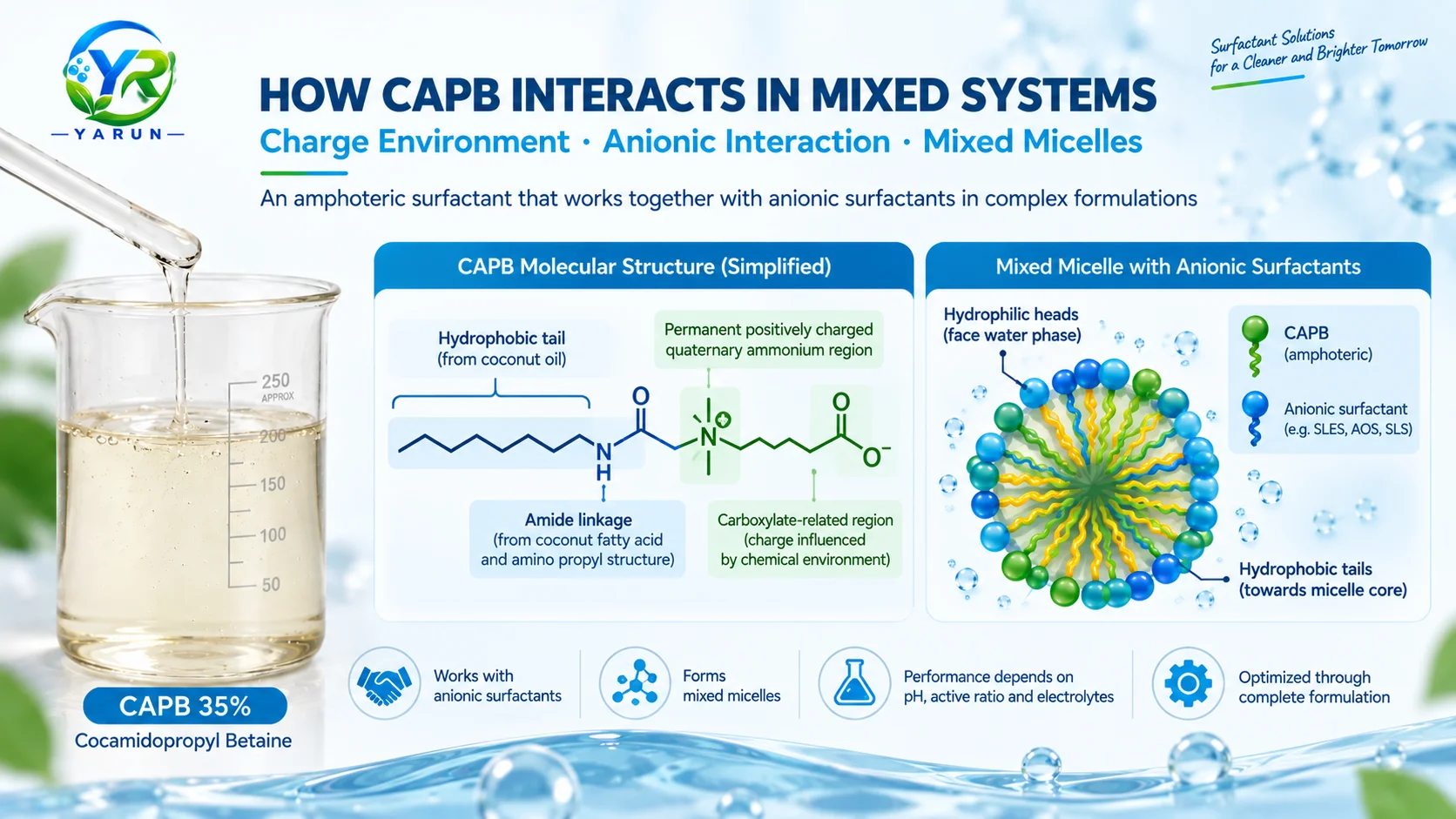
CAPB stands for Cocamidopropyl Betaine. It is commonly described as an amphoteric or zwitterionic surfactant derived from a fatty-acid amidoamine route and converted to a betaine structure.
The molecule contains:
- A hydrophobic fatty-chain-derived region;
- an amide-containing linkage;
- a permanently charged quaternary ammonium group;
- a carboxylate group whose protonation state is affected by the chemical environment.
Commercial CAPB is supplied as an aqueous mixture rather than as a pure isolated molecule. The mixture can contain:
- CAPB surfactant active;
- water;
- sodium chloride;
- residual starting materials or process-related components;
- preservative, depending on the commercial grade;
- other constituents defined by the manufacturing process and specification.
The grade name “CAPB 35%” should therefore not be interpreted as proof of exactly 35% CAPB active matter.
2. Current YARUN CAPB 35% Product Facts
YARUN’s CAPB 35% Cocamidopropyl Betaine product page identifies the following current commercial quality profile:
| Parameter | Current product information |
|---|---|
| Product | CAPB 35% Cocamidopropyl Betaine |
| INCI name | Cocamidopropyl Betaine |
| CAS number | 61789-40-0 |
| Ionic character | Amphoteric surfactant |
| Appearance | Colorless to light-yellow clear liquid |
| Solid content | 35 ± 2% |
| Active matter | 29–32% |
| Sodium chloride | ≤6.0% |
| pH value | 4.5–5.5 |
| Free amine | ≤0.5% |
| Standard packaging | 200 kg HDPE drum |
| Alternative packaging | IBC, subject to order confirmation |
| Reference HS code | 3402490000 |
These figures represent the current product control profile. Final acceptance must follow the approved purchase specification, applicable test methods and commercial batch COA.
The pH value must be interpreted according to the specified sample preparation and test method. It is not a recommended pH range for every finished product.
3. Why “35% Solids” and “Active Matter” Are Different
Total solids and surfactant active matter are related but different purchasing parameters.
Total solids can include:
- CAPB active;
- inorganic salts;
- other non-volatile constituents included under the applicable method.
Active matter is the portion attributed to surfactant-active components under the specified analytical method.
For the current YARUN grade:
- Solid content: 35 ± 2%;
- active matter: 29–32%.
A buyer should not calculate formulation dosage or cost by assuming the entire solids result is surfactant active.
When comparing two CAPB offers, confirm:
- Whether the quoted concentration is solids or active matter;
- the analytical method;
- sodium chloride content;
- water content where specified;
- preservative status;
- impurity limits;
- whether results refer to a typical value, specification limit or batch result.
4. Understanding CAPB Charge Behavior
CAPB contains both positively and negatively charged functional regions within the same molecular structure.
The quaternary ammonium group carries a permanent positive charge. The carboxylate region can be affected by protonation under acidic conditions.
This means CAPB behavior changes with the surrounding environment, but it should not be simplified as a molecule that freely becomes “fully anionic” at one pH and “fully cationic” at another.
Relevant variables include:
- Formulation pH;
- ionic strength;
- primary surfactant;
- other charged ingredients;
- total active matter;
- temperature.
Charge behavior influences interactions with:
- Anionic surfactants;
- cationic ingredients;
- polymers;
- surfaces;
- electrolytes;
- suspended particles.
Compatibility must be evaluated in the complete formula.
5. What Happens When CAPB Is Combined With Anionic Surfactants?
CAPB is commonly combined with anionic surfactants such as SLES, AOS or SLS.
In solution, these materials can form mixed aggregates rather than behaving as two completely independent surfactants.
Interactions between CAPB and anionic surfactants may affect:
- Micelle size and shape;
- surface adsorption;
- foam-film properties;
- viscosity;
- electrolyte response;
- cleansing profile;
- deposition and rinsing;
- interaction with skin or other surfaces.
The result depends on the ratio and total active concentration.
A formulation containing 10% commercial SLES 70% and 5% commercial CAPB 35% does not contain a 2:1 active-surfactant ratio. The concentrations must first be converted to active matter.
The general calculation is:
Surfactant active in formula = Commercial material dosage × Confirmed active-matter fraction
All surfactants should be converted to the same active basis before ratios are compared.
6. CAPB and SLES: Why the Ratio Matters
SLES and CAPB are frequently combined in hand wash, shampoo, liquid soap and hand-dishwashing formulations.
SLES commonly provides a substantial part of the anionic cleansing and foaming system. CAPB can modify the mixed system’s:
- Foam texture;
- foam retention;
- viscosity response;
- salt curve;
- cleansing profile;
- sensory properties.
The relationship is not linear.
Increasing CAPB may initially improve a desired property, but further addition can:
- Move the formulation away from its optimum rheological region;
- change clarity;
- shift electrolyte response;
- increase cost;
- reduce the relative concentration of the primary surfactant;
- create no proportional improvement.
The optimal ratio must be determined through controlled formulation trials.
For the primary surfactant’s dilution, micelle and salt-curve behavior, see how SLES 70% works in liquid detergents.
7. CAPB and AOS
CAPB can also be evaluated with AOS in liquid cleansing and household-cleaning systems.
Important considerations include:
- AOS physical form;
- dissolution method;
- total active matter;
- surfactant ratio;
- electrolyte load;
- pH;
- clarity;
- low-temperature behavior;
- foam under soil loading.
If AOS 92% powder is used, the AOS must first be incorporated through a validated wetting and dissolution process. CAPB should not be expected to correct undissolved AOS or poor powder processing.
See how AOS 92% composition and dissolution affect detergent formulation.
8. Compatibility With Cationic Ingredients Requires Care
CAPB is sometimes broadly described as compatible with anionic, nonionic and cationic surfactants.
This is a useful initial classification, but it is not a guarantee that every CAPB grade can be added to every cationic system.
Compatibility can be affected by:
- pH;
- relative charge density;
- concentration;
- electrolyte level;
- cationic polymer type;
- conditioning agent;
- fragrance;
- addition sequence;
- temperature.
Possible outcomes include:
- Haze;
- precipitation;
- viscosity loss;
- complex formation;
- reduced deposition;
- instability during storage.
Any formulation containing CAPB and strongly cationic ingredients requires specific compatibility testing.
9. How CAPB Changes Foam
CAPB can participate in adsorption at the air–water interface and in the liquid films surrounding bubbles.
In mixed systems, it may help modify:
- Initial foam generation;
- bubble size;
- foam texture;
- foam retention;
- foam under oil or soil loading;
- rinsing behavior.
However, CAPB is not an automatic foam booster at every concentration.
Foam performance depends on:
- Primary surfactant;
- CAPB-to-primary-surfactant ratio;
- total active matter;
- water hardness;
- pH;
- electrolytes;
- fragrance and oils;
- soil loading;
- temperature;
- mechanical test conditions.
A clean-water cylinder-shake test may produce attractive foam but fail to represent dishwashing under oil load or cleansing under real-use conditions.
Foam should therefore be tested under application-relevant conditions.
10. Foam Quality Is Not the Same as Cleaning Performance
A stable, fine foam may improve product perception and application experience. It does not directly measure soil removal.
Cleaning depends on:
- Soil type;
- surface;
- detergent dosage;
- surfactant system;
- builders and solvents;
- contact time;
- temperature;
- mechanical action;
- rinsing.
The formulation brief should state whether foam is:
- A functional requirement;
- a consumer-perception requirement;
- a controlled attribute;
- undesirable for the intended equipment.
High foam can be valuable in a hand-dishwashing product and problematic in an automated cleaning system.
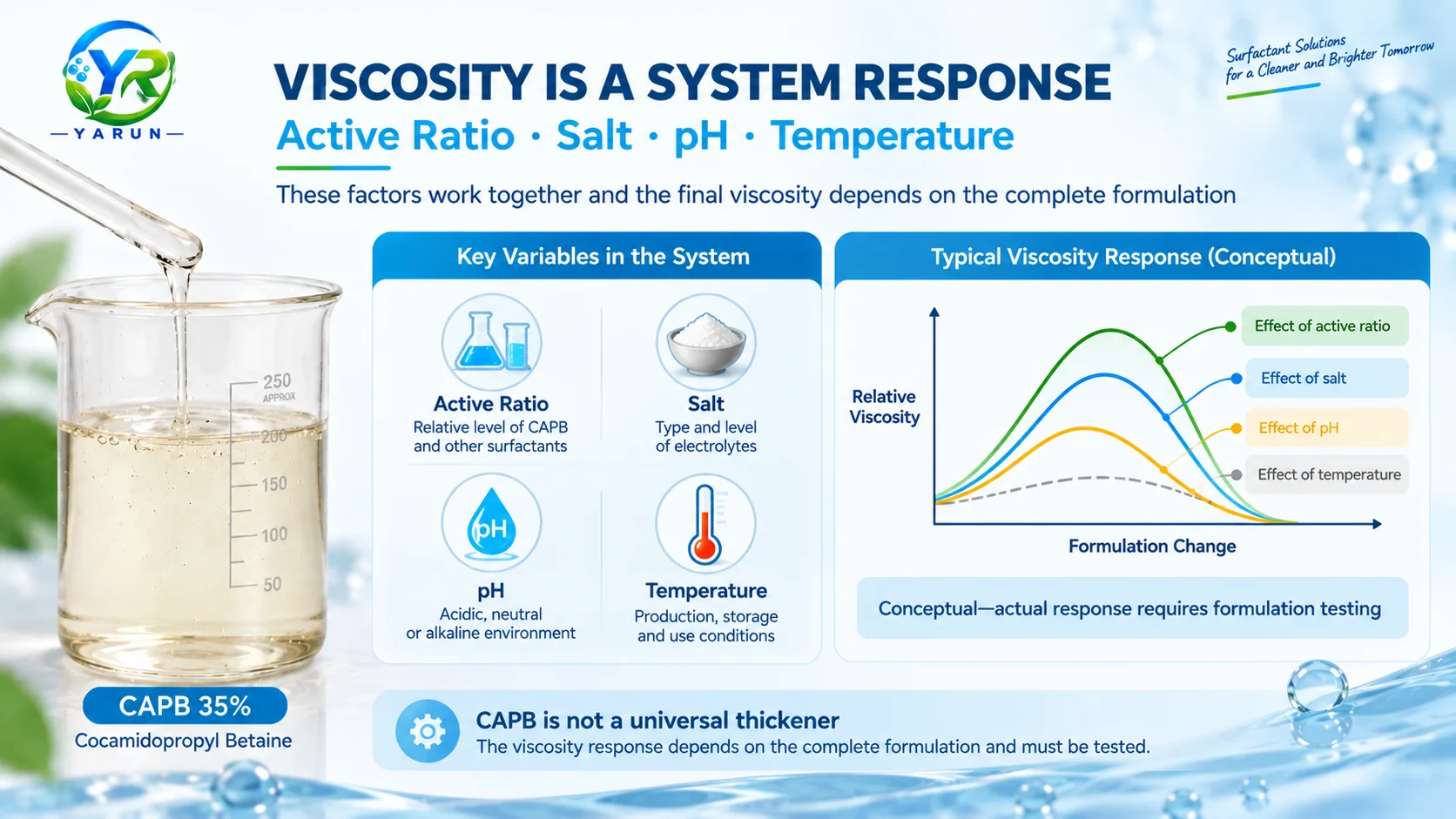
11. How CAPB Can Affect Viscosity
CAPB can change micellar organization when combined with suitable surfactants. This can increase resistance to flow in some formulations.
The effect depends on:
- Primary surfactant identity;
- active-matter ratio;
- total active concentration;
- sodium chloride already present;
- externally added salt;
- pH;
- fragrance;
- solvents;
- nonionic surfactants;
- polymers;
- temperature;
- order of addition.
CAPB is therefore not a universal thickener.
The same commercial CAPB grade can:
- Increase viscosity in one formula;
- have little effect in another;
- reduce viscosity after exceeding a useful ratio;
- shift the salt-response peak;
- contribute to haze or instability under unsuitable conditions.
A viscosity result must always include the measurement temperature, method, spindle, speed and equilibration time.
12. CAPB Is Part of the Electrolyte System
Commercial CAPB 35% can contain sodium chloride within its specification.
This means CAPB introduces both:
- Surfactant active;
- an electrolyte contribution.
When CAPB dosage changes, the formulation’s total salt environment may also change.
The complete electrolyte balance can include:
- Sodium chloride in CAPB;
- sodium sulfate or sodium chloride in other surfactants;
- added salt;
- neutralized acids;
- builders;
- preservatives;
- water minerals;
- dyes and other ingredients.
If a formulator increases CAPB and then adds the original salt quantity unchanged, the formula may move past its useful viscosity region.
13. Build a Controlled Rheology Study
A controlled viscosity study should keep the base formula constant and vary only one intended factor.
Record:
- Raw-material lot numbers;
- commercial dosage;
- active-matter ratio;
- total active matter;
- calculated and measured electrolyte inputs;
- pH;
- addition sequence;
- mixing time;
- sample temperature;
- equilibration period;
- viscosity method;
- appearance and clarity;
- storage observations.
Do not select the formulation solely at the highest observed viscosity.
A commercial product should have an operating margin that tolerates normal variation in:
- Raw-material lots;
- production temperature;
- fragrance;
- salt;
- filling;
- storage.
A formula positioned exactly at a narrow viscosity peak may be difficult to manufacture repeatedly.
14. Does CAPB Automatically Make a Formula Mild?
No single raw material proves that a finished product is mild.
CAPB may support a milder surfactant balance in suitable systems, particularly when used with anionic surfactants. Major ingredient manufacturers also describe beneficial effects in properly designed anionic combinations.
However, finished-product mildness depends on:
- Total surfactant active;
- surfactant ratio;
- pH;
- contact time;
- rinse conditions;
- fragrance;
- preservatives;
- solvents;
- impurities;
- intended user population;
- complete safety assessment;
- appropriate finished-product testing.
Terms such as:
- “Mild”;
- “gentle”;
- “suitable for sensitive skin”;
- “hypoallergenic”;
- “baby-safe”;
- “non-irritating”
require evidence appropriate to the product, claim and destination market.
A CAPB specification or supplier statement alone is insufficient.
15. Why CAPB Impurities Matter
CAPB manufacturing can involve amidoamine intermediates and dimethylaminopropylamine, commonly abbreviated as DMAPA.
Residual process-related impurities have received particular attention in personal-care applications because sensitization concerns associated with commercial CAPB materials may involve impurities rather than the intended CAPB structure alone.
For personal-care projects, buyers should confirm which impurity parameters are controlled, such as:
- Residual amidoamine, where applicable;
- DMAPA, where applicable;
- free amine under the stated method;
- microbiological limits;
- preservative status;
- nitrosamine-related controls where relevant to the manufacturing route and market.
YARUN’s current public product profile states:
Free amine: ≤0.5%
This must not be presented as a specific DMAPA or amidoamine limit unless the approved specification and analytical method explicitly confirm that interpretation.
Where a customer requires a tighter personal-care impurity profile, verification is required before quotation or approval.
16. Preservative Status Must Be Confirmed
Commercial CAPB grades may be:
- Preserved;
- unpreserved;
- supplied with different preservative systems.
A preservative used in the raw material can affect:
- Finished-product labeling;
- allergen or restricted-substance review;
- microbiological strategy;
- destination-market compliance;
- compatibility with the final preservative system.
Do not assume that all CAPB 35% products have the same preservative status.
The buyer should request:
- TDS;
- SDS;
- ingredient or composition information where applicable;
- preservative declaration;
- microbiological specification for relevant applications;
- batch COA.
17. Application-Specific Selection
Hand-Dishwashing Liquid
Important evaluation points include:
- Foam under oil load;
- grease-removal performance;
- viscosity;
- clarity;
- rinsing;
- hand-use profile;
- fragrance compatibility;
- cost per usable dose.
CAPB normally functions as part of a surfactant blend rather than replacing the primary surfactant directly.
Hand Wash and Liquid Soap
Evaluate:
- Total surfactant active;
- pH;
- cleansing;
- foam texture;
- preservative;
- fragrance;
- viscosity;
- skin-tolerance strategy;
- finished-product safety.
Shampoo and Body Wash
In addition to surfactant balance, review:
- Conditioning-polymer compatibility;
- deposition;
- hair or skin feel;
- fragrance;
- preservative;
- viscosity;
- impurity profile;
- applicable cosmetic requirements.
Liquid Laundry Detergent
CAPB may be evaluated where foam character, rheology or surfactant balance requires adjustment.
The project should consider:
- Machine or hand-wash use;
- foam target;
- builders;
- enzymes;
- polymers;
- water hardness;
- rinse behavior;
- cost contribution.
Household and Institutional Cleaners
Selection should reflect:
- Target surface;
- soil;
- pH;
- foam requirement;
- wiping or rinsing process;
- occupational exposure;
- material compatibility;
- wastewater requirements.
18. Diagnosing Common CAPB Formulation Problems
| Observation | Variables to investigate |
|---|---|
| Formula remains thin | Active-matter ratio, total surfactant active, salt level, pH, temperature and fragrance |
| Viscosity rises and then falls | Electrolyte level or CAPB ratio may have passed the useful rheological region |
| Formula becomes hazy | Fragrance, cationic ingredients, electrolytes, nonionic surfactants, pH and temperature |
| Precipitate develops | Charge incompatibility, polymer interaction, pH, concentration and addition sequence |
| Foam is lower than expected | Active matter, soil load, water hardness, primary surfactant, oil and test method |
| Foam collapses under use | Soil loading, fragrance oils, surfactant ratio and mechanical conditions |
| Product thickens after standing | Micellar equilibration, hydration, temperature or delayed electrolyte interaction |
| Viscosity changes in storage | Temperature cycle, evaporation, polymer interaction, contamination or phase change |
| Color or odor varies | Raw-material lot, storage, preservative, oxidation, contamination or process history |
| Two CAPB lots perform differently | Active matter, solids, salt, pH, impurities, preservative and analytical variation |
A corrective investigation should use controlled samples rather than changing CAPB, salt, fragrance and pH simultaneously.
19. Compare CAPB Offers on Active Matter
Price per metric ton does not provide a complete comparison.
A basic calculation is:
Raw-material cost per metric ton of active matter = Price per metric ton ÷ active-matter fraction
For example, a product at 30% confirmed active matter should be evaluated using 0.30—not the 35% grade name—when calculating active-matter cost.
A complete comparison should also include:
- Total solids;
- sodium chloride;
- impurity controls;
- preservative status;
- microbiological requirements;
- packaging;
- freight;
- container loading;
- formulation dosage;
- effect on added salt;
- viscosity response;
- rework risk;
- batch consistency;
- document package.
The lowest CAPB price per ton may not provide the lowest finished-formula cost.
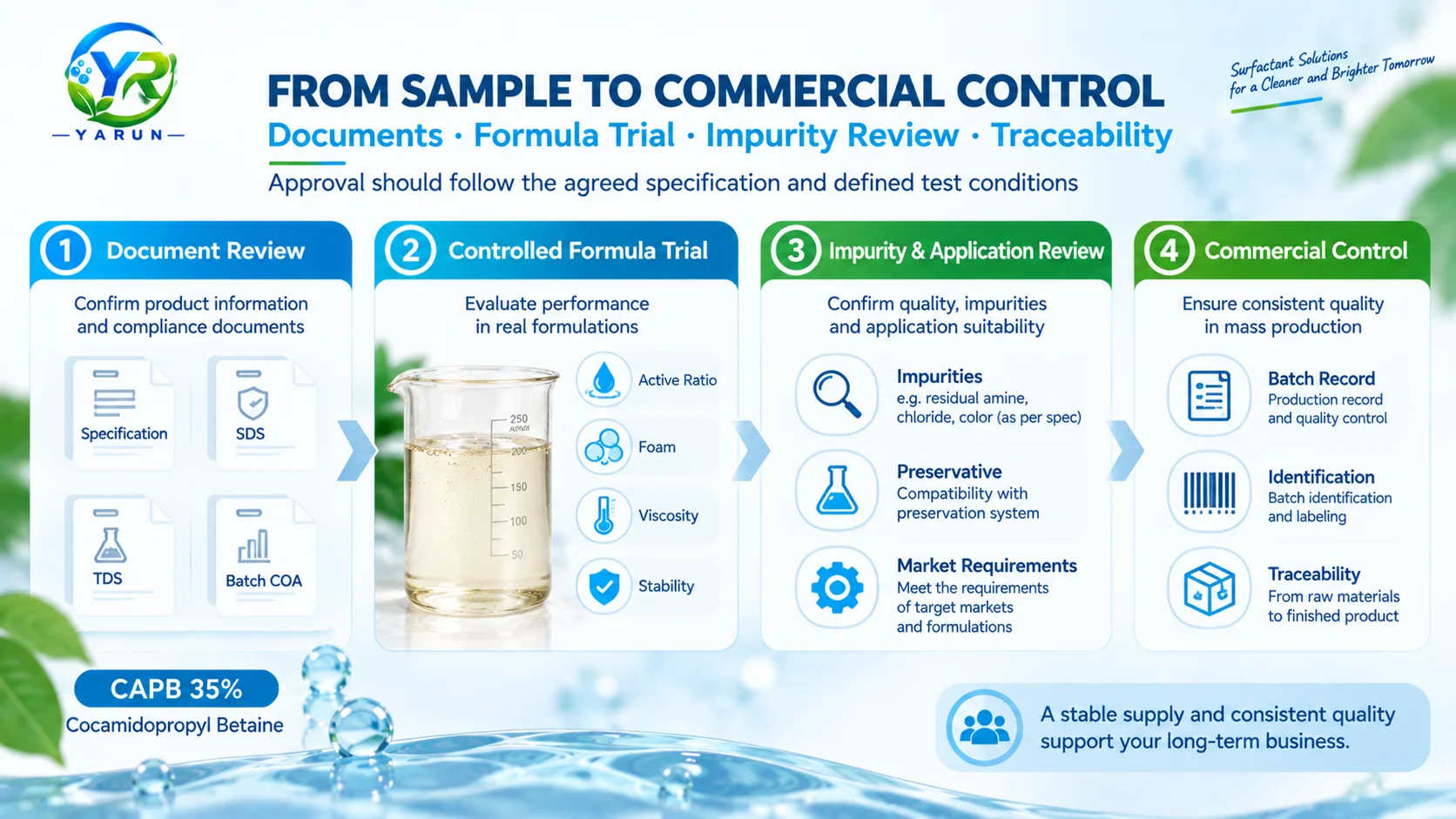
20. A Better CAPB Qualification Program
Stage 1: Document Review
Confirm:
- Product identity;
- approved specification;
- TDS;
- SDS;
- representative COA;
- active-matter method;
- preservative status;
- impurity requirements;
- packaging and storage guidance.
Stage 2: Incoming Sample Review
Record:
- Supplier;
- sample and batch code;
- appearance;
- color;
- odor;
- clarity;
- pH under the defined method;
- COA values;
- packaging condition;
- date received;
- storage conditions.
Stage 3: Active-Basis Formulation Comparison
Use the same:
- Primary surfactant;
- total active matter;
- water;
- equipment;
- mixing;
- pH;
- fragrance;
- temperature;
- measurement method.
Compare:
- Foam before and after representative soil;
- viscosity response;
- salt curve;
- clarity;
- rinsing;
- cleaning performance;
- stability;
- relevant application properties.
Stage 4: Impurity and Regulatory Review
For personal-care or sensitive-use projects, confirm:
- Applicable impurity limits;
- preservative;
- microbiological specification;
- regulatory documentation;
- finished-product safety-assessment requirements;
- claim evidence.
Stage 5: Pilot Verification
Confirm:
- Dosing;
- addition sequence;
- mixing;
- batch time;
- pH adjustment;
- air entrainment;
- transfer;
- filling;
- final uniformity.
Stage 6: Commercial-Batch Control
Link:
- Purchase specification;
- CAPB batch COA;
- incoming inspection;
- formula and manufacturing record;
- finished-product tests;
- batch identification;
- retained samples;
- traceability.
When moving from qualification of one surfactant to evaluation of a multi-component base, the review should also cover dilution instructions, the completed product, stability and pilot-scale verification.
21. Information to Send Before Requesting a Recommendation
For a useful CAPB review, provide:
- Target country;
- finished-product type;
- primary surfactant;
- current surfactant dosages;
- active-matter data;
- target pH;
- target viscosity;
- foam requirement;
- water quality;
- fragrance and solvent system;
- current salt quantity;
- current formulation problem;
- personal-care impurity requirements where applicable;
- preservative requirements;
- packaging;
- expected order quantity;
- destination port;
- required documents.
This information distinguishes a simple price request from a formulation, supplier-change or troubleshooting project.
22. How YARUN Supports CAPB 35% Projects
YARUN supplies CAPB 35% Cocamidopropyl Betaine for personal-care, dishwashing and household-cleaning applications, subject to the approved specification and project requirements.
Support can include:
- Product-specification confirmation;
- sample availability confirmation;
- batch COA;
- SDS;
- TDS;
- packaging confirmation;
- preservative-information coordination where available;
- bulk quotation;
- active-matter and commercial comparison;
- export-document coordination;
- sample and formulation-review coordination.
Final suitability depends on the complete formula, surfactant ratio, pH, electrolyte system, impurities, processing, destination market and completed testing.
YARUN does not treat the CAPB grade name, a fresh sample or a single viscosity result as proof of finished-product mildness, safety or commercial repeatability.
23. Request a CAPB Surfactant-System Review
If you are evaluating CAPB 35% for a new formulation, changing suppliers or troubleshooting foam, viscosity, haze or batch variation, send YARUN:
- Target application;
- required specification;
- primary surfactant system;
- target active matter;
- viscosity and foam objectives;
- impurity or preservative requirements;
- main formulation problem;
- packaging;
- expected quantity;
- destination country and port;
- required documents.
YARUN can review the project information and coordinate the appropriate specification, sample, documentation and quotation route.
Request a CAPB Surfactant-System Review
Frequently Asked Questions
What does CAPB 35% mean?
It is a commercial grade designation commonly associated with approximately 35% total solids. The current YARUN profile lists 35 ± 2% solids and 29–32% active matter.
Is CAPB an amphoteric or zwitterionic surfactant?
CAPB is commonly classified as amphoteric or zwitterionic. It contains a permanent quaternary ammonium charge and a carboxylate-related region affected by the chemical environment.
Is total solids the same as active matter?
No. Total solids can include surfactant active, inorganic salts and other non-volatile constituents measured under the applicable method.
Does CAPB always thicken SLES?
No. Viscosity depends on the CAPB-to-SLES active ratio, total concentration, salt, pH, fragrance, temperature and other ingredients.
Does more CAPB always create more foam?
No. Foam response is formulation-specific and may reach a useful region beyond which more CAPB provides little benefit or changes other properties.
Does CAPB automatically make a product mild?
No. CAPB can support a milder surfactant balance, but finished-product mildness requires evaluation of the complete formula and appropriate evidence.
Can CAPB be combined with cationic ingredients?
Some systems may be compatible, but broad compatibility cannot be assumed. The specific cationic material, pH, concentration and storage conditions must be evaluated.
Why does sodium chloride in CAPB matter?
It contributes to the formula’s total electrolyte load and may shift viscosity, clarity and salt response.
What impurity parameters matter for personal-care CAPB?
Depending on the project, buyers may need controls for free amine, residual amidoamine, DMAPA, preservative status and microbiological quality. Requirements must be confirmed for the grade and market.
Can two CAPB 35% products be substituted kilogram for kilogram?
Not automatically. Compare active matter, total solids, sodium chloride, pH, impurities, preservative and performance in the target formula.
What should buyers check on a CAPB COA?
Review the parameters in the approved specification, including appearance, solids, active matter, sodium chloride, pH, free amine and any project-specific impurity or microbiological requirements.
Can YARUN provide CAPB documents and bulk pricing?
YARUN can provide or coordinate the applicable specification, batch COA, SDS, TDS, packaging information and bulk quotation according to the confirmed project requirements.
Conclusion
CAPB 35% should not be evaluated as a universal foam booster, thickener or mildness ingredient.
Its commercial performance depends on the interaction between:
- Active matter;
- total solids;
- sodium chloride;
- pH;
- impurity profile;
- preservative;
- primary surfactant;
- active ratio;
- mixed-micelle behavior;
- fragrance;
- temperature;
- processing;
- finished-product validation.
More CAPB does not automatically mean more viscosity or foam. A 35% grade name does not mean 35% active matter. A CAPB specification does not prove that the finished formula is mild, non-irritating or suitable for sensitive users.
Manufacturers should compare grades on an active basis, control the complete electrolyte system, verify relevant impurities and test the finished formulation under defined production, storage and application conditions.