Author Information
Published by the Technical Team of Hebei Yarun Daily Chemical Co., Ltd.
Body
A detergent concentrate base can simplify part of a local manufacturing project.
Depending on the specific system, it may reduce the number of separately purchased materials, part of the formulation workload and some of the complexity associated with raw-material inventory.
However, simplicity at the purchasing stage does not automatically create reliability at the production stage.
A base that looks clear, feels viscous or generates abundant foam may still produce an unsuitable finished product after it is combined with local water, fragrance, color or other approved additions.
The more useful question is not:
Does the concentrate sample look good?
It is:
Can this concentrate base produce a defined, acceptable and repeatable finished product under the buyer’s actual water, equipment, process, packaging and market conditions?
This distinction matters because a concentrate sample, a diluted laboratory sample, a pilot batch and a released commercial batch represent different levels of evidence.
A professional evaluation should connect all four.
Key Evaluation Principles
Define the intended finished product before evaluating the concentrate.
Confirm what the dilution ratio means and calculate finished yield on a consistent mass basis.
Test the completed product using representative local water, approved additions and defined methods.
Compare competing bases under equivalent finished-product conditions.
Verify the result at pilot scale before routine commercial production.
Approve the complete production system—not only the concentrate sample.
Companies that have not yet selected between a concentrate base, individual raw materials, a hybrid route and finished-product OEM can first review:
1. Define the Finished Product Before Testing the Base
A concentrate base cannot be evaluated separately from the product it is expected to produce.
The buyer should first prepare a finished-product brief.
Define the Application
Confirm whether the planned product is intended for:
Hand dishwashing;
liquid laundry;
multipurpose cleaning;
floor cleaning;
institutional cleaning;
food-service cleaning;
vehicle cleaning;
degreasing;
or another defined application.
“Liquid detergent” is not one universal product category.
Different applications may require different:
Surfactant systems;
active-matter levels;
foam profiles;
pH conditions;
solvents;
builders;
hydrotropes;
chelating systems;
fragrances;
preservatives;
packaging;
performance tests;
and use instructions.
Each application requires a separately defined finished-product brief, compatibility review and performance-validation plan.
Define the Target Customer
The finished product may be intended for:
Household consumers;
wholesalers;
supermarkets;
hotels;
restaurants;
laundries;
contract-cleaning companies;
workshops;
institutions;
or industrial users.
The target customer affects expected performance, packaging, use conditions and acceptable production cost.
Define the Market Position
The business should identify whether the intended product will be positioned as:
Economy;
standard;
premium;
concentrated;
professional-use;
or another clearly defined category.
A higher finished active-matter level alone does not define a premium product.
Commercial positioning depends on the complete formulation, performance, packaging, fragrance, customer experience, supporting evidence and market context.
Define the Commercial Requirements
Before testing the base, record:
Target country;
expected monthly output;
planned batch size;
packaging sizes;
sales channel;
target finished-product cost;
intended launch schedule;
and applicable destination-market requirements.
Without a finished-product brief, an evaluation may produce a technically acceptable sample that does not fit the buyer’s business.
2. Verify the Identity of the Concentrate Base
A sample should have a controlled identity before formulation work begins.
At minimum, record:
Supplier;
product name;
product code;
sample or batch number;
date received;
packaging condition;
appearance;
color;
odor;
storage condition;
and documents supplied with the sample.
A clear identity connects the sample to its specification, future production lots and any later investigation.
Review the Specification
The specification should define the parameters used to identify and control the base.
Depending on the product, these may include:
Appearance;
active matter;
total solids;
pH under a defined method;
density;
viscosity under defined conditions;
relevant inorganic salts;
preservative information;
microbiological requirements where applicable;
and other project-specific parameters.
The exact specification should reflect the particular formulation and intended market rather than being copied from another detergent base.
Distinguish Active Matter from Total Solids
Active matter and total solids are not automatically the same.
Total solids may include:
Surfactant active matter;
inorganic salts;
builders;
non-surfactant organic materials;
and other non-volatile constituents measured under the applicable method.
The supplier should state:
What the reported value represents;
which test method is used;
whether it is a specification range or typical value;
and whether it applies to the supplied base or completed finished product.
A percentage in a product name is therefore not a complete analytical definition.
Review the Document Package
Depending on the project, the buyer may require:
An approved product specification;
representative batch COA;
SDS;
applicable TDS;
packaging information;
storage guidance;
batch identification;
completion instructions;
information about permitted local additions;
finished-product control requirements;
and destination-market documentation.
These documents serve different purposes.
| Document | Primary Function | What It Does Not Prove |
|---|---|---|
| Specification | Defines the agreed product-control parameters and ranges | It does not prove that every finished formulation is suitable |
| Batch COA | Reports selected results for an identified production batch | It does not replace the approved purchase specification |
| SDS | Communicates hazard, handling, storage and emergency information | It is not a finished-product performance certificate |
| TDS | Provides technical and application information for the supplied product | It does not prove compatibility with the buyer’s water, process or packaging |
| Completion Instruction | Defines how the base should be converted into the intended finished product | It does not replace pilot verification and batch-release testing |
None of these documents, by itself, proves that the buyer’s finished product will be commercially suitable.
3. Clarify the Dilution Ratio and Finished Yield
Dilution language can create serious technical and commercial misunderstandings.
A statement such as:
Dilution ratio: 1:5
is not sufficiently precise by itself.
It may mean:
One part base plus four parts water or other approved additions, producing five parts finished product; or
one part base plus five parts water, producing six parts finished product.
The supplier should state:
Whether the ratio is calculated by mass or volume;
how much water is added;
whether other materials must be added;
the total finished-product mass produced;
whether the ratio is a recommended condition, adjustable range or maximum dilution claim;
and which finished-product specification applies at that condition.
An unambiguous instruction should follow this structure:
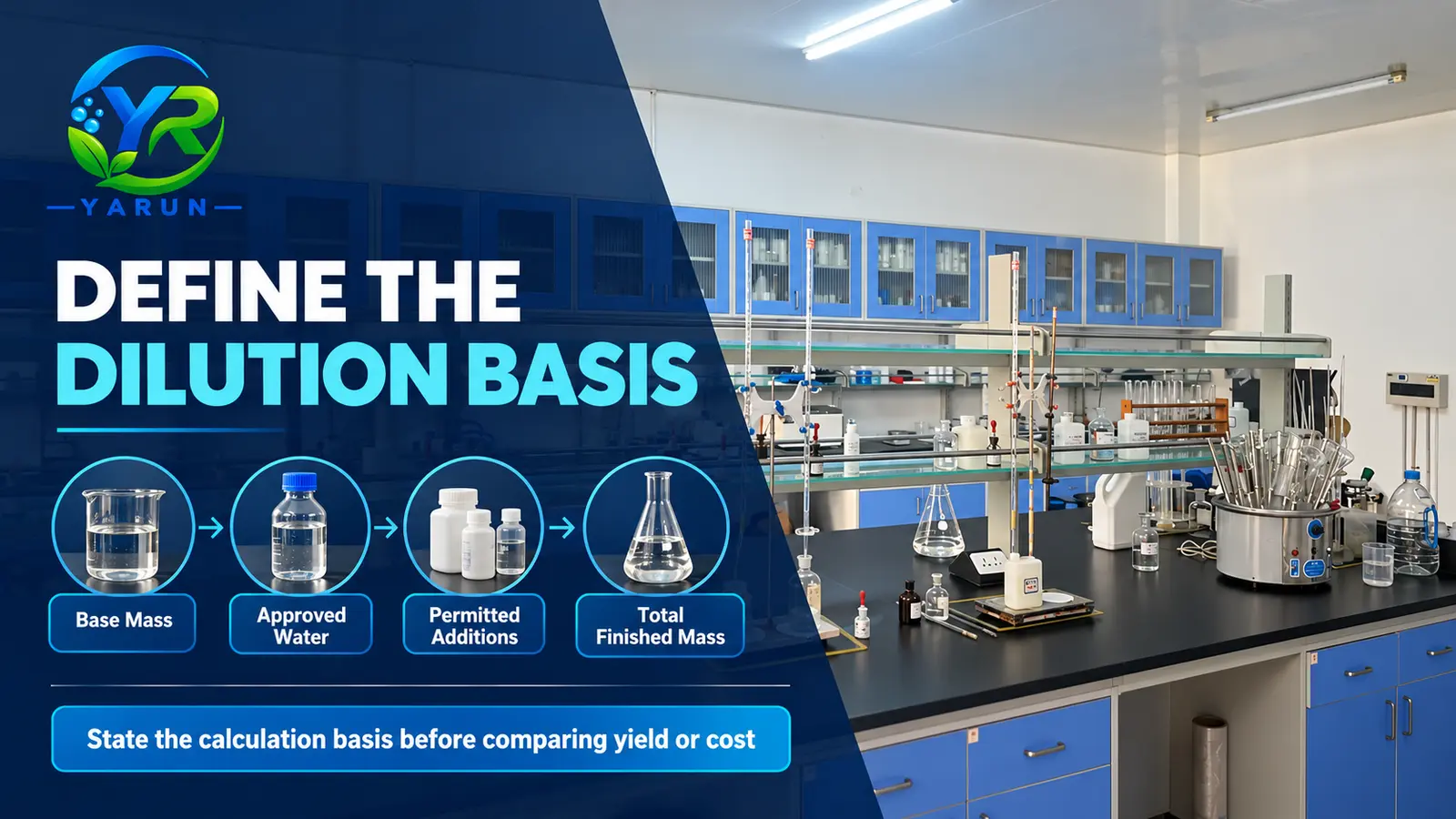
A defined mass of concentrate base is combined with a defined mass of approved water and any specified additions to produce a stated total mass of finished product.
The actual quantities must come from the approved project instruction.
Calculate Theoretical Finished Active Matter
A basic mass-balance calculation is:
Theoretical finished active matter = Base mass × Base active-matter fraction ÷ Total finished-product mass
When the base mass, confirmed active-matter fraction and final batch mass are known, this formula provides a theoretical result on a mass basis.
The calculation does not demonstrate:
Cleaning performance;
foam performance;
rinse behavior;
mildness;
stability;
preservation;
packaging compatibility;
or market acceptance.
It is a mass-balance calculation, not a finished-product performance claim.
Verify the Finished Yield
Theoretical yield should be distinguished from accepted commercial output.
Actual accepted output may be affected by:
Material retained in containers;
transfer loss;
foam;
air entrainment;
sampling;
filling loss;
adjustment;
rework;
and rejected material.
A commercially useful dilution ratio must therefore be connected to accepted finished output, not only theoretical output.
4. Design a Controlled Dilution Trial
A useful trial changes one defined variable at a time and records what actually happened.
It should not rely on uncontrolled mixing followed by visual judgment.
Establish a Trial Record
The trial record should identify:
Concentrate-base batch;
sample quantity;
water source;
water condition;
actual quantities;
addition sequence;
addition rate where relevant;
mixing equipment;
mixing condition;
batch temperature;
mixing time;
permitted local additions;
equilibration time;
sampling time;
sampling location;
and test methods.
The record should be detailed enough for another trained operator to repeat the trial.
Treat Water as a Raw Material
Water may be the largest component of the completed product.
Its quality may influence:
Clarity;
color;
odor;
viscosity;
electrolyte response;
fragrance compatibility;
preservation;
storage stability;
and batch consistency.
The buyer should identify:
Water source;
treatment process;
storage condition;
relevant hardness or conductivity information;
microbiological controls where applicable;
and frequency of verification.
Water used during supplier development may differ from the water available in the buyer’s factory. A trial using representative local water provides stronger evidence than relying only on the supplier’s laboratory water.
Control the Addition Sequence
The order in which water, base and other approved materials are added may affect:
Local concentration;
dispersion;
neutralization where applicable;
clarity;
viscosity;
fragrance incorporation;
foam;
and processing time.
The approved sequence should be documented and followed during comparative trials.
Control Mixing
Mixing should establish uniformity without introducing unnecessary air or foam.
Equipment and operating conditions should be selected from:
Formulation viscosity;
required circulation;
foam sensitivity;
batch size;
vessel geometry;
addition method;
and scale-up requirements.
A laboratory stirrer and a commercial mixing tank require separate verification because they may produce different circulation and air-entrainment conditions.
Control Local Additions
Depending on the specific base, local completion may involve:
Water;
fragrance;
color;
pH adjustment;
viscosity adjustment;
or other approved materials.
Each permitted addition should have:
A defined identity;
agreed specification;
approved quantity or range;
controlled procedure;
compatibility assessment;
and relevant finished-product test.
Undocumented local modification weakens traceability and makes batch investigation more difficult.
For a broader review of equipment, water, mixing, scale-up and production control, see:
Liquid Detergent Manufacturing: Equipment, Process Control and Concentrate-Base Options
5. Evaluate the Finished Product, Not Only the Concentrate
The commercial objective is normally to sell the completed product—not the concentrate in its original container.
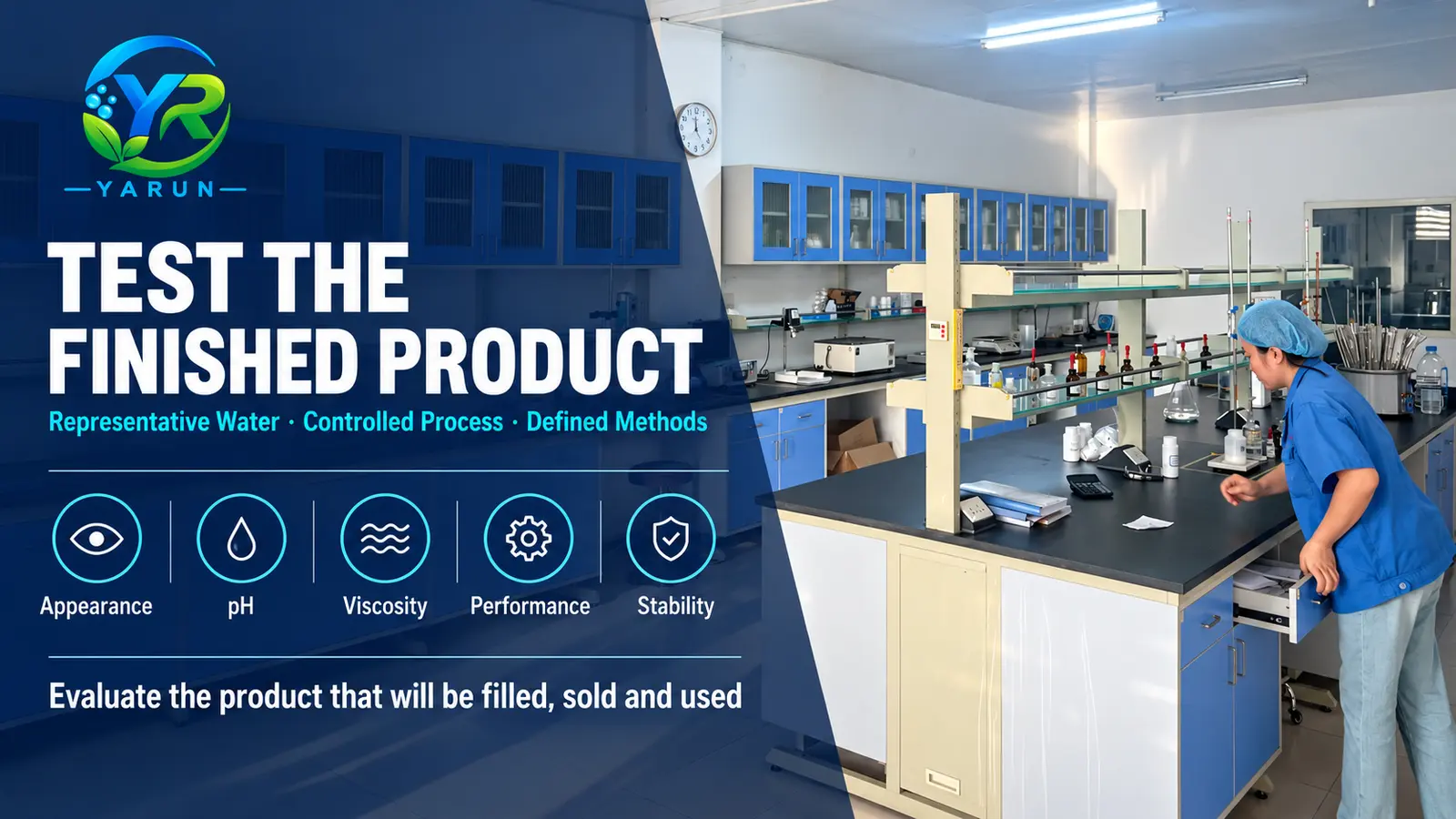
The diluted and completed product should therefore become the main subject of application testing.
Appearance and Uniformity
Record:
Appearance;
color;
odor;
clarity or opacity as applicable;
visible separation;
sediment;
suspended material;
surface foam;
and uniformity.
Clarity should only be treated as a requirement when it forms part of the defined specification and market position.
pH
A pH result is meaningful only when the test conditions are defined.
Record:
Whether the product is tested neat or diluted;
dilution water where applicable;
temperature;
instrument or method;
calibration status;
equilibration;
and acceptance range.
The appropriate target must be established for the specific product and market.
Viscosity
Viscosity is sensitive to measurement conditions.
The test record may need to define:
Instrument;
spindle or measurement geometry;
speed or shear condition;
temperature;
sample preparation;
air-removal condition;
equilibration time;
and measurement timing.
A viscosity number without a method is incomplete.
The result may also change after standing because of temperature, air release, hydration or micellar equilibration.
Density and Finished Yield
Density may be relevant to:
Mass-to-volume conversion;
filling;
packaging;
inventory;
and commercial yield.
If production and sales units use both mass and volume, the conversion basis should be documented.
Cleaning Performance
Cleaning performance should be evaluated under conditions relevant to the intended application.
Define variables such as:
Soil;
substrate or article;
product dose;
water;
temperature;
contact time;
washing action;
rinse condition;
comparator;
number of replicates;
and evaluation method.
For hand dishwashing, ISO 4198 provides guidance for comparative performance testing and highlights the importance of washing conditions, test soils and relevant performance characteristics.
ASTM D8549 provides guidance for evaluating the cleaning performance of light-duty hand dishwashing detergents using defined test soils or test materials.
These references support an important principle:
Performance results are meaningful only when the test conditions are defined.
They do not establish one universal formulation, dilution ratio or pass/fail specification for every market.
Foam Performance
Foam may influence user experience and suitability for a particular washing process, but foam is not a substitute measurement for cleaning performance.
The test should distinguish between:
Initial foam;
foam under soil loading;
foam stability;
foam collapse;
rinse behavior;
and requirements of the intended application.
ASTM D4009 provides guidance for evaluating the foam stability of hand dishwashing detergents in the presence of defined food soils.
Results obtained using different equipment, soils, water or procedures may not be directly comparable.
Application-Specific Performance
Depending on the product, further evaluation may include:
Grease removal;
particulate-soil removal;
stain removal;
redeposition;
spotting or filming;
surface compatibility;
fabric compatibility;
machine compatibility;
rinse behavior;
residue;
or another defined application result.
Testing should reflect how the customer will actually use the finished product.
Manufacturers developing hand dishwashing products can review:
Liquid Hand Dishwashing Detergent Formulation: Surfactant Selection, Foam, Viscosity and Scale-Up
6. Evaluate Stability and Packaging Compatibility
A sample that looks acceptable immediately after mixing has not completed a stability assessment.
Distinguish the Test Articles
The project may need separate stability observations for:
The supplied concentrate base;
the base diluted with approved water;
the completed fragranced product;
the product with color or other permitted additions;
and the product in its intended package.
Each test article represents a different formulation condition.
Establish the Stability Plan
A stability plan should define:
Sample identity;
batch identity;
packaging;
storage conditions;
observation intervals;
test parameters;
methods;
acceptance criteria;
and action for an out-of-specification result.
Depending on the project, observations may include:
Appearance;
color;
odor;
pH;
viscosity;
phase separation;
sediment;
haze;
evaporation;
package deformation;
leakage;
closure integrity;
and other relevant parameters.
The appropriate conditions and duration depend on the formulation, packaging, destination market and intended claim.
Interpret Accelerated Testing Correctly
Accelerated testing can help identify potential physical or chemical problems and compare formulations.
It does not, by itself, establish a specific commercial shelf life. Shelf-life support should reflect the formulation, package, storage conditions, test design and applicable market requirements.
Review Packaging Compatibility
The final package may interact with the product through:
Permeation;
stress cracking;
softening;
deformation;
leakage;
closure failure;
color transfer;
label damage;
or fragrance loss.
Compatibility should be evaluated using the actual or representative packaging system.
7. Compare Concentrate Bases Under Equivalent Conditions
Two concentrate bases should not be compared only by price per metric ton or the largest advertised dilution number.
A fair comparison should use the same:
Finished-product brief;
final batch mass;
active-matter basis where relevant;
water;
fragrance;
color;
other approved additions;
equipment;
addition sequence;
mixing condition;
test temperature;
equilibration time;
packaging;
and performance method.
Compare on an Active Basis
Where active matter is relevant and confirmed by an appropriate method, calculate:
Base cost per kilogram of active matter = Base cost per kilogram ÷ Base active-matter fraction
This calculation can identify differences hidden by water and non-active content.
The complete formulation must still be considered because salts, builders, solvents, hydrotropes, preservatives and the surfactant balance may affect the final result.
Compare on a Finished-Product Basis
A commercially useful comparison asks:
How much accepted finished product is produced?
Which local additions are required?
How much labor and processing time are required?
Does the system require repeated adjustment?
What tests are required?
What is the production loss?
Does the product meet the target specification?
Can the result be repeated?
Does the final product fit its intended market position?
The correct comparison is between production routes that deliver the same defined and accepted finished product.
Use Decision-Relevant Evidence
Fresh-sample clarity, concentrate viscosity, initial foam, the stated dilution ratio and base price may provide useful initial information.
Commercial selection should combine those observations with finished-product performance, stability, process repeatability, accepted output and total qualified production cost.
8. Move from Laboratory Trial to Pilot Verification
A successful laboratory trial shows that the system may be workable under the recorded laboratory conditions.
Commercial production introduces a different scale and operating environment.
Why Scale-Up Changes the System
When batch size changes, the following may also change:
Vessel geometry;
liquid depth;
impeller diameter;
impeller position;
power input;
circulation pattern;
addition time;
heat transfer;
surface-air contact;
foam generation;
mixing time;
and sampling position.
These changes can affect:
Uniformity;
air entrainment;
viscosity;
clarity;
fragrance dispersion;
adjustment requirements;
processing time;
and filling.
Suggested Verification Sequence
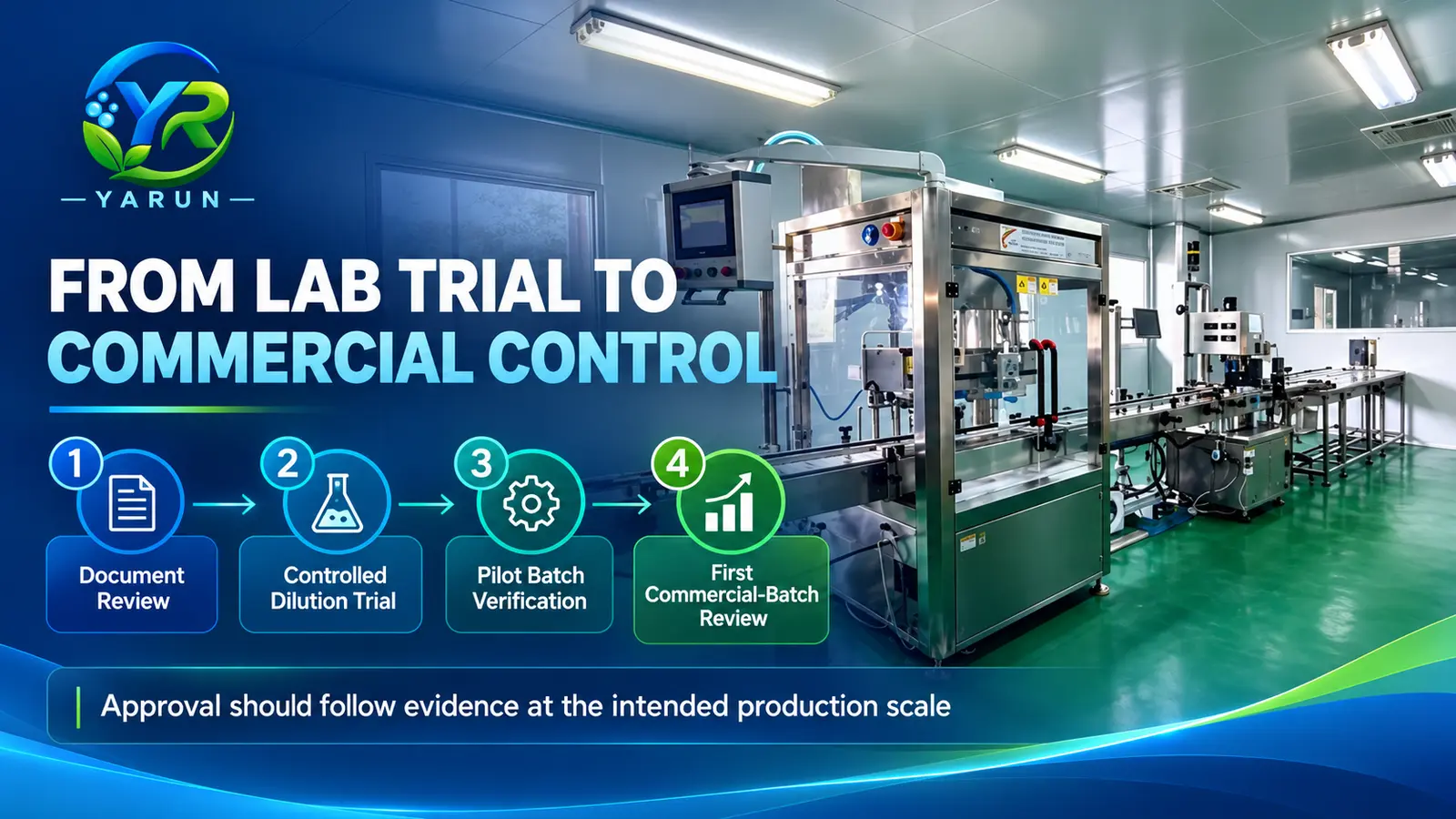
A controlled qualification program may follow this order:
Finished-product brief;
document review;
incoming sample identification;
controlled laboratory dilution;
finished-product testing;
local-water verification;
stability and packaging assessment;
pilot batch;
comparison of laboratory and pilot results;
first commercial-batch review;
routine batch-control plan.
The exact program should reflect the product, production scale and project risk.
Record the Pilot Batch
The pilot record should include:
Base batch;
actual quantities;
water source;
local materials;
equipment;
usable vessel volume;
addition sequence;
mixing conditions;
time;
temperature where relevant;
foam and air observations;
adjustments;
actual output;
production loss;
sampling;
test results;
deviations;
and comparison with the laboratory trial.
Important differences between laboratory and pilot results should be investigated through controlled comparisons.
9. Calculate Commercial Value from Accepted Finished Output
The purchase price of the concentrate base is only one component of the commercial calculation.
A more useful formula is:
Cost per kilogram of accepted finished product = Total qualified production cost ÷ Accepted finished-product output
Total Qualified Production Cost
Depending on the project, this may include:
Concentrate-base cost;
international freight;
duties and clearance;
local transport;
water treatment;
permitted local additions;
labor;
energy;
quality control;
packaging;
filling;
production loss;
rework;
rejected batches;
inventory financing;
and slow-moving stock.
Accepted Finished-Product Output
The denominator should represent product that:
Meets the agreed specification;
passes the defined release tests;
is contained in acceptable packaging;
and can be sold for the intended application.
It should not be based only on theoretical dilution output before production loss, rework or rejection.
Include Operational Complexity
A route with a lower theoretical material cost may require:
More suppliers;
more specifications;
more incoming inspections;
more inventory;
more formulation work;
more production steps;
more troubleshooting;
and more unused stock.
A concentrate-base route may reduce some of these burdens, while also requiring control of a defined upstream system and specification.
The commercially preferable route is the one that delivers the required accepted output at the lower total qualified production cost and at a level of operational risk the business can control.
10. Make a Documented Approval Decision
An evaluation should end with a documented decision.
| Decision | Meaning | Required Action |
|---|---|---|
| Approved | The defined base, completion process and finished product meet the agreed requirements under the evaluated conditions | Record the approved specification, process, scale, packaging and change-control conditions |
| Conditionally Approved | The system appears viable, but identified evidence or verification remains incomplete | Complete the listed actions before routine commercial production |
| Not Approved | The available evidence does not support commercial use for the defined project | Hold production, investigate the cause and repeat the relevant evaluation if appropriate |
Approved
Approval should identify:
Approved base and batch reference;
finished-product formula or completion instruction;
water requirement;
permitted local additions;
approved process;
finished-product specification;
test methods;
packaging;
production scale;
and change-control requirements.
Approval should remain limited to the recorded product, package, factory, process, scale and destination-market conditions.
Conditionally Approved
Conditional approval may be appropriate when the system appears technically viable but defined work remains outstanding.
Examples include:
Representative local-water confirmation;
fragrance compatibility;
packaging compatibility;
additional stability observations;
pilot verification;
missing documentation;
or clarification of a production parameter.
The open items, responsible party and approval conditions should be recorded.
Not Approved
The project should be held when material issues remain unresolved.
Possible reasons include:
Unclear product identity;
untraceable sample;
ambiguous dilution instructions;
active-matter or solids terminology that cannot be confirmed;
incomplete critical documentation;
unacceptable diluted-product behavior;
incompatibility with local water or permitted additions;
failure to meet the intended product specification;
inability to reproduce the laboratory result;
unexplained batch variation;
unsuitable packaging;
or unacceptable commercial cost.
A Not Approved decision means that the available evidence does not support commercial approval for the defined project at that time. Corrective investigation and controlled re-evaluation may establish a different result later.
11. Establish Change Control After Approval
Commercial approval should include a process for reviewing relevant changes.
The supplier and buyer should establish which changes require notification or re-evaluation.
Examples may include changes to:
Concentrate-base specification;
formulation;
raw-material source;
active-matter range;
preservative;
appearance;
packaging;
manufacturing site;
production process;
storage guidance;
completion instruction;
or required local additions.
The buyer should also review changes to:
Local water source;
fragrance;
color;
packaging;
mixing equipment;
batch size;
filling system;
and finished-product specification.
A commercially small change may still affect viscosity, clarity, preservation, stability or performance.
12. Information Required for a Base Evaluation
A useful project review requires more than a request for price or dilution ratio.
Prepare the following information.
Business Information
Target country;
business type;
target customers;
sales channel;
intended market position;
expected monthly output;
and project stage.
Product Information
Planned finished product;
household or institutional/commercial application;
expected characteristics;
target packaging;
fragrance and color direction;
intended use;
and required customization.
Concentrate Information
Product name;
supplier;
batch or sample code;
specification;
active-matter or solids information;
stated dilution ratio;
completion instruction;
documents received;
and current sample observations.
Production Information
Water source;
water-treatment capability;
mixing equipment;
usable batch volume;
weighing capability;
filling equipment;
quality-control instruments;
technical personnel;
and current production problems.
Evaluation Status
Indicate whether the project is currently:
Comparing suppliers;
reviewing documents;
testing a sample;
troubleshooting a diluted product;
preparing a pilot batch;
or preparing commercial production.
Request a Detergent Concentrate Base Evaluation Review
YARUN is evaluating how small and medium-sized manufacturers select, test and prepare detergent concentrate bases for local production.
If you are reviewing a concentrate sample or planning a controlled production trial, share a few basic details.
YARUN can help identify whether the next step should be document review, a controlled dilution trial, pilot verification or further commercial evaluation.
Submit Your Base Evaluation Request
Prefer WhatsApp? Start a Quick Discussion
This review is intended to understand project requirements and determine an appropriate evaluation route.
Product specifications, completion instructions, samples, pricing and commercial availability should be confirmed only after the applicable product-development and verification stages have been completed.
Frequently Asked Questions
1. Is a higher dilution ratio always commercially better?
No.
A higher stated dilution ratio may reduce the quantity of concentrate used per batch, but the buyer should also evaluate:
The meaning of the ratio;
final active matter;
required local additions;
water quality;
processing;
finished-product performance;
stability;
production loss;
and cost per kilogram of accepted finished product.
Commercial value depends on the accepted finished product—not the dilution number alone.
2. What does a 1:5 dilution ratio mean?
The expression is ambiguous unless the supplier defines it.
It may mean one part base plus four parts water or other approved additions, producing five parts finished product. It may also be interpreted as one part base plus five parts water, producing six parts finished product.
The supplier should state:
The calculation basis;
base quantity;
water quantity;
other required additions;
and total finished-product mass.
The ratio should be clarified before purchasing or production planning.
3. Can we approve a concentrate base from one laboratory sample?
No.
One laboratory sample may support an initial technical assessment, but commercial approval may also require:
Document review;
sample identity;
controlled dilution;
representative local water;
finished-product testing;
stability;
packaging compatibility;
pilot verification;
and defined commercial-batch controls.
The required depth depends on the product, market, production scale and risk.
4. Why does the product become thin, cloudy or separated after dilution?
Possible causes include:
Water quality;
surfactant balance;
electrolyte level;
fragrance;
color;
pH;
temperature;
addition sequence;
mixing;
local concentration;
incompatibility with another material;
or insufficient equilibration.
The investigation should compare controlled samples and change one variable at a time.
Adding more salt or another thickener without identifying the cause may move the formulation farther from its intended condition.
5. Should we test the concentrate or the diluted finished product?
Both may require testing, but they answer different questions.
Testing the concentrate helps confirm the identity and condition of the supplied material.
Testing the diluted and completed product determines whether the system produces an acceptable product under the buyer’s actual conditions.
Commercial approval should focus on the finished product that will be filled, sold and used.
6. What documents should a detergent concentrate supplier provide?
Depending on the project, the buyer may request:
Product specification;
representative batch COA;
SDS;
applicable TDS;
packaging information;
storage guidance;
unambiguous completion instruction;
required water information;
permitted local additions;
finished-product control requirements;
and batch traceability.
The necessary documents depend on the formulation, application, destination market and commercial arrangement.
The document package and finished-product testing should support each other.
7. When is a pilot batch required?
A pilot batch should be considered when the project is moving beyond laboratory evaluation and differences may exist in:
Equipment;
vessel geometry;
batch size;
water;
addition rate;
mixing;
temperature;
local materials;
packaging;
or production environment.
Pilot verification is particularly important before routine commercial manufacture.
Its purpose is to determine whether the controlled laboratory result can be reproduced at a more representative scale and to identify changes required before commercial approval.
Conclusion
A detergent concentrate base should be evaluated as part of a complete production system.
The decision should connect:
Finished-product requirements;
concentrate identity;
specification;
dilution definition;
local water;
permitted additions;
process control;
finished-product testing;
stability;
packaging;
pilot verification;
commercial cost;
batch release;
and change control.
A clear sample, high viscosity, strong initial foam or attractive dilution claim provides only part of the evidence.
The most useful concentrate base is the system that can be clearly defined, properly documented, controlled under local conditions, tested using appropriate methods and repeated at the intended production scale.
Further Technical Reading
Liquid Detergent Manufacturing: Equipment, Process Control and Concentrate-Base Options
Liquid Hand Dishwashing Detergent Formulation: Surfactant Selection, Foam, Viscosity and Scale-Up