1. What Formulation Work Does a Car Wash Liquid Base Already Provide?
A car wash liquid base integrates several formulation functions into a concentrated starting system for local production. The buyer completes preparation through a defined process rather than developing the base from individual raw materials.
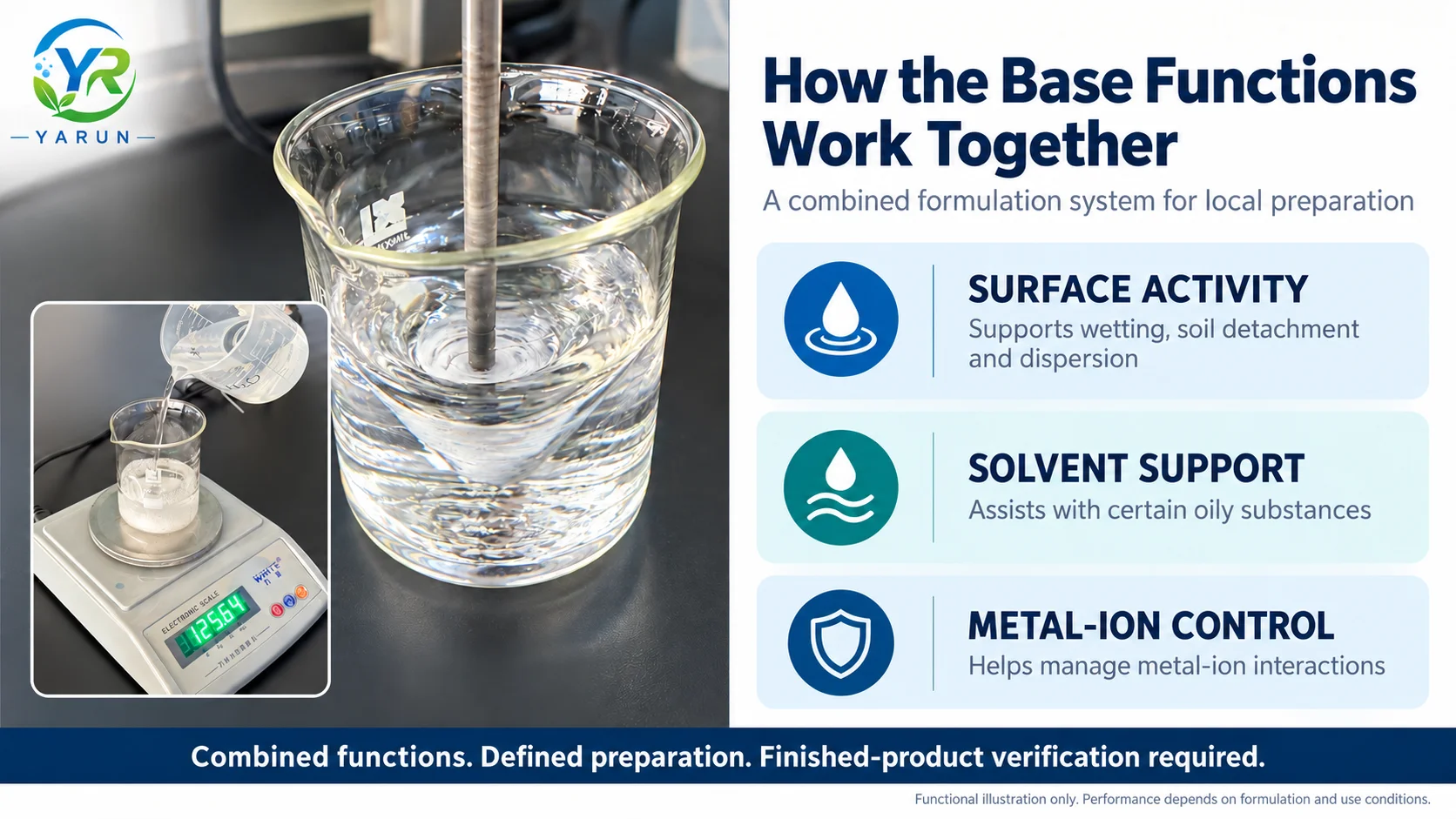
The system combines surface-active cleaning functions, solvent support and metal-ion control. These functions address different formulation needs: interaction with surfaces and soil, the handling of certain oily substances, and control of metal ions that can affect the system’s behavior.
Formulation involves more than selecting ingredients with useful individual properties. Their compatibility and balance must be considered together, both in the supplied concentrate and after preparation. The base therefore provides an established combination of functions, while the preparation route defines how that system is converted into the intended finished product.
For the 72% Concentrated Car Wash Liquid Base, the specified route combines the base with softened water at a defined ratio by weight. Local responsibilities include controlled preparation, finished-product testing, filling and packaging.
This approach reduces the initial formulation work required locally. The prepared product must still be verified against its target specifications and intended use conditions.
2. How Do the Functions Within the Base Work Together?
The base combines functions that address different parts of the same cleaning task. Surface-active components act at interfaces, solvent support helps with certain oily substances, and metal-ion control helps manage the chemical environment in which the system operates.
Surface Activity Establishes Contact and Supports Soil Removal
Surfactants contain water-attracting and oil-affine regions. They adsorb at interfaces, changing how the liquid interacts with a surface and its soil. This can support wetting, oily-soil detachment and the dispersion of removed material.
Different surfactant types contribute differently to these processes. Combining them provides a way to balance wetting, cleaning, foam and compatibility within one formulation. The result depends on their identities, proportions and operating conditions; combining several surfactants does not automatically prove improved performance.
Solvent Support Complements Interfacial Action
Some oily substances are difficult to handle through water and surface activity alone. A suitable solvent can help dissolve certain oily components and influence how they interact with the surrounding liquid.
This complements the surfactant system rather than replacing it. Dissolving part of a soil does not complete the cleaning process: the material must still be detached, carried in the liquid and removed during rinsing.
Metal-Ion Control Supports the Working Environment
Calcium, magnesium and other metal ions can interact with formulation components and soil. A chelating function binds certain metal ions, reducing their availability for those interactions.
Its effectiveness depends on the amount and type of ions present, the formulation and the conditions of use. Including this function does not establish compatibility with every water source or remove the need for softened water in the specified preparation route.
Together, these functions form a coordinated formulation approach. Their individual roles explain the design logic; controlled testing of the prepared product establishes whether the combination delivers the required result.
3. What Must the Formulation Achieve in Concentrated Form?
Combining cleaning functions is only part of developing a concentrate base. Those functions must also be incorporated into a system suitable for supply and subsequent preparation.
At high concentration, formulation components share a limited amount of water. Their solubility, compatibility and interactions influence whether the mixture remains uniform and how it flows. A component that performs well in a dilute cleaning solution may behave differently in a concentrated mixture.
The formulation must therefore balance two requirements: bringing the intended functions together in the supplied base and allowing that combination to be prepared into the target finished product.
Active matter alone cannot describe this balance. Two bases with similar active matter can differ in handling, preparation behavior and finished-product properties because their compositions differ.
For the 72% Concentrated Car Wash Liquid Base, the relevant question is therefore not simply how much active matter it contains, but how the complete formulation behaves before and after its specified preparation.
4. What Changes When Softened Water Is Added?
Under the specified water-only preparation route, adding softened water reduces the concentration of every component supplied in the base while preserving their relative mass proportions, provided that no component is selectively lost.
This is an important feature of the base approach: the buyer reduces the overall concentration without rebuilding the original ingredient balance.
However, preserving proportions does not preserve every physical property. Water changes the environment surrounding the formulation components and can affect their interactions, solubility and flow behavior. Finished viscosity, appearance and other properties must therefore be checked rather than calculated from the concentrate’s values.
Softened water helps limit the calcium and magnesium introduced during preparation. It supports control of the preparation environment; it does not replace the formulation’s own metal-ion control or establish performance in every washing-water condition.
The standard 1:9 route produces a nominal tenfold reduction in component concentrations. On the stated 72% active-matter basis, the calculated result is approximately 7.2%. This describes the mass balance, not the cleaning performance or a finished-product test result.
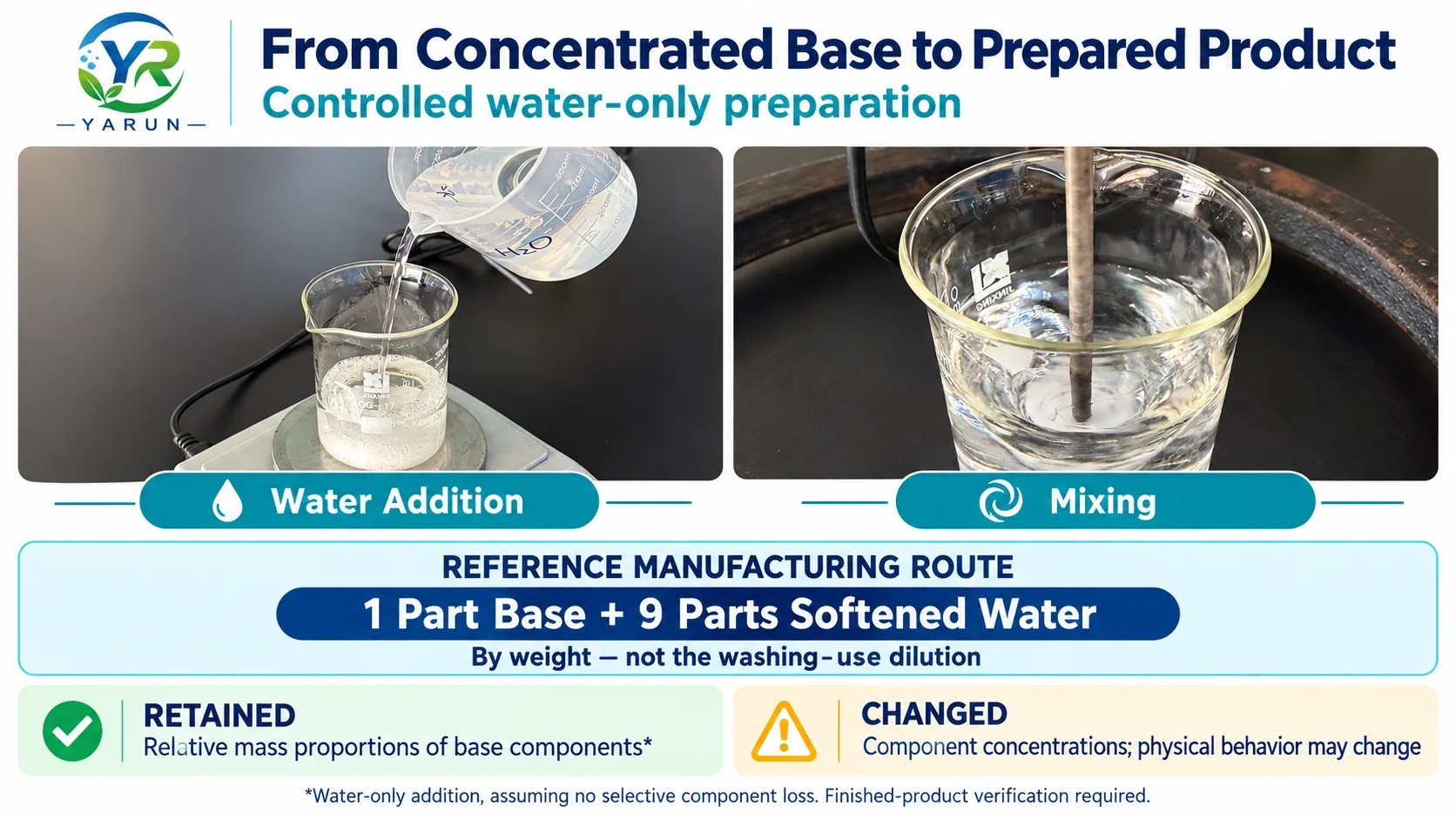
For the specified water input, weight ratio and reference batch output, review the product’s standard softened-water preparation route.
5. How Does the Prepared System Become a Car Wash Product?
The base carries the starting formulation balance into the prepared product. Its combined functions can then contribute to cleaning when the product is used under suitable conditions.
The surface-active system supports contact with soil and its removal. Solvent assistance contributes to the handling of certain oily materials, while metal-ion control helps manage interactions that could affect the system. Their practical contribution depends on the concentrations present during washing and the conditions in which they operate.
Manufacturing preparation and vehicle washing are therefore two separate stages. The first establishes the finished formulation. The second brings that formulation into contact with soil, potentially after further dosing or dilution.
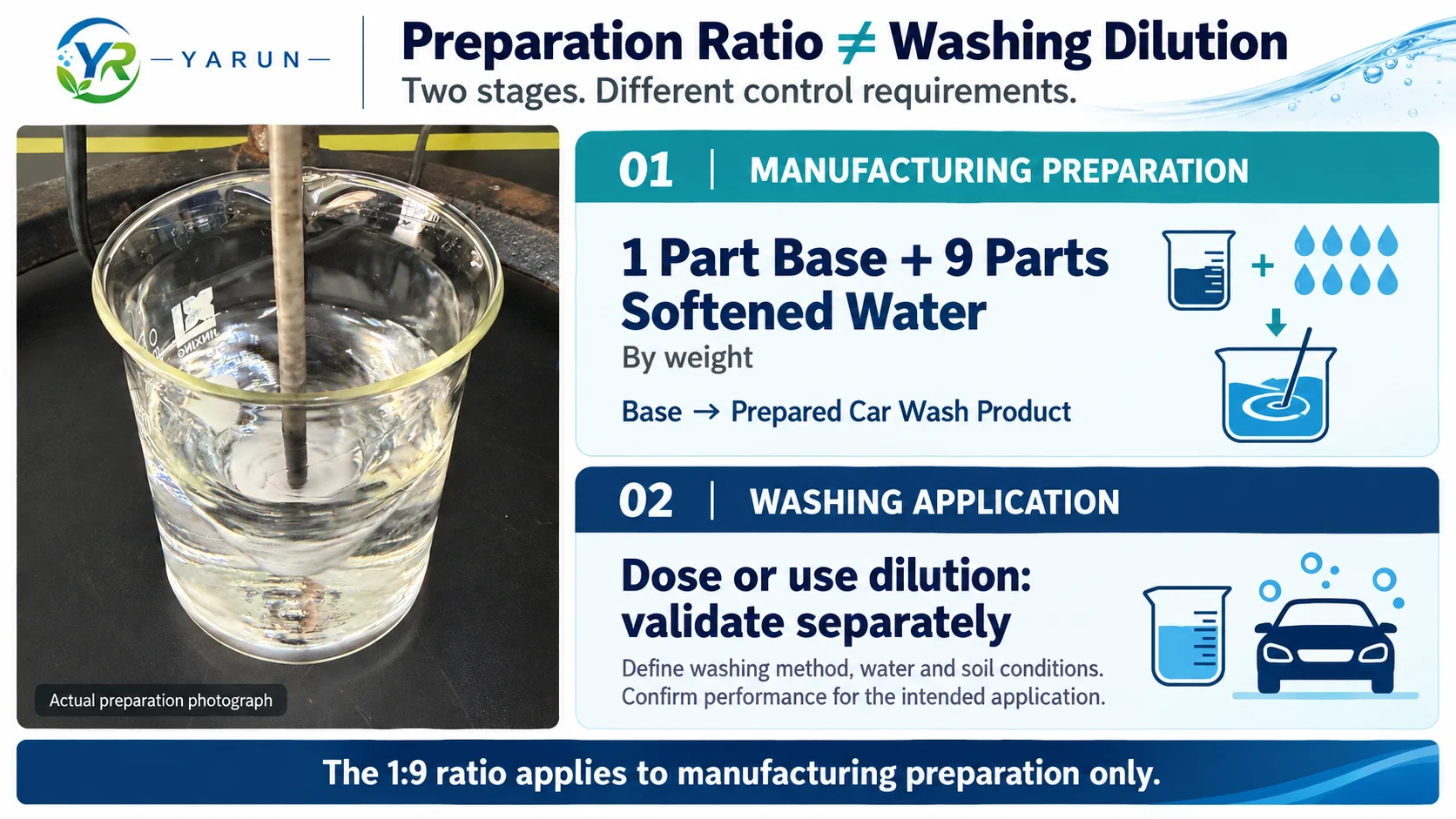
This distinction explains why the manufacturing ratio cannot also serve as a washing instruction. It also explains why a correctly prepared batch does not, by itself, establish suitability for every washing method or surface.
The base provides a defined formulation starting point and preparation route. Finished-product specifications and application evidence establish where that prepared system can be used effectively.
For the broader process of sample evaluation, pilot verification and batch approval, see How to Evaluate a Detergent Concentrate Base Before Commercial Production.
Frequently Asked Questions
1. Why is a formulated base more than several cleaning ingredients mixed together?
The components share the same liquid environment and influence one another. Surfactants can participate in mixed aggregates and interfacial layers, while supporting ingredients affect solubility and ionic conditions. The formulation therefore behaves as a system rather than as independent ingredients. This explains the need for controlled composition; it does not, by itself, prove a performance advantage over another formulation.
2. If dilution preserves ingredient proportions, why can product behavior change?
Water-only dilution preserves relative mass proportions, provided that no component is selectively lost. It changes absolute concentrations, however, which can alter molecular association, solubility and interactions within the liquid. Preserving the recipe balance therefore does not preserve viscosity, appearance or performance automatically. Those properties must be established at the intended finished concentration.
3. Why can a concentrate become temporarily harder to mix as water is added?
Some concentrated surfactant systems pass through compositions with higher viscosity during dilution. At the contact zone between water and base, these intermediate compositions can form before the batch becomes uniform. This is a possible explanation for mixing resistance, not a confirmed characteristic of every base. The actual cause should be investigated against the formulation, temperature, addition method and mixing conditions.
4. Why does metal-ion control not make softened water unnecessary?
Chelating agents bind metal ions within a finite capacity. Their effective binding also depends on pH and competition between different metals. Hardness introduced during preparation can use part of that capacity and affect formulation behavior. Softened water helps control this initial load; washing-water conditions remain a separate consideration. A chelating function is not evidence of unlimited hard-water tolerance.
5. Does a lower surface tension mean the base will produce a better cleaner?
Not necessarily. Surface tension describes the liquid–air interface, whereas washing involves additional interfaces between liquid, soil and the vehicle surface. Wetting rate, oil–water interfacial behavior, soil detachment, dispersion and rinsing also matter. A surface-tension result can characterize one aspect of a formulation, but cannot replace a cleaning test under defined conditions.
6. If the prepared product is clear and uniform, has the base worked as intended?
Clarity and uniformity provide useful observations, but do not establish long-term physical stability, preservation or cleaning performance. A clear product can change during storage, and a freshly uniform batch may not remain uniform at another temperature. Evidence should match the claim: storage observations for physical stability, microbiological evaluation for preservation, and application testing for cleaning.
7. How can manufacturers distinguish a preparation problem from a formulation limitation?
Compare the local batch with a reference preparation using the same base batch and controlled water, temperature and measurement methods. First check weighing, addition sequence, mixing and sampling. If those variables are controlled and the target remains unmet, investigate whether the formulation and preparation route fit the required specification. This comparison narrows the cause without immediately changing the recipe and losing the diagnostic baseline.
Conclusion
A car wash liquid base brings several formulation functions into a concentrated manufacturing input. Its working principle lies in how those functions interact within the supplied system and remain available after controlled preparation.
Water-only dilution preserves the relative mass balance of the supplied components, but changes their concentrations and physical environment. The preparation route therefore connects formulation design with finished-product production; it does not replace application testing.
For manufacturers, the useful purchasing question is whether the base, local preparation conditions and intended washing application form a workable combination. Concentration, preparation behavior, finished specifications and application results should be considered together.
Request a Car Wash Base Project Review
Planning to produce car wash liquid locally? Share your target market, intended washing application, expected monthly output, available mixing and filling equipment, local softened-water conditions, target specifications, packaging format and destination port.
These details provide the basis for reviewing product suitability, available technical documentation, sample evaluation requirements and commercial supply.