A business planning to manufacture liquid detergents locally may begin with a simple question:
What equipment and formula do we need?
That question is important, but it comes too early.
The more useful starting point is:
What type of finished product does the business intend to sell, which production responsibilities can it control, and which responsibilities should remain with an upstream supplier?
A household dishwashing liquid, a liquid laundry detergent, a multipurpose cleaner and an institutional degreaser do not have the same formulation, processing or finished-product requirements. However, the businesses producing them must address a common set of operational questions:
Who defines and controls the formula?
Which materials must be qualified and stored?
What water quality is required?
Which processing steps must be controlled?
What equipment functions are necessary?
How will each batch be tested and released?
Can a laboratory result be reproduced at production scale?
What is the cost of an accepted finished product—not merely the cost of the purchased inputs?
For small and medium-sized manufacturers, the objective is not to build the most technically complex factory. It is to establish a production route that the business can control, repeat and scale.
1. Define the Business Before Selecting the Formula
The production system should follow the commercial objective of the project.
Before selecting equipment, raw materials or a concentrate base, the manufacturer should define the intended product and market.
Target Application
Confirm whether the project is intended for:
Household cleaning;
hand dishwashing;
liquid laundry;
general surface cleaning;
institutional or commercial cleaning;
food-service cleaning;
vehicle cleaning;
or another defined application.
“Liquid detergent” is a broad manufacturing category. A process suitable for one product should not automatically be treated as suitable for every other liquid cleaning product.
Target Customer
The product may be intended for:
Household consumers;
supermarkets;
wholesalers;
hotels;
restaurants;
contract-cleaning companies;
laundries;
institutions;
workshops;
or industrial users.
The target customer affects packaging, product positioning, use instructions, performance requirements and applicable market responsibilities.
Market Position
The manufacturer should define whether the intended product is:
Economy;
standard;
premium;
concentrated;
professional-use;
or another clearly described market position.
A higher active-matter level does not automatically create a premium product. Product positioning must be supported by the complete formulation, performance, packaging, customer experience and evidence.
Commercial Scale
The project should also define:
Expected monthly output;
batch size;
number of planned SKUs;
packaging sizes;
sales channels;
available working capital;
target finished-product cost;
and required launch schedule.
Without this information, it is difficult to decide whether the business should purchase finished products, a concentrate base, a controlled premix or individual raw materials.
2. Select a Manufacturing Route That Matches the Business
Local detergent production does not require every company to follow the same route.
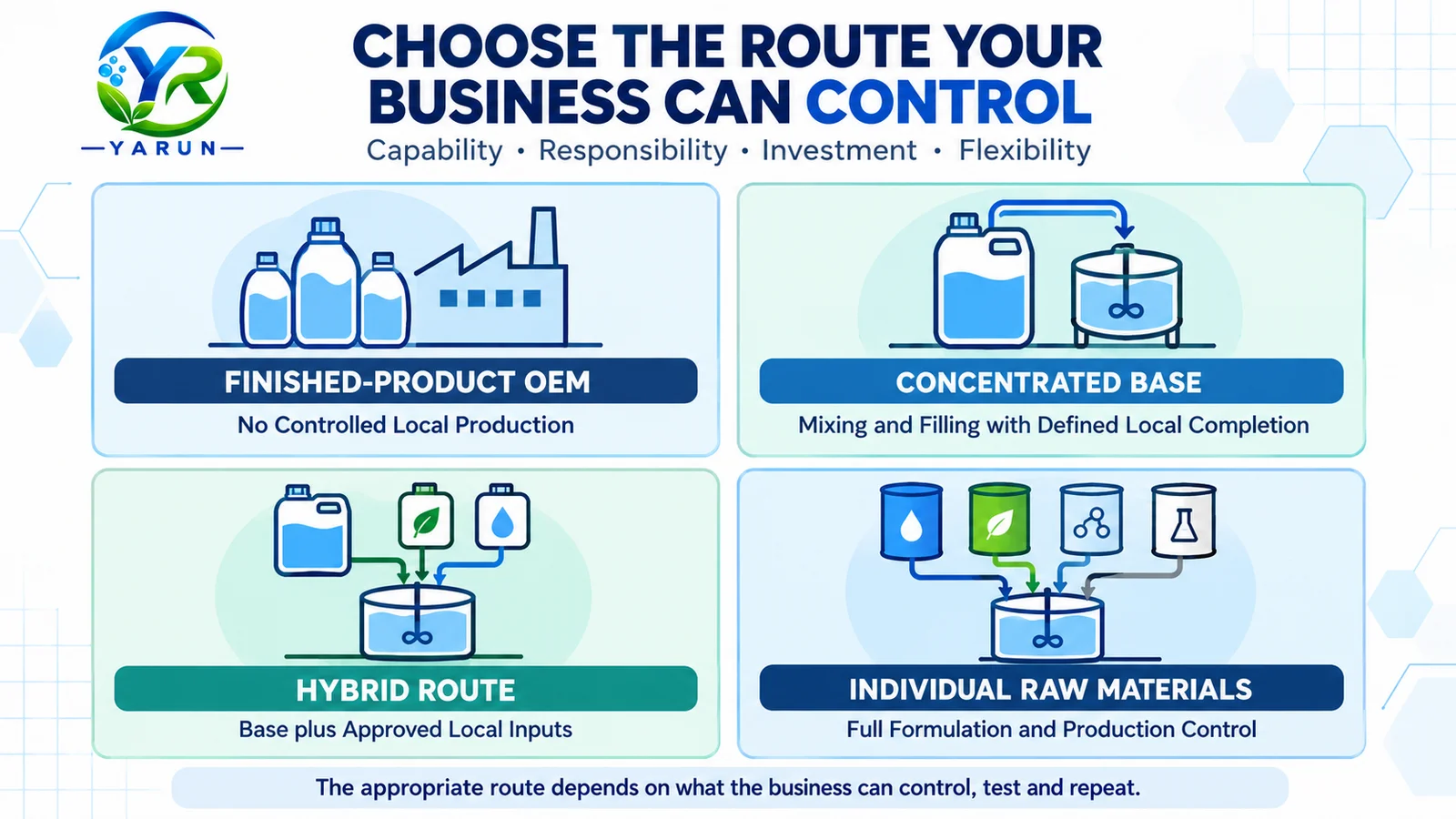
Four routes are commonly evaluated.
Route 1: Finished-Product OEM or Private Label
Under this route, the product is manufactured and normally filled by an external producer.
It may be appropriate when a company:
Does not have controlled mixing or filling equipment;
wants to test a market before investing in production;
requires a complete finished product;
or does not yet have production and quality-control personnel.
The buyer still needs to confirm the finished-product specification, packaging, documentation, applicable market requirements and commercial terms.
Route 2: Concentrated Base
A concentrate base is a partially completed formulation intended for controlled local completion.
Depending on the specific product, local work may include:
Adding a defined quantity of approved water;
controlled mixing;
adding an approved fragrance or color;
making a permitted pH or viscosity adjustment;
testing the completed product;
filling;
and applying batch identification.
A base may reduce part of the formulation and inventory workload. It does not remove the need for production control or finished-product release.
Route 3: Hybrid Production
A hybrid route may combine:
An imported concentrate base;
controlled local water;
approved local fragrance or color;
defined locally sourced supporting materials;
and local packaging.
Every locally sourced material should have a specification, an approved addition level, a controlled procedure and an appropriate compatibility assessment.
Hybrid production does not mean uncontrolled modification.
Route 4: Individual Raw Materials
Under this route, the manufacturer purchases the ingredients separately and controls the complete formulation.
This may provide greater formula flexibility, but it also requires stronger capabilities in:
Raw-material qualification;
formulation;
active-matter calculation;
neutralization where applicable;
preservation;
compatibility;
process development;
stability;
troubleshooting;
and inventory management.
Companies that have not selected a route can review the detailed comparison in:
The product application in that comparison is hand dishwashing liquid, but the responsibility-allocation principles are relevant to other local liquid-detergent projects.
3. Build the Minimum Production Functions
Manufacturers often ask for a list of machines. A more reliable approach is to define the functions the production system must perform.
Equipment selection should then reflect the formula, viscosity, batch size, process, available space, cleaning requirements and planned output.
Water Preparation
The production system should provide water that meets the requirements of the confirmed formulation.
The appropriate treatment depends on:
Local water source;
mineral content;
microbiological condition;
formula sensitivity;
and finished-product specification.
Accurate Weighing and Dosing
The factory should be able to measure:
Concentrate base;
water;
raw materials;
fragrance;
color;
pH-adjustment materials;
viscosity-adjustment materials;
and other approved additions.
The required accuracy depends on the material and the formulation. A weighing system suitable for water may not be suitable for a low-dosage ingredient.
Controlled Mixing
The mixing vessel and agitator should be selected according to:
Batch size;
expected viscosity;
material density;
required circulation;
foam sensitivity;
addition method;
and cleaning requirements.
High-shear equipment is not automatically required for every liquid detergent. Similarly, a simple mixer should not be assumed to be adequate for every formulation.
Transfer and Filling
The transfer and filling system should be compatible with:
Product viscosity;
foam behavior;
packaging size;
filling accuracy;
cleaning procedure;
and production output.
Excessive agitation or unsuitable pumping may introduce air, increase foam or change the condition of the product before filling.
Quality-Control Capability
A basic production operation may need the ability to evaluate:
Appearance;
odor;
pH;
viscosity under a defined method;
density where relevant;
batch uniformity;
and other project-specific release parameters.
More advanced testing may be performed internally or through an approved external laboratory, depending on the product and market.
Storage and Traceability
The facility should be able to identify and separate:
Incoming materials;
approved materials;
quarantined materials;
rejected materials;
work in progress;
released finished products;
and retained samples.
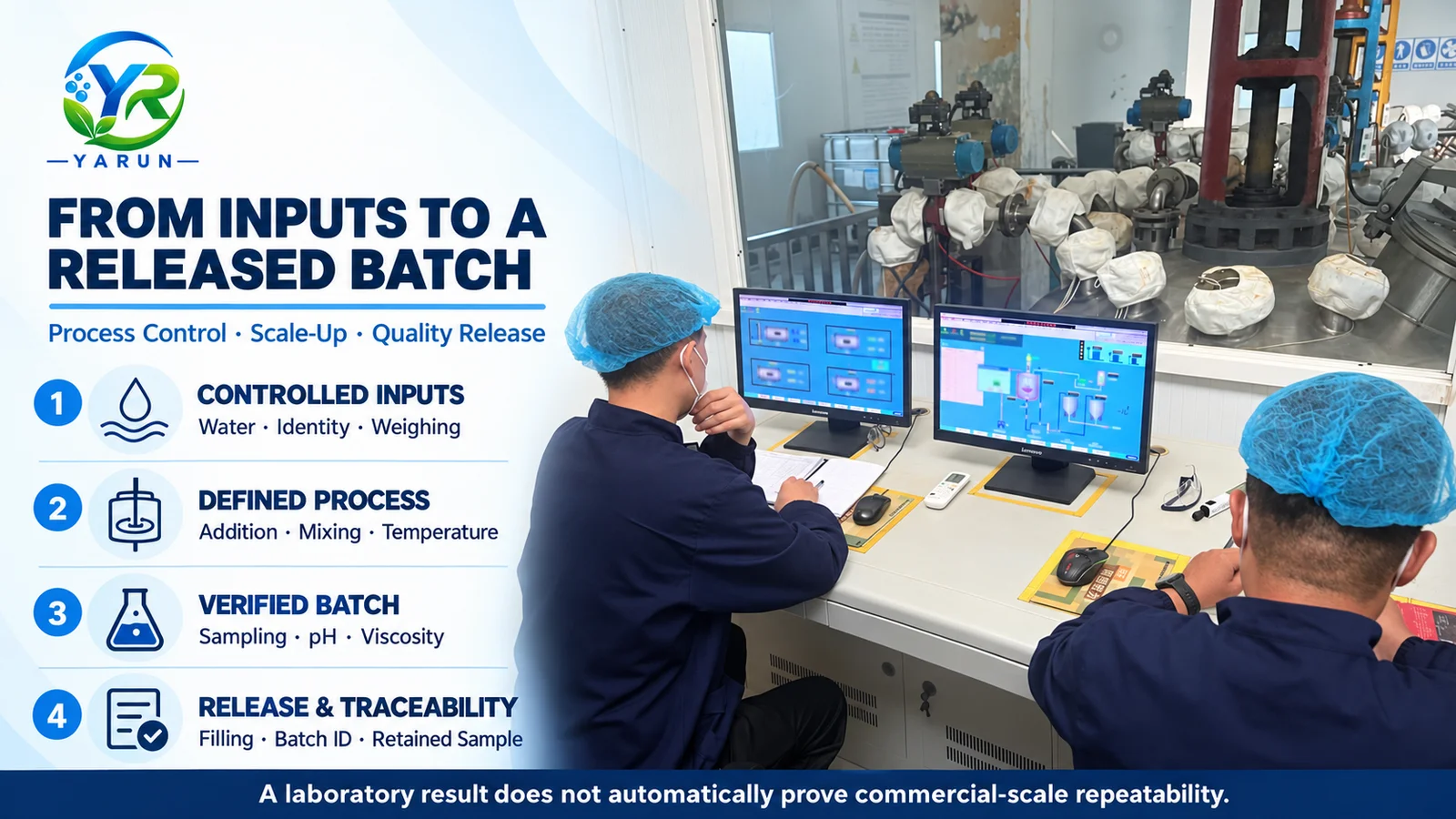
The minimum production system is therefore more than a mixing tank. It is a controlled path from incoming material to released finished product.
4. Treat Production Water as a Raw Material
Water may be the largest component of many locally completed liquid detergents, but it is sometimes treated as if it has no specification.
That can create avoidable production problems.
Depending on the formulation, water quality may influence:
Appearance;
clarity;
viscosity;
electrolyte response;
fragrance compatibility;
color stability;
preservation;
storage stability;
and batch consistency.
Manufacturers should identify:
Water source;
treatment process;
storage condition;
relevant hardness or conductivity information;
microbiological controls where applicable;
and the frequency of water verification.
A supplier should not assume that water used during laboratory development is identical to water available in the buyer’s factory.
Before approving a concentrate base, both parties should establish whether:
The buyer’s water has been evaluated;
a defined water specification is required;
a trial can be completed using representative local water;
and a change of water source requires re-evaluation.
“Just add water” is not a sufficient production instruction unless the required water and process conditions have been defined.
5. Control the Process, Not Only the Formula
A formula describes what is present. A manufacturing procedure explains how the materials are converted into a repeatable batch.
Two factories using nominally similar materials may obtain different results because of differences in:
Addition sequence;
addition rate;
mixing intensity;
mixing time;
batch temperature;
holding time;
local concentration;
air entrainment;
equipment geometry;
and adjustment procedure.
A controlled process normally includes the following stages.
Stage 1: Production Preparation
Before production begins, confirm:
Approved formula or completion instruction;
correct material identity;
material batch numbers;
available quantities;
equipment cleanliness;
scale or dosing-device status;
packaging availability;
and batch documentation.
Stage 2: Charging and Addition
Water, concentrate base and other approved materials should be added according to the defined procedure.
Changing the order of addition may affect:
Dispersion;
neutralization;
clarity;
foam;
viscosity;
and processing time.
The approved order should not be changed simply to make production appear faster.
Stage 3: Mixing
Mixing should be sufficient to establish uniformity without creating unnecessary foam, air or excessive mechanical stress.
The operator should know:
When mixing starts;
which speed or operating condition applies;
how additions are introduced;
how long each stage continues;
and how batch uniformity is evaluated.
Stage 4: Controlled Adjustment
Any pH, viscosity, fragrance or color adjustment should follow an approved method.
The procedure should define:
Permitted adjustment material;
addition range;
addition rate;
mixing after addition;
test method;
equilibration time;
and escalation procedure if the batch remains outside specification.
Repeated uncontrolled correction can move the formulation away from its validated condition.
Stage 5: Equilibration, Sampling and Release
Some liquid detergent systems require time for:
Air to escape;
micellar structure to equilibrate;
viscosity to stabilize;
fragrance to disperse;
or temperature to return to the defined test condition.
Sampling immediately after mixing may not represent the condition used for final release.
The batch record should define when and where the sample is taken.
6. Understand Why Scale-Up Changes the Result
A successful laboratory sample is evidence that a formulation may be workable under those laboratory conditions.
It is not proof that the same result will automatically be achieved in a larger vessel.
When batch size increases, several factors may change:
Vessel dimensions;
liquid depth;
impeller diameter;
impeller position;
circulation pattern;
power input;
addition rate;
heat transfer;
mixing time;
surface-air contact;
foam generation;
and sampling position.
This can create practical differences.
Excessive Foam
A larger mixer may pull more air into a surfactant system. The product may appear less dense, become difficult to fill or require a longer deaeration period.
Incomplete Uniformity
A batch may look uniform at the surface while the material near the bottom, wall or addition point remains different.
Different Viscosity
Viscosity may change because of:
Temperature;
electrolyte distribution;
fragrance;
mixing history;
active ratio;
water quality;
or insufficient equilibration.
Salt or another electrolyte may increase viscosity within a useful region and then reduce it after the system passes that region. It should not be treated as a universal linear thickener.
Delayed Change
A product may meet an immediate viscosity reading but change after standing. The testing procedure should therefore define temperature, instrument, spindle or measurement system where relevant, speed, sample condition and timing.
A pilot batch should compare laboratory and production results under defined conditions. Any important difference should be investigated before routine commercial manufacture.
7. Establish a Practical Quality-Control System
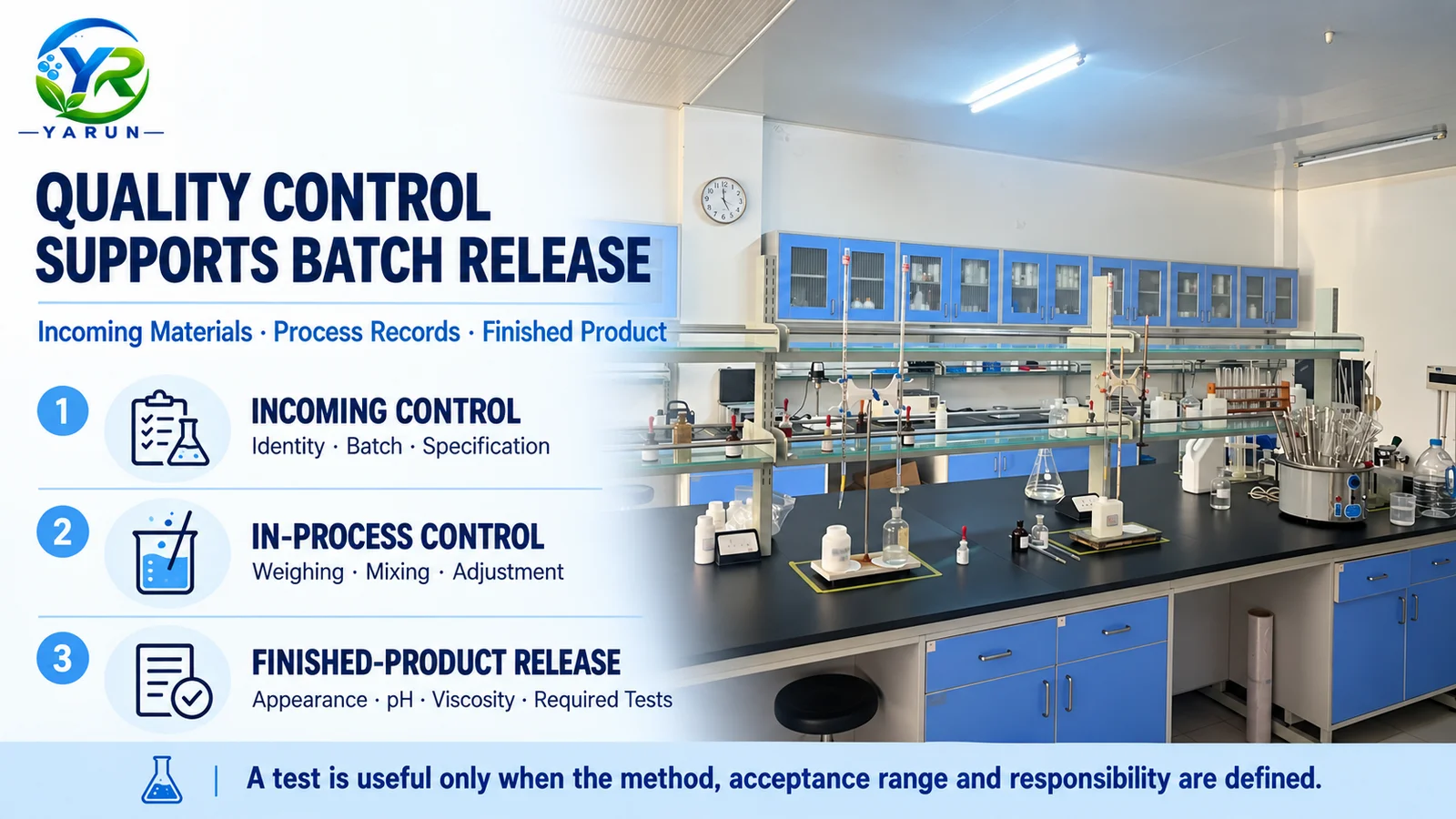
Quality control should be linked to decisions.
A test is useful when the business knows:
What is being measured;
why it matters;
which method is used;
what range is acceptable;
who approves the result;
and what happens when the result is outside the range.
Incoming-Material Control
Depending on the project, incoming review may include:
Supplier;
product name;
batch number;
packaging condition;
appearance;
odor;
relevant specification;
COA;
and storage requirements.
A supplier document should be compared with the agreed purchase specification. It should not be accepted only because it is titled “COA.”
In-Process Control
The production record may include:
Actual quantities;
addition sequence;
start and completion time;
relevant temperature;
mixing condition;
intermediate appearance;
pH where applicable;
adjustment quantities;
and deviations.
Finished-Product Release
The release specification may include:
Appearance;
color;
odor;
uniformity;
pH and test method;
viscosity and test method;
density where relevant;
active matter where required;
cleaning performance under a defined method;
foam performance under a defined method;
relevant stability;
packaging compatibility;
and microbiological or preservative verification where applicable.
ISO 4198 provides guidance for comparative evaluation of hand dishwashing detergents and identifies the importance of washing conditions, soils and performance characteristics.
ASTM D8549 addresses cleaning-performance testing for light-duty hand dishwashing detergents. ASTM D4009 addresses foam-stability evaluation in the presence of test food soils.
These references reinforce an important principle:
Cleaning or foam results are meaningful only when the test conditions are defined.
They do not establish one universal formula, one universal active-matter level or one pass/fail specification for every market.
Manufacturers developing hand dishwashing products can review:
Liquid Hand Dishwashing Detergent Formulation: Surfactant Selection, Foam, Viscosity and Scale-Up
8. Calculate Commercial Value on Accepted Finished Output
The purchase price of a concentrate base or raw material is only one part of the commercial calculation.
A more useful cost model is:
Finished-product cost per kilogram = Total qualified production cost ÷ Accepted finished-product output
The total qualified production cost may include:
Concentrate base or raw materials;
international freight;
duties and clearance;
local transport;
water treatment;
approved local additions;
labor;
energy;
quality control;
filling;
packaging;
production loss;
rework;
rejected batches;
inventory financing;
and slow-moving materials.
The output figure should represent accepted finished product—not theoretical output before loss, rework or rejection.
Why Dilution Ratio Alone Is Not Enough
A higher stated dilution ratio may appear commercially attractive, but the buyer should also verify:
The meaning of the ratio;
total finished-product mass;
theoretical finished active matter;
required local materials;
production procedure;
final specification;
and whether the completed product meets the intended market position.
A concentrated input that produces an unsuitable or inconsistent finished product does not provide a low commercial cost.
Why Raw-Material Price Alone Is Not Enough
Individual raw materials may provide greater purchasing transparency and formulation control, but the business may also need to manage:
Multiple suppliers;
multiple MOQs;
separate specifications;
additional inventory;
formulation development;
preservation;
troubleshooting;
and unused stock.
The correct comparison is therefore between production routes delivering the same defined and accepted finished product.
9. How a Concentrate Base May Simplify Local Production
For an appropriate project, a concentrate base may provide a more standardized starting point.
Potential operational benefits may include:
Fewer purchased input materials;
fewer incoming material codes;
reduced formulation workload;
a defined local completion procedure;
local use of water and packaging;
simpler production training;
and a staged path toward broader manufacturing capability.
These benefits depend on the specific base, the supplier’s evidence and the buyer’s production conditions.
A professional base project should define:
Product Identity
Controlled product name;
specification;
active-matter or solids terminology;
representative batch COA;
SDS;
applicable TDS;
packaging;
storage;
and batch identification.
Completion Procedure
Quantity of base;
quantity and specification of water;
other permitted additions;
total finished-product mass;
order of addition;
mixing requirements;
relevant temperature conditions;
equilibration;
permitted adjustment;
and filling conditions.
Finished-Product Control
Approved finished-product specification;
test methods;
release requirements;
stability plan;
packaging compatibility;
retained samples;
and traceability.
Scale-Up Evidence
Laboratory trial;
representative-water evaluation;
pilot batch where applicable;
comparison between laboratory and pilot results;
and commercial-batch approval criteria.
A base should not be approved solely because a fresh sample looks clear, has a high viscosity or carries an attractive dilution claim.
10. Build a Production Platform, Not Only One Product
A small or medium-sized manufacturer may begin with one product, but the long-term business value often comes from building reusable production capability.
The reusable platform may include:
Water control;
weighing;
mixing;
transfer;
filling;
packaging;
pH and viscosity testing;
batch records;
retained samples;
and traceability.
Once these functions are established, the business may evaluate additional household or institutional cleaning categories.
Possible future categories may include:
Hand dishwashing liquids;
liquid laundry detergents;
multipurpose cleaners;
floor cleaners;
degreaser products;
and other defined cleaning applications.
However, equipment compatibility does not mean that one formula or one concentrate base is suitable for every product.
Each new category requires its own review of:
Application;
target user;
formulation;
production procedure;
performance;
packaging;
stability;
safety information;
and destination-market requirements.
The commercial objective is not to dilute one base into every possible product. It is to build a controlled manufacturing system that can evaluate and introduce additional products responsibly.
11. Information Required Before a Production Review
A useful project discussion requires more than a request for price.
Manufacturers, brand owners and distributors should prepare the following information.
Business Information
Target country;
business type;
target customers;
sales channel;
intended market position;
expected monthly output;
target packaging;
and project stage.
Product Information
Planned product;
household or institutional/commercial application;
expected product characteristics;
fragrance and color direction;
required customization;
and target finished-product cost where available.
Production Information
Available mixing equipment;
usable batch volume;
filling equipment;
water source;
water-treatment capability;
weighing capability;
available quality-control instruments;
technical personnel;
batch-record capability;
and current production problems.
Route Preference
Indicate whether the business is currently evaluating:
Finished-product OEM/private label;
a concentrate base;
a hybrid route;
individual raw materials;
or a capability and cost comparison before deciding.
This information makes it possible to determine whether the next step should be a business review, document review, controlled sample, laboratory trial, pilot batch or another form of project evaluation.
Assess Your Local Detergent Production Plan
YARUN is evaluating how small and medium-sized manufacturers plan local production of household and institutional liquid detergents.
If you are considering a concentrate base, individual raw materials, a hybrid route or finished-product OEM, share the following information:
Target country;
business type;
target customers;
planned product;
expected monthly output;
available mixing and filling equipment;
water source or treatment;
quality-control capability;
preferred route;
and main production concern.
Share Your Production Plan on WhatsApp
This assessment is intended to understand production requirements and buyer preferences. Product specifications, completion instructions, samples, pricing and commercial availability should be confirmed only after the applicable product-development and verification stages have been completed.
Frequently Asked Questions
1. Which production route is suitable if we have mixing and filling equipment but no formulation team?
A concentrate-base route may be appropriate for initial evaluation because part of the formulation work may already be completed upstream.
However, the factory still needs controlled water, accurate weighing, an approved completion procedure, basic finished-product testing, filling control and batch records.
The decision should also consider the intended product, monthly output, customization needs and available quality-control capability. A base should not be selected only because it appears easier to dilute.
2. Can one detergent concentrate base be used to make several different finished products?
Not automatically.
A base developed for one application should not be treated as a universal base for dishwashing liquid, laundry detergent, floor cleaner and degreaser.
Different applications may require different surfactant systems, pH conditions, solvents, builders, foam profiles, fragrance systems, preservation, packaging and performance tests.
Any additional application should be reviewed and validated separately.
3. Does a ready-to-dilute base only require water?
That depends on the specific base.
Some systems may be designed for controlled water addition. Others may require approved fragrance, color, viscosity adjustment or additional processing.
The supplier should state:
How much water is added;
what water specification applies;
whether the ratio is based on mass or volume;
what other materials are permitted;
what total finished-product mass is produced;
and which final tests are required.
“Add water” without these details is not a complete manufacturing instruction.
4. What is the minimum equipment needed to start local liquid-detergent production?
There is no universal equipment list.
At minimum, the business should evaluate whether it can provide:
Suitable water;
accurate weighing;
controlled mixing;
safe material transfer;
filling;
basic quality testing;
batch identification;
storage;
and production records.
The actual equipment depends on product type, batch size, viscosity, process, foam sensitivity, packaging and output. Expensive automation is not always necessary, but uncontrolled manual production is not an adequate substitute for defined process control.
5. Why can a laboratory sample work while the production batch fails?
Scale-up changes vessel geometry, circulation, mixing energy, addition rate, heat transfer, air entrainment, batch time and sampling conditions.
These differences may affect:
Uniformity;
foam;
viscosity;
clarity;
processing time;
and final test results.
A larger batch should therefore follow a controlled pilot or scale-up program. Multiplying every ingredient by the same number does not, by itself, reproduce the laboratory process.
6. How should we compare the cost of a concentrate base with individual raw materials?
Compare both routes on the cost per kilogram of accepted finished product.
Include:
Landed input cost;
local additions;
water treatment;
labor;
energy;
testing;
packaging;
inventory;
loss;
rework;
and rejected batches.
A base may have a higher price per delivered kilogram but reduce the number of purchased materials and part of the formulation workload. Individual raw materials may have a lower theoretical material cost but require more technical control and inventory.
Neither route is automatically cheaper.
7. What evidence should we request before approving a concentrate base for commercial production?
Request or establish:
Controlled specification;
representative batch COA;
SDS;
applicable TDS;
unambiguous completion instruction;
required water specification;
processing conditions;
permitted local adjustments;
finished-product specification;
test methods;
stability plan;
packaging compatibility;
laboratory and pilot records where applicable;
batch-release requirements;
and traceability.
A fresh sample, dilution claim or laboratory result is not sufficient evidence for routine commercial production.
Conclusion
Small and medium-sized manufacturers do not need to begin with the most complex equipment or the largest possible raw-material portfolio.
They do need to define:
The market they intend to serve;
the product they intend to make;
the responsibilities they can control;
the responsibilities expected from the supplier;
the process required to complete the product;
and the evidence required to release each batch.
A concentrate base may simplify part of the local manufacturing route by reducing input complexity and providing a more standardized starting system.
Its value does not come from concentration or dilution ratio alone.
Its value depends on whether the production route can be clearly understood, commercially justified, controlled under local conditions, verified through appropriate testing and repeated at the intended scale.
The objective is not simply to make liquid detergent.
It is to establish a production system capable of releasing consistent, traceable and commercially appropriate finished products.