A commercial hand dishwashing liquid should not be designed by copying a fixed formula from another factory.
Two products can contain similar surfactant names and still behave differently because of differences in:
- surfactant active matter;
- surfactant ratio;
- water quality;
- electrolyte concentration;
- pH;
- fragrance and solvents;
- other functional additives;
- mixing sequence;
- process temperature;
- production equipment;
- finished-product positioning;
- consumer-use conditions.
This is why questions such as:
“How much SLES should I add?”
or:
“How much salt is required to reach the correct viscosity?”
cannot be answered reliably without defining the complete formulation system.
For manufacturers comparing several surfactant families, YARUN’s detergent surfactant selection guide provides the broader comparison between SLES, LABSA, AOS, SLS, CAPB and CDEA.
This article focuses on a narrower commercial question:
How should a manufacturer develop and validate a liquid hand dishwashing detergent system?
The objective is not to provide one universal recipe. It is to establish a repeatable decision and testing process that connects raw-material selection with finished-product performance and commercial production.
1. Start With the Finished-Product Brief
Raw-material selection should begin with the finished product—not with the raw material a supplier happens to offer.
Before deciding whether the main surfactant system should use SLES, neutralized LABSA, CAPB, CDEA, AOS or another compatible component, define the intended product.
A useful project brief should include:
| Decision area | Questions to define |
|---|---|
| Market position | Economy, mainstream or premium? |
| Target market | Which country or region will the product be sold in? |
| Main use | Household hand dishwashing, institutional use or another manual-cleaning application? |
| Cleaning target | What type and level of oily soil must be removed? |
| Foam profile | High initial foam, longer foam persistence or another consumer expectation? |
| Appearance | Clear, translucent, colored or opaque? |
| Viscosity | What filling, pouring and consumer-use behavior is required? |
| Water | Purified process water, softened water or local tap water? |
| Fragrance | What fragrance type and loading direction is planned? |
| Packaging | Bottle, pouch, refill or bulk format? |
| Cost | What is the target finished-product cost? |
| Production | What tank, agitator, heating/cooling and dosing capability is available? |
Only after this brief is defined should the surfactant system be selected.
A formula designed for the lowest possible cost may require different decisions from a premium product designed for a particular foam, clarity or sensory profile.
2. Build a Surfactant System, Not a List of Ingredients
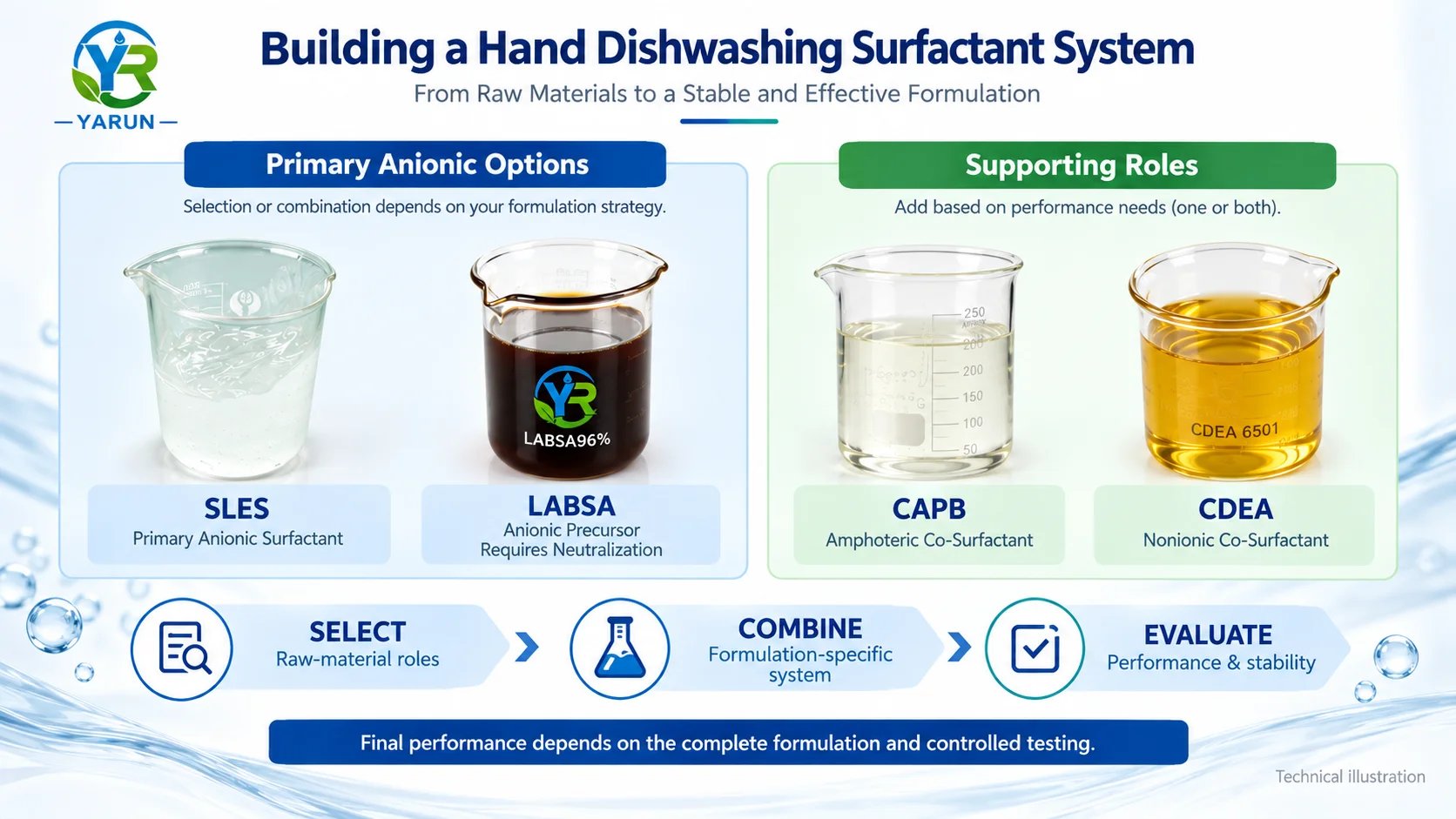
A hand dishwashing formulation normally performs through a surfactant system, rather than through one ingredient acting independently.
The system can include different functional roles:
Primary surfactant
Provides a substantial part of the detergency and interfacial activity.
Secondary or co-surfactant
May modify foam, rheology, compatibility or other formulation characteristics.
Supporting ingredients
May control:
- water hardness;
- pH;
- viscosity;
- fragrance solubilization;
- preservation;
- appearance;
- product stability;
- processing.
This distinction matters because raw materials should not be compared only by purchase price per kilogram.
A primary surfactant and a co-surfactant may provide fundamentally different commercial functions.
Likewise, adding more total surfactant does not automatically produce a better dishwashing liquid.
The correct objective is:
the required cleaning, foam, viscosity, stability and rinsing behavior at an acceptable finished-product cost.
3. SLES as a Primary Surfactant Platform
Sodium Laureth Sulfate (SLES) is widely considered when developing liquid cleaning systems because it combines anionic surfactant activity with practical use in aqueous formulations.
In a hand dishwashing project, SLES can be evaluated for:
- detergency contribution;
- grease-removal performance within the complete formulation;
- initial foam;
- foam under soil load;
- compatibility with co-surfactants;
- viscosity response;
- clarity;
- processing behavior;
- cost per unit of usable active matter.
However, SLES should not be evaluated in isolation.
Its viscosity response can change when the formulation changes in:
- total active matter;
- electrolyte level;
- CAPB or other co-surfactants;
- fragrance;
- solvents;
- pH;
- temperature;
- water composition.
Adding more electrolyte does not guarantee continuously increasing viscosity.
For a deeper explanation of micelle formation and formulation-specific salt response, see YARUN’s SLES 70% mechanism and salt-curve guide.
Current commercial specifications and supply information should be checked separately on the YARUN SLES 70% product page.
4. When LABSA Makes Commercial Sense
LABSA can be commercially attractive in detergent manufacturing, particularly when detergency economics are important.
But LABSA is not a ready-to-use neutral surfactant.
It is an acidic raw material that must be neutralized to form the corresponding surfactant salt used in the finished detergent system.
Therefore, evaluating LABSA requires more than comparing its purchase price with SLES.
The manufacturer must consider:
- active matter;
- neutralizing agent;
- calculated neutralization requirement;
- raw-material analytical basis;
- addition sequence;
- mixing;
- heat generation during neutralization;
- pH control;
- resulting electrolyte contribution;
- color;
- odor;
- process time;
- equipment capability;
- final formulation stability.
A plant that can control neutralization consistently may reach a different commercial conclusion from a plant that wants a simpler liquid-processing route.
For this reason:
LABSA price per kilogram is not the same as final surfactant-system cost.
The relevant calculation includes the neutralization process and the effect of the resulting system on the finished product.
YARUN’s LABSA 96% neutralization and formulation-cost guide explains this decision in more detail.
Current supply specifications should be confirmed on the YARUN LABSA 96% product page.
5. CAPB and CDEA Do Not Perform the Same Role
CAPB and CDEA are sometimes both described too simply as “foam boosters” or “thickeners.”
That description is not sufficient for formulation decisions.
CAPB
Cocamidopropyl Betaine is an amphoteric surfactant commonly evaluated as a co-surfactant in mixed systems.
Depending on the complete formulation, CAPB can influence:
- foam character;
- foam stability;
- mixed-surfactant behavior;
- rheology;
- clarity;
- compatibility.
But the presence of CAPB alone does not prove that a finished dishwashing product is mild, non-irritating or suitable for sensitive skin.
Any skin-contact claim must be evaluated at finished-product level with appropriate evidence.
For the underlying charge, mixed-micelle, foam and viscosity behavior, see the CAPB 35% mechanism guide and the YARUN CAPB 35% product page.
CDEA
CDEA 6501 is a nonionic alkanolamide-type co-surfactant.
In compatible formulations it may support:
- foam stability;
- viscosity development;
- product body;
- surfactant-system performance.
CDEA should not be treated as a universal thickener.
A level that increases viscosity in one formulation may behave differently when the primary surfactant, electrolyte, pH, fragrance, temperature or active-matter level changes.
Regulatory and impurity requirements for diethanolamide-containing ingredients must also be reviewed according to the intended application and destination market.
See YARUN’s CDEA 6501 formulation mechanism guide and the YARUN CDEA 6501 product page for the current commercial route.
6. Where AOS May Enter the Evaluation
AOS is another anionic surfactant option that can be considered when a formulation team wants to evaluate a different foam or surfactant profile.
However, high-active AOS powder creates different processing requirements from liquid SLES or CAPB.
Before using a high-active powder in a liquid hand dishwashing formulation, the manufacturer should evaluate:
- wetting;
- dispersion;
- dissolution;
- addition sequence;
- water temperature under the defined process;
- agitation;
- residue;
- clarity;
- electrolyte interaction;
- foam under soil load;
- commercial-scale processing.
AOS should not simply replace SLES kilogram for kilogram.
Active matter and the complete formulation response must be recalculated and retested.
For projects considering this route, see YARUN’s AOS 92% dissolution and formulation guide and the YARUN AOS 92% product page.
7. Compare Active Matter Before Comparing Dosage
One of the most common procurement mistakes is comparing raw materials kilogram for kilogram without correcting for active matter.
A basic calculation is:
Active surfactant contribution = raw-material addition × active-matter fraction
This does not determine finished-product performance, but it provides a more useful starting point than comparing delivered kilograms alone.
For example, two raw materials can have very different:
- active-matter concentrations;
- water content;
- neutralization requirements;
- supporting functions;
- processing costs.
Therefore:
10 kg of one commercial surfactant cannot automatically be replaced by 10 kg of another.
The comparison should include:
- active contribution;
- surfactant function;
- formulation response;
- process cost;
- stability;
- finished-product performance;
- delivered cost.
CAPB and CDEA require an additional consideration: their commercial value may come from supporting functions rather than simply maximizing primary detergent active matter.
8. Factory Water and Consumer-Use Water Are Different Questions
Water quality is often discussed too generally.
A manufacturer should separate:
Process water
The water used inside the factory to manufacture the dishwashing liquid.
Consumer-use water
The water in which the customer actually uses the product.
These can be very different.
A factory may use purified or softened water and still sell the product into a market where household water contains significant calcium, magnesium or dissolved salts.
Using purified process water can reduce one source of production variability, but it does not prove that the finished detergent will perform consistently in every consumer-use water condition.
Hardness and dissolved ions can alter the behavior of anionic surfactant systems and may influence:
- clarity;
- precipitation risk in some systems;
- foam;
- surfactant availability;
- cleaning performance;
- rinsing behavior.
Therefore, a development program should normally distinguish:
manufacturing-water stability from in-use water performance.
If the target market has variable water conditions, representative local water or controlled hardness conditions should be included in performance testing.
9. Grease Removal and Foam Should Be Tested Separately
Foam is important in many hand dishwashing markets because consumers can use visible foam as part of their product experience.
But:
high foam is not direct proof of high cleaning performance.
A useful evaluation should distinguish between:
- initial foam;
- foam stability;
- foam under oily-soil load;
- cleaning performance;
- soil redeposition;
- rinsing;
- consumer-visible foam.
A formula can produce impressive foam in clean water and lose that foam rapidly when oil or food soil is introduced.
Another formula may generate less dramatic initial foam but maintain adequate performance under realistic dishwashing conditions.
Therefore, screening only with:
water + detergent + agitation
is not sufficient for commercial formulation selection.
A better comparison uses a defined soil or grease challenge under controlled conditions.
The test method should record:
- detergent dosage;
- water quantity;
- water quality;
- temperature;
- soil type;
- soil loading;
- agitation method;
- evaluation time.
The important question is not:
“Which sample produces the largest foam?”
It is:
“Which sample provides the required cleaning and foam profile under the intended use conditions?”
10. Viscosity Is a System Property
Dishwashing liquid viscosity strongly affects:
- filling;
- pumping;
- bottle dispensing;
- pouring;
- consumer perception;
- production consistency.
But viscosity should not be treated as a simple “add salt until thick” problem.
In surfactant systems, viscosity may respond to changes in:
- surfactant identity;
- surfactant ratio;
- total active matter;
- electrolyte concentration;
- pH;
- fragrance;
- solvents;
- temperature;
- other additives;
- mixing history.
SLES/CAPB-type mixed surfactant systems can show major rheological changes when composition changes, which is one reason a fixed salt dosage cannot be transferred safely from one formula to another.
A useful viscosity development study should therefore add electrolyte gradually under controlled conditions and record the response rather than jumping directly to a predetermined dosage.
It is equally important to define the measurement method.
“Viscosity = 2,000” has limited technical value without information such as:
- measurement temperature;
- instrument;
- spindle or geometry;
- speed or shear condition;
- sample conditioning time.
The commercial target should be defined using a repeatable measurement method.
11. Troubleshooting Common Dishwashing Liquid Problems
When a laboratory sample behaves incorrectly, changing several ingredients at once makes diagnosis difficult.
A more useful approach is to identify the likely variables and test them systematically.
| Problem | Avoid assuming | Check first |
|---|---|---|
| Product is too thin | “It only needs more salt.” | Active matter, surfactant ratio, electrolyte response, temperature, fragrance |
| Product becomes too thick | “Adding water will solve everything.” | Electrolyte level, surfactant structure, temperature, batch sequence |
| Product turns hazy | “The surfactant is defective.” | Fragrance, electrolyte, pH, solubilization, water, compatibility |
| Sediment appears | “More mixing is always required.” | Dissolution, raw-material condition, water hardness, incompatibility |
| Foam collapses with grease | “Increase SLES immediately.” | Soil-load test, total surfactant system, dosage, water conditions |
| Viscosity changes after storage | “The fresh batch passed, so the formula is stable.” | Temperature, fragrance, electrolyte, formulation equilibrium |
| Batch-to-batch viscosity varies | “Operator error is the only cause.” | Raw-material specification, addition sequence, temperature, water and measurement method |
| Excessive aeration occurs | “Higher mixer speed is better.” | Feed location, agitation, vortex formation, mixing sequence |
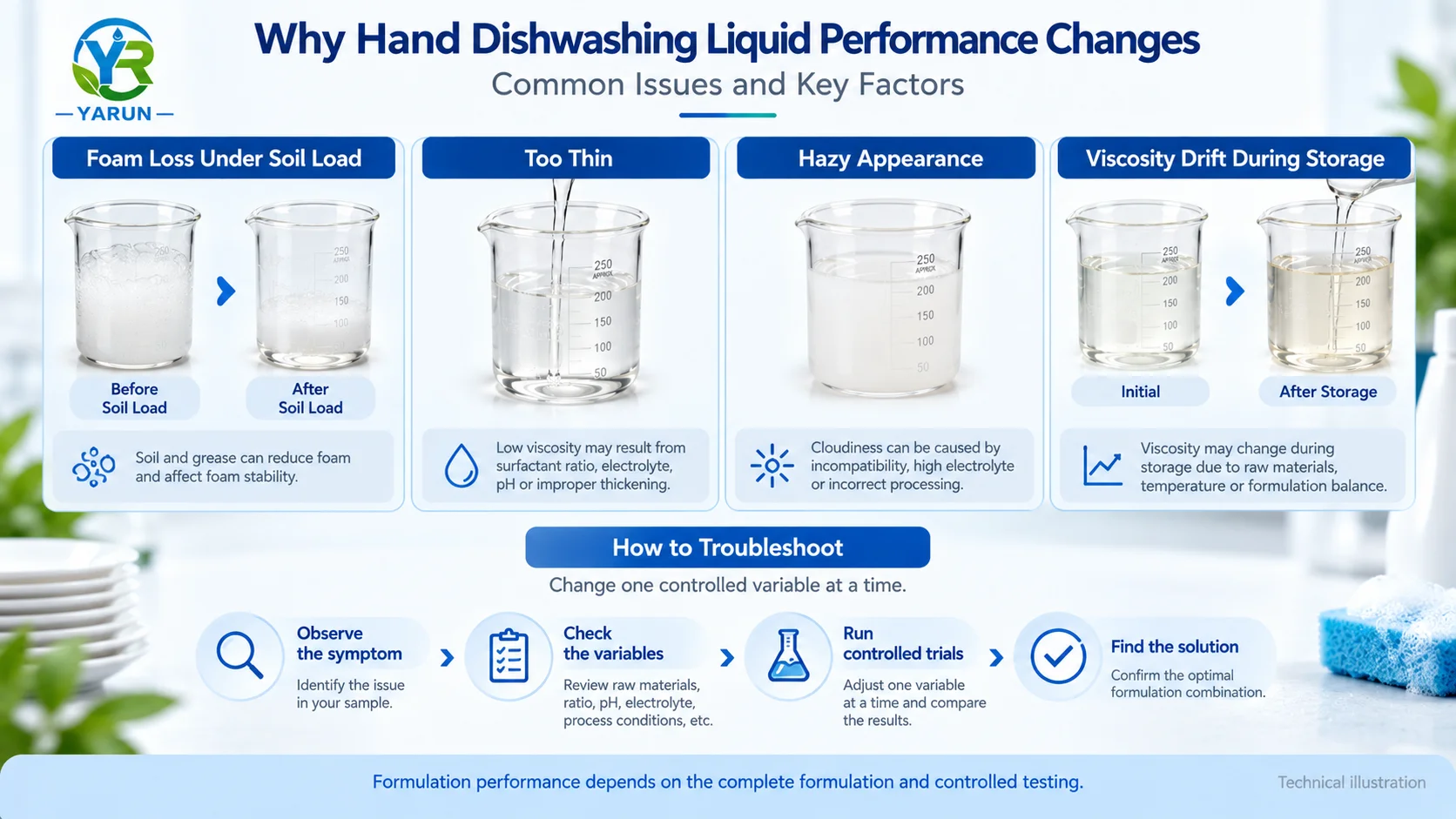
The objective of troubleshooting is to identify cause and effect, not to add more ingredients until the sample looks acceptable.
12. Fragrance, Color and Other Additives Are Part of the Formula
A base surfactant system should not be declared complete before the actual commercial additives have been tested.
Fragrance can influence:
- clarity;
- solubilization;
- viscosity;
- odor profile after storage.
Likewise, changes in:
- color system;
- preservative system;
- chelating strategy;
- pH adjustment;
- solvents;
- other functional additives;
can alter the final formulation.
This is why a clear, stable and correctly thickened base formula does not prove that the final fragranced product will behave the same way.
Commercial validation should use the intended final ingredient set.
13. Individual Raw Materials vs Concentrated Premix
Not every detergent manufacturer wants to purchase and dose each surfactant separately.
There are two different supply routes.
Route A — Individual Raw Materials
This route may suit manufacturers that have:
- internal formulation capability;
- raw-material storage;
- accurate weighing and dosing;
- controlled mixing;
- pH adjustment capability;
- quality-control procedures;
- sufficient production scale.
Advantages can include greater control over:
- formula structure;
- raw-material sourcing;
- active matter;
- cost optimization;
- product differentiation.
But the factory must manage more:
- raw-material SKUs;
- specifications;
- batch variability;
- dosing;
- process control;
- documentation.
Route B — Concentrated Premix
A concentrated premix may be considered when a manufacturer wants to reduce the number of separately handled raw materials or simplify local production.
However, a premix should not be defined only by:
“Add water at 1.”
Before a suitable concentrate can be evaluated, the project should define:
- premix active matter;
- intended dilution basis;
- required finished-product active matter;
- water source;
- target viscosity;
- foam requirement;
- grease-removal target;
- fragrance strategy;
- color;
- pH target;
- packaging;
- local production capability.
The concentrate itself must also be evaluated for practical handling, storage and dilution behavior.
A concentrate that is stable in transport but becomes difficult to dilute, or a concentrate that dilutes easily but cannot reach the required finished viscosity, may not be commercially suitable.
YARUN can discuss both individual detergent surfactant raw materials and a concentrated-premix route based on a defined project brief. Final composition, dilution conditions and finished-product performance must be confirmed through sample and production testing.
14. Design Controlled Formulation Trials
A useful formulation trial changes a limited number of variables.
Changing SLES, CAPB, CDEA, fragrance and salt simultaneously may produce a different viscosity—but it does not explain why.
A controlled trial should first define the reference formula and test conditions.
Keep constant where possible
- batch size;
- water source;
- water quantity;
- equipment;
- mixing method;
- ingredient sequence;
- test temperature;
- fragrance;
- pH measurement method;
- viscosity method;
- foam-test method;
- grease challenge.
Change one defined variable
Examples include:
- primary surfactant active contribution;
- primary/co-surfactant ratio;
- electrolyte level;
- CDEA level;
- CAPB level;
- fragrance loading;
- water hardness condition.
Record the result
Useful observations include:
- appearance;
- clarity;
- pH;
- viscosity;
- foam;
- foam under soil load;
- cleaning result;
- rinsing;
- odor;
- sediment;
- separation;
- storage behavior.
The best formulation is not necessarily the sample with the highest viscosity, strongest initial foam or largest amount of active matter.
It is the formulation that meets the complete product brief with acceptable cost and repeatability.
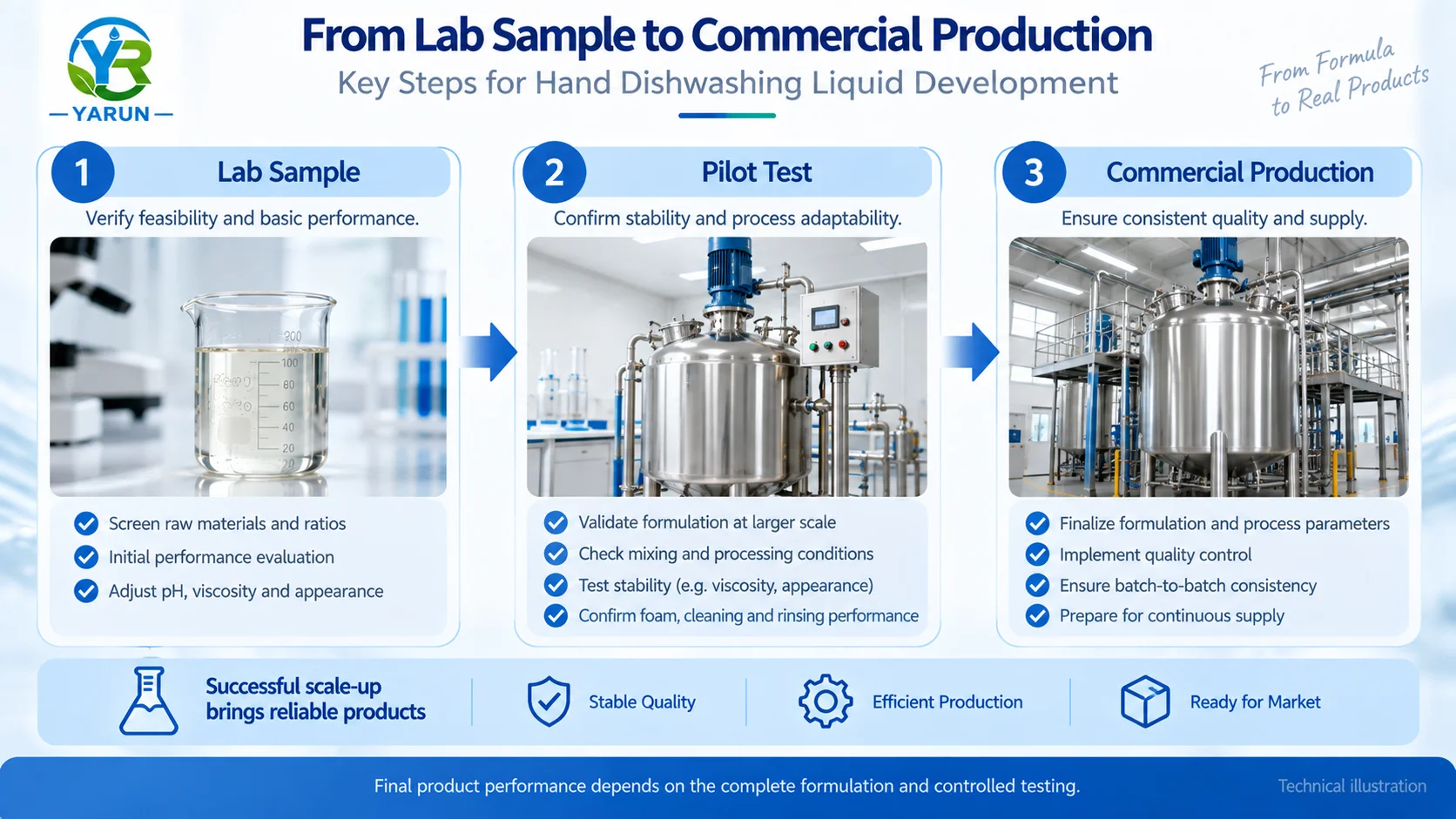
15. Laboratory Success Is Not Commercial-Batch Success
A small beaker test answers an important question:
Can the formulation concept work under these laboratory conditions?
It does not automatically answer:
Can the factory reproduce it at commercial scale?
Scale-up can change:
- mixing time;
- circulation;
- shear;
- localized concentration;
- heat transfer;
- neutralization control;
- aeration;
- dissolution;
- ingredient feed rate;
- fragrance incorporation.
A practical validation sequence is:
Controlled laboratory sample → Pilot or intermediate batch → Commercial validation
At each stage, compare the same critical parameters.
The formula should not be judged only immediately after mixing.
Where relevant, confirm:
- appearance after equilibration;
- viscosity;
- pH;
- fragrance stability;
- separation;
- sediment;
- storage response;
- performance after storage.
The commercial acceptance criteria should be agreed before full-scale production.
16. Raw-Material Purchasing Should Follow the Formulation Decision
After the surfactant system is selected, procurement should convert the successful formulation into controlled raw-material requirements.
For each critical surfactant, confirm:
- product name and grade;
- active matter or applicable solids specification;
- appearance;
- relevant chemical identity;
- pH or other applicable control parameters;
- packaging;
- batch COA requirements;
- SDS;
- TDS or specification;
- sample approval;
- order quantity;
- lead time;
- destination port.
Do not qualify a surfactant only because:
- the product name is the same;
- the CAS number is the same;
- active matter appears similar;
- the supplier offers a lower price.
Commercial surfactant grades can differ in impurity profile, salts, water content, appearance, physical form and processing behavior.
A replacement raw material should therefore be checked against the agreed specification and, where necessary, confirmed in the actual formulation.
YARUN’s current detergent surfactant raw-material range includes product routes for manufacturers evaluating SLES, LABSA, AOS, SLS, CAPB and CDEA.
17. Compare Commercial Cost at Finished-Product Level
Buying the cheapest surfactant does not necessarily produce the lowest-cost dishwashing liquid.
The commercial calculation may need to include:
- delivered raw-material price;
- active matter;
- neutralization chemicals;
- co-surfactants;
- electrolyte;
- process time;
- heating or cooling;
- mixing time;
- production loss;
- packaging;
- freight;
- final product yield;
- required consumer dosage.
For primary surfactants, cost per kilogram of active matter can be a useful screening calculation:
Delivered cost per kg active = delivered raw-material cost per kg ÷ active-matter fraction
But this is still not the final decision.
A co-surfactant that appears expensive on an active-matter basis may be commercially justified if it helps the finished formulation reach the required viscosity, foam profile or processing behavior.
The final comparison should therefore be:
cost of achieving the required finished-product specification, not simply cost per kilogram of raw material.
18. Information to Provide Before Requesting a Formulation or Raw-Material Review
A technically useful inquiry should contain more than:
“Please send your best price.”
For a hand dishwashing project, provide:
- Target country or market;
- Product positioning: economy, mainstream or premium;
- Existing formula, if available;
- Existing surfactants and their grades;
- Target active matter, if defined;
- Grease-removal requirement;
- Foam requirement;
- Target viscosity and measurement method, if defined;
- Process water type;
- Known consumer-use water conditions;
- Target pH, if already specified;
- Fragrance and color direction;
- Packaging format;
- Individual raw materials or concentrated premix requirement;
- Expected order quantity or monthly consumption;
- Destination port;
- Required documents such as SDS, TDS, specification or COA;
- Current formulation problem, if troubleshooting an existing product.
The more clearly the project is defined, the easier it becomes to distinguish between a raw-material issue, a formulation issue and a process issue.
YARUN Support for Hand Dishwashing Projects
For B2B detergent projects, YARUN can support discussions covering:
- detergent surfactant raw-material selection;
- current product-grade and specification review;
- individual raw-material requirements;
- concentrated-premix requirements based on a defined project brief;
- sample coordination;
- SDS, TDS, specification and available quality-document support;
- packaging options;
- quotation preparation;
- export supply planning.
Where formulation comparison is required, the target product, active matter, water, process conditions and performance requirements should be defined before sample evaluation.
Final finished-product specifications and performance should be confirmed through the customer’s controlled formulation, pilot and commercial validation.
Frequently Asked Questions
Is there one standard formula for liquid hand dishwashing detergent?
No.
Formulation depends on the target market, product positioning, surfactant system, active matter, water quality, foam profile, viscosity, fragrance, process capability and cost target.
A formulation that works for one factory or market should not automatically be copied into another.
Is SLES enough to make a complete dishwashing liquid?
SLES can provide an important primary surfactant function, but a commercial finished product may require additional ingredients for co-surfactant performance, viscosity, water management, pH, fragrance, preservation and other product requirements.
The complete system must be validated.
Is LABSA cheaper than SLES?
Purchase price alone cannot answer this.
LABSA requires neutralization and introduces additional process and formulation considerations. Compare the complete delivered and processing cost together with finished-product performance.
Can CAPB automatically make a dishwashing liquid mild?
No.
CAPB can influence mixed-surfactant behavior and may be used in formulations where skin-contact characteristics matter, but the presence of one raw material does not prove a finished-product mildness or irritation claim.
Such claims require appropriate finished-product evidence.
Is CDEA simply a thickener?
No.
CDEA can support viscosity and foam behavior in compatible systems, but its effect depends on the complete formulation. It should not be treated as a universal viscosity solution.
How much salt should be added to a dishwashing liquid?
There is no universal salt dosage.
Electrolyte response depends on the surfactant system, active matter, co-surfactants, fragrance, pH, temperature and other formulation variables.
Salt should be evaluated through a controlled formulation-specific study.
Does more foam mean stronger grease removal?
No.
Foam and detergency are related to the surfactant system but they are not the same measurement. A hand dishwashing formulation should be evaluated for both cleaning and foam behavior under representative soil conditions.
Does using purified water solve hard-water problems?
Purified process water can reduce manufacturing-water variability.
It does not prove how the product will perform when consumers use it in hard or variable local water. Consumer-use conditions should be considered separately.
Can a concentrated premix simply be diluted with water?
Only when the premix has been designed and validated for a defined dilution route.
The required active matter, water quality, viscosity, pH, fragrance, finished-product target and dilution process should be specified before selecting a concentrate.
Should a laboratory formula go directly into commercial production?
No.
A laboratory sample demonstrates feasibility under laboratory conditions. Production equipment can change mixing, heat transfer, aeration, dissolution and ingredient distribution.
Pilot or commercial-scale validation is required before routine production.
Conclusion
A reliable liquid hand dishwashing detergent is not created by finding one “best” surfactant or copying a fixed percentage formula.
The development sequence should be:
Define the finished-product brief → select the surfactant system → calculate active matter → evaluate water conditions → test cleaning and foam → develop viscosity → troubleshoot systematically → validate the final additives → scale up → control raw-material purchasing.
SLES, LABSA, AOS, CAPB and CDEA can each play different roles, but their value depends on how they behave in the complete formulation.
For commercial manufacturers, the most useful question is therefore not:
“What percentage should I use?”
It is:
“Which surfactant system can consistently achieve my required finished-product performance, process conditions and cost target?”
Request a Hand Dishwashing Formulation Review
If you are developing, reformulating or sourcing raw materials for a liquid hand dishwashing detergent, provide your target country, product positioning, surfactant requirements, active-matter target, water type, foam and viscosity requirements, packaging, expected quantity and destination port.
YARUN can review the project requirements and discuss suitable individual raw-material or concentrated-premix supply routes.
Request a Hand Dishwashing Formulation Review