By the R&D Team at Hebei Yarun Daily Chemical Co., Ltd.
A dishwashing liquid manufacturing base provides a formulated starting system for local production. The buyer completes the product through a defined combination of water, applicable local additions, mixing, adjustment and finished-product checks.
For a suitable manufacturer, a base can reduce separate ingredient sourcing and starting-formulation work while leaving selected fragrance, color and packaging decisions local.
The important questions are how the cleaning system works, what changes during preparation, which choices remain local, and what evidence supports a purchasing decision.
This guide addresses bases for hand dishwashing liquid. It does not describe automatic dishwasher detergents or household dilution of a ready-to-use product.
1. What Is a Dishwashing Liquid Manufacturing Base?
A manufacturing base is a formulated intermediate intended for further preparation into finished dishwashing liquid.
It differs from a single surfactant raw material and from a concentrated finished detergent.
| Product type | What it provides | What remains for the buyer |
|---|---|---|
| Individual surfactant raw material | A formulation ingredient, such as a commercial surfactant grade | Develop and control the complete formulation and process |
| Dishwashing liquid manufacturing base | A combined formulation starting point | Complete preparation, applicable customization, testing and filling |
| Concentrated finished detergent | A product formulated for its stated end use | Follow its use instructions, including dosing or use dilution where specified |
The terms base, premix and concentrate do not define an identical degree of completion across suppliers. The product specification and preparation information should establish what is supplied and what must be added locally.
2. How Does the Surfactant System Help Remove Grease?
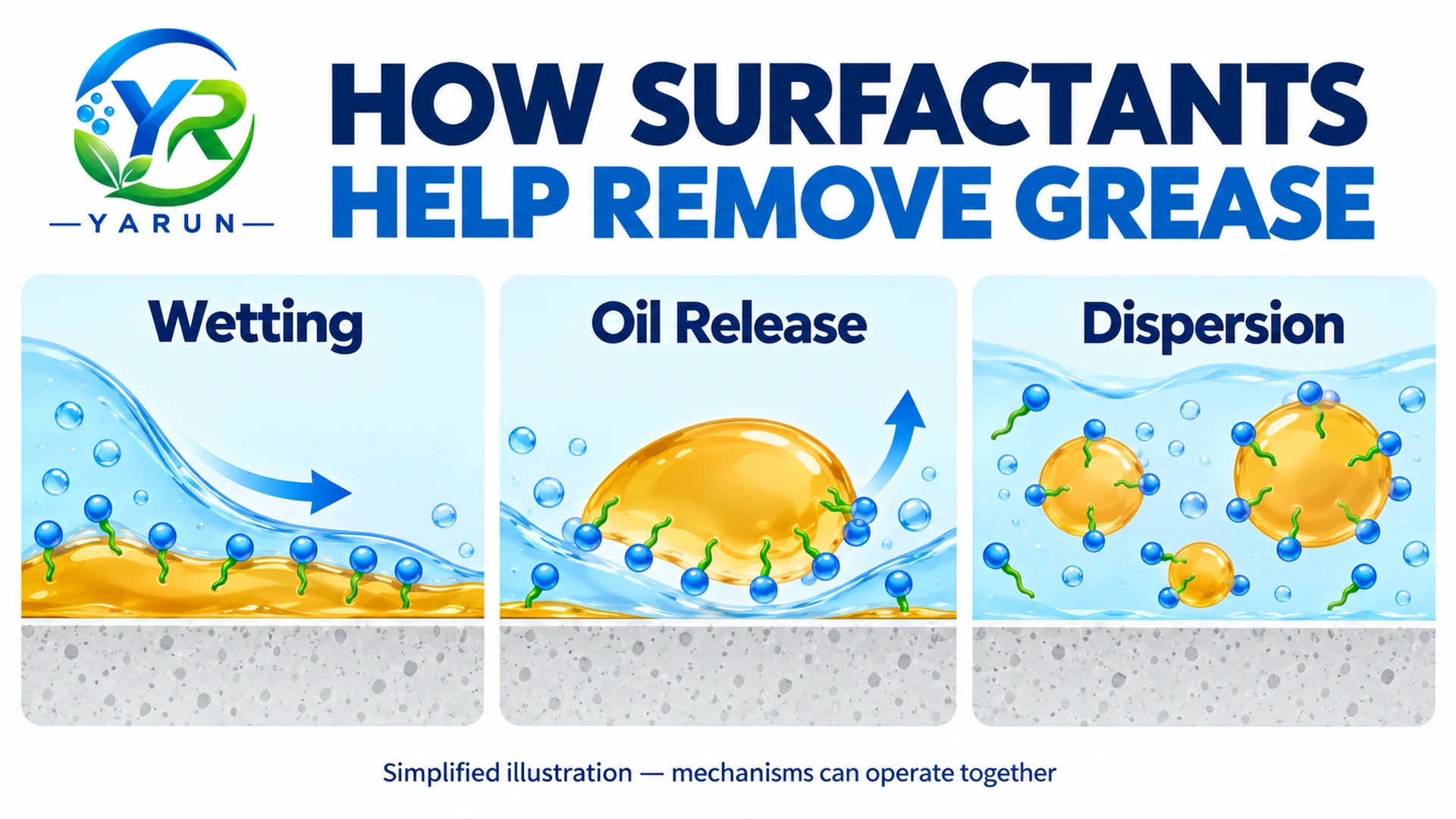
Water alone has limited ability to remove many oily food residues. Surfactants help by changing interactions between water, oil and the dish surface.
Several mechanisms can operate together:
- Wetting: surfactants help the wash liquid spread and contact soil.
- Interfacial action and roll-up: changes at the solid–oil–water interfaces can help oil detach from a surface.
- Emulsification and dispersion: detached oily material can be broken into droplets and distributed through the wash liquid.
- Micellar solubilization: under suitable conditions, micelles can incorporate some oily components into the surfactant solution.
Surfactants contain regions with different affinities for water and oil. At suitable concentrations and conditions, they can form aggregates called micelles. These aggregates contribute to solubilization, but they are not the only mechanism involved in washing.
The mechanisms above are not a fixed sequence followed identically by every formula. Their contributions depend on the soil, surface, surfactant system, temperature, water and mechanical action.
Food residues also contain materials other than oil. Removing a fresh grease film and removing dried mixed food soil are different tasks.
A manufacturing base supplies a starting cleaning system. Its performance must be considered in the prepared product and under relevant washing conditions.
3. What Does Formulation Achieve Before the Base Leaves the Factory?
A manufacturing base brings several formulation decisions together before the buyer starts local preparation.
Those decisions include selecting the starting surfactant system, setting the ingredient balance and establishing how the base should be handled and prepared.
Concentrated surfactant mixtures can behave differently from their diluted forms. At high concentration, interactions between surfactants, water and other components can produce structures with different flow properties.
Adding water changes those interactions. Viscosity therefore does not necessarily decrease in direct proportion to dilution, and the thickness of a base cannot reliably predict the thickness of its prepared product.
The manufacturer must consider two related conditions:
| Condition | Main questions |
|---|---|
| Supplied concentrate | Can it be stored, weighed and transferred under the specified conditions? |
| Prepared dishwashing liquid | Does it meet the intended appearance, flow, cleaning and other finished-product requirements? |
A workable concentrate must have a suitable preparation route as well as an appropriate supplied specification.
At YARUN’s production base, reference preparation and sample checks help connect these two conditions. The formulation provides the starting system; the preparation record shows how a particular finished sample was obtained.
For the buyer, the benefit is an existing formulation starting point and a defined basis for evaluation. The remaining local work should be stated clearly rather than assumed.
4. How Does the Concentrate Become Finished Dishwashing Liquid?
Local preparation follows the instruction established for the specific base. It may include weighing, charging water and other materials in the specified order, mixing, permitted adjustment, equilibration, sampling and filling after release.
A product example makes the mass relationship easier to understand.
YARUN’s reference preparation route for a 75% active-matter hand dishwashing liquid base combines one part base with four parts combined preparation additions, by weight.
| Reference input or output | Mass |
|---|---|
| Concentrated base | 1 kg |
| Combined preparation additions | Approximately 4 kg |
| Total prepared product | Approximately 5 kg |
The four parts include water and applicable preparation materials, such as fragrance, colorant and viscosity-adjustment materials, within the combined total. They do not mean four parts water followed by additional materials outside that total.
Water used to prepare salt or color solutions also forms part of the combined addition quantity.
Calculating Theoretical Finished Active Matter
Where additions provide no extra surfactant active matter and there is no active-matter loss:
Theoretical finished active matter = Base mass × Base active-matter fraction ÷ Total prepared mass
For the stated example:
1 kg × 0.75 ÷ 5 kg = 0.15, or approximately 15%.
This is a mass-balance calculation, not a finished-product test result. It does not establish cleaning performance, stability or compliance with a market standard.
The reference route is defined by weight. Any alternative dosing arrangement requires an appropriate, verified basis.
Why Dilution Is More Than a Concentration Calculation
The mass balance explains how much surfactant active matter is theoretically present. It does not describe the complete physical state of the prepared liquid.
Dilution changes surfactant concentration and the environment in which the surfactants interact. Fragrance and electrolyte additions can further influence that system.
A preparation may therefore need a defined sequence, mixing and equilibration before its final properties are assessed.
Concentration calculations and finished-product measurements are both useful because they answer different questions.
5. Why Are Active Matter, Viscosity, Foam and Cleaning Different?
These properties help describe a dishwashing liquid, but they answer different questions.
| Property | What it describes | What it does not establish alone |
|---|---|---|
| Active matter | Surfactant-active content under the applicable analytical method | Cleaning performance or finished-product suitability |
| Viscosity | Resistance to flow under defined measurement conditions | Active concentration or grease removal |
| Foam | Foam formation and persistence under the test conditions | Complete cleaning performance |
| Cleaning performance | Soil removal under a defined evaluation method | Every other aspect of product quality |
Total solids and active matter are also different measurements. Solids may include salts and other non-volatile materials, depending on composition and method.
Foam can matter to washing behavior and customer acceptance. Viscosity can matter to pouring, dispensing and filling. Neither should be dismissed—but neither substitutes for a cleaning test.
Adding sodium chloride to increase viscosity does not add surfactant active matter. A thicker sample should therefore not be described as having higher surfactant concentration on that basis.
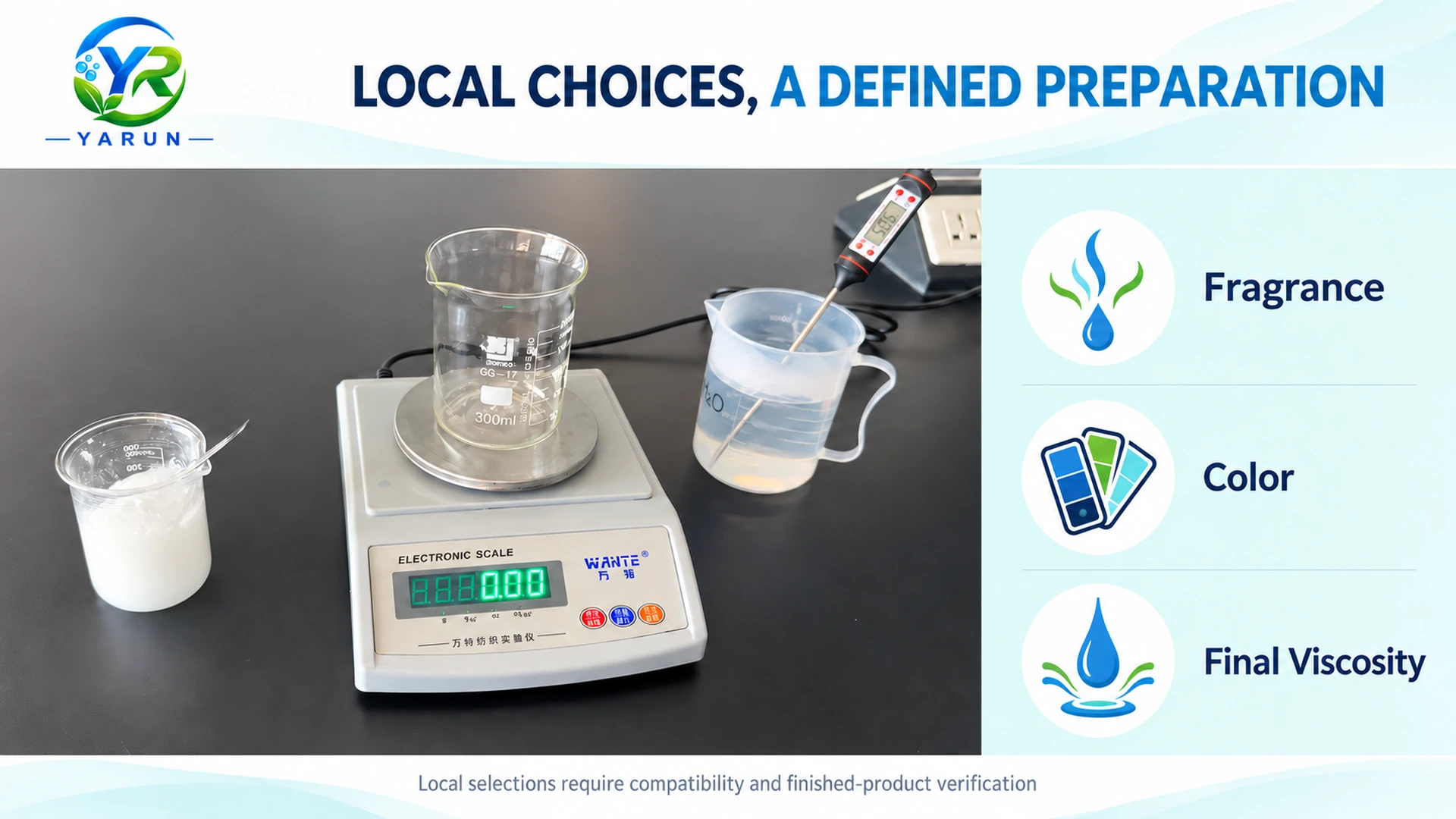
6. Why Leave Fragrance, Color and Final Salt Adjustment to Local Preparation?
A base can supply the formulation starting point while leaving selected finishing decisions local.
For a supply arrangement where fragrance and color are not preset, the buyer gains room to adapt the finished presentation. Final salt adjustment can also be established around the complete preparation rather than the concentrate alone.
The benefit is flexibility. The trade-off is additional local material control and verification.
Water Establishes the Local Preparation Environment
Water contributes more than mass. Its mineral content, treatment and microbiological condition can influence the prepared system.
Representative local water should therefore be part of the initial evaluation. A source described simply as “clean” or “purified” still needs to be suitable for the intended formulation.
Relevant water requirements should reflect the base, preparation process and finished-product target.
Fragrance Supports Market Choice
Local fragrance selection allows a manufacturer to match its brand, customer preferences and cost position without necessarily purchasing a separately fragranced base for every variant.
However, fragrance components can influence clarity, viscosity and stability. A preferred scent must also be compatible at the intended dosage.
A pre-fragranced supply can reduce local dosing work when the fragrance and formula are already fixed. Neither arrangement is universally superior.
Color Supports Product Differentiation
Local color selection allows visual differentiation between brands, fragrances and product lines.
The buyer must use a suitable colorant, control the addition and assess color stability. Color intensity is not a measure of active matter or cleaning strength.
Leaving color open creates choice. Preset color reduces one local operation.
Final Salt Adjustment Supports the Completed System
In many salt-responsive surfactant formulations, sodium chloride influences interactions and structures within the surfactant system. It can increase viscosity within a useful range. Beyond that range, additional salt can reduce viscosity.
The response depends on the complete composition, including water, fragrance, surfactant concentration and existing electrolyte.
Establishing final adjustment with the intended local additions included gives the manufacturer room to match the prepared product’s flow requirements.
It also requires controlled dosing and testing. Leaving final adjustment local does not mean that the supplied base contains no sodium chloride: commercial ingredients can already contribute salt.
| Local choice | Main opportunity | Work retained locally |
|---|---|---|
| Fragrance | Brand and market adaptation | Dosing and compatibility evaluation |
| Color | Visual differentiation | Suitable material selection, dosing and stability checks |
| Final salt adjustment | Target flow and dispensing behavior | Controlled adjustment and viscosity verification |
7. Why Does the Preparation Process Matter?
A composition describes what is present. A process determines how the materials are combined into a uniform batch.
| Process factor | Why it matters |
|---|---|
| Addition sequence and rate | Help control dispersion and avoid unsuitable local concentrations |
| Mixing and circulation | Distribute materials throughout the working volume |
| Air entrainment | Can affect appearance, sampling and filling |
| Temperature | Influences viscosity, solubility and comparability of measurements |
| Equilibration and sampling time | Help define when the sample represents the release condition |
More mixing is not automatically better. Mixing should achieve uniformity without unnecessary air or foam.
The appropriate procedure depends on the formulation, equipment and batch size. It should define the operating sequence and checks rather than relying on repeated operator judgment.
This converts an initial preparation into an instruction that can be taught, recorded and evaluated.
8. What Can YARUN’s Factory Preparation and Testing Records Demonstrate?
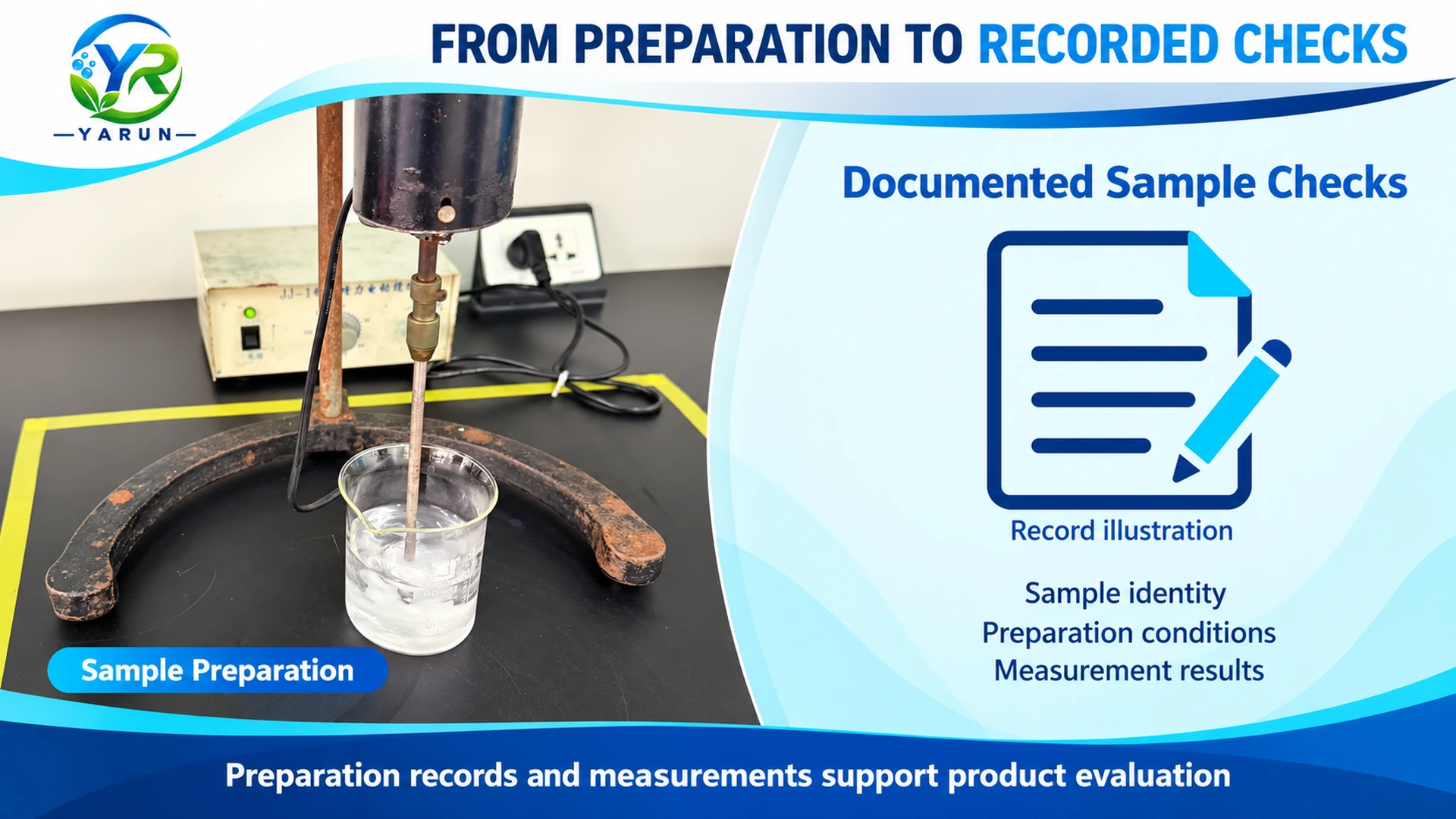
A factory record is most useful when the reader can connect the material, the operation and the sample result.
YARUN’s hand dishwashing reference preparation documents the route from the base through preparation to sampling and physical checks. Preparation images and retained samples provide further context for that recorded work.
The reported results for one reference prepared sample were:
| Parameter | Reference prepared-sample result |
|---|---|
| pH | 6.79 |
| Viscosity | 2,375 mPa·s |
These are results for the prepared dishwashing liquid, not fixed specifications of the concentrated base.
The different parts of the record have different purposes:
| Evidence | What it supports |
|---|---|
| Weighing and addition record | The materials and quantities used in that preparation |
| Mixing and sampling record | How the sample was produced and collected |
| pH and viscosity results | The measured properties of the identified sample |
| Retained sample | A reference for subsequent observation or comparison |
For a valid viscosity comparison, the measurement method, temperature, settings and sample condition must be considered. A viscosity number without that information is not a complete comparison basis.
Likewise, pH and viscosity do not establish grease removal, preservation, storage life or commercial-batch consistency. Those require evidence appropriate to the claim.
The value of a documented factory preparation is that it makes the product discussion concrete: what was prepared, how it was prepared and which properties were actually checked.
9. How Can a Base Simplify Routine Manufacturing?
The practical benefit of a base becomes clearer when initial setup is separated from routine production.
During initial setup, the manufacturer confirms local water, intended additions, equipment and finished-product requirements. More than one trial may be needed.
Once the preparation method is established, routine work can follow a defined batch instruction:
- Weigh the specified materials;
- follow the confirmed addition sequence;
- mix under the established conditions;
- make permitted adjustments;
- sample and check the batch;
- release for filling when the requirements are met.
Compared with building the complete formula from separate ingredients, a suitable base can reduce the number of materials purchased and the number of individual additions. It can also reduce the need to repeat starting-formulation development.
Changes still need review. A new fragrance, water source, preparation ratio or larger batch may require further verification.
The aim is to give operators a clear, repeatable method—not to remove quality control.
10. Where Does the Business Value Come From?
For a business that would otherwise import prepared finished liquid, concentrated supply can reduce the mass of formulated input shipped for a planned finished output. Actual freight savings depend on packaging, shipment arrangements and local costs.
Other potential sources of value include:
- Local purchasing of suitable water and packaging;
- fewer separate formulation inputs to source and stock;
- less work developing the starting formulation;
- and local control over selected brand and presentation choices.
These benefits must be compared with the work retained locally: material handling, preparation, testing, filling and management.
A base is therefore not automatically the lowest-cost route. Its commercial value depends on whether the supply model fits the manufacturer’s capability and target product.
11. How Should Manufacturers Evaluate a Base for Their Own Project?
Start with the product you intend to sell.
Define its application, target market, packaging, expected characteristics and production scale. Then assess the base using representative water and planned local additions.
The evaluation should establish whether the prepared product meets the intended requirements and whether the method can be reproduced at a representative scale.
For a structured evaluation approach, see How to Evaluate a Detergent Concentrate Base Before Commercial Production.
To discuss a YARUN hand dishwashing base project, provide:
- Target country and business type;
- intended finished product;
- expected purchasing quantity or monthly output;
- available mixing and filling capability;
- fragrance, color and packaging direction;
- delivery destination.
These details help move the discussion toward a relevant product, sample evaluation and quotation.
Discuss Your Hand Dishwashing Liquid Base Project
Frequently Asked Questions
1. What formulation work does a dishwashing liquid base actually replace?
A base can reduce the need to select and combine every starting formulation ingredient separately. It may also reduce individual sourcing and dosing work. The extent depends on the supplied composition and remaining local additions. Water control, preparation, selected customization and finished-product release still need to be managed.
2. Why can two bases with the same active matter produce different finished products?
Active matter does not describe the complete formulation. Surfactant types and ratios, other components, local additions and processing can affect the result. Comparable active-matter methods are important, but equal percentages do not establish equivalent cleaning, foam, rinsing or stability.
3. Should we choose a base by concentration, dilution ratio or finished-product performance?
Define the required finished product first. Check whether the proposed preparation can achieve that target, then compare concentration, output, local work and commercial terms. Concentration and dilution help describe the supply model; they do not replace finished-product evaluation.
4. When is a concentrate base a better fit than buying individual raw materials?
It is worth evaluating when a business has controlled mixing and filling capability but wants to reduce starting-formulation development and separate ingredient management. A producer with an established formulation team and a need for detailed ingredient control may prefer individual raw materials. The choice should match the work the business wants to retain.
5. How much control do we retain over fragrance, color, viscosity and packaging?
Those choices can remain local within the evaluated preparation system. Compatible fragrance, color and packaging can support brand differentiation. Major changes to concentration, cleaning composition or intended use go beyond ordinary finishing and require a broader formulation review.
6. Where can a base create value beyond its purchase price?
Value may come from concentrated transport, local packaging, fewer separately managed formulation inputs and reduced starting-development work. Assess those opportunities alongside local materials, labor, testing, losses and accepted output. A lower drum price alone does not establish the better manufacturing option.
7. What evidence supports moving from a YARUN sample trial to a commercial order?
A relevant trial should use representative local water, intended additions and defined preparation conditions. The prepared product should meet the agreed requirements, with sufficient verification for the planned scale. Confirm the supplied specification, preparation information, packaging, quantity, documents and delivery terms before ordering. An attractive fresh sample is only part of that decision.
Conclusion
A dishwashing liquid manufacturing base combines formulation ingredients so the buyer can begin from an existing system and complete the product locally.
Its cleaning system must be understood separately from its concentration, flow and foam. Local preparation connects that starting system with water, selected additions and a defined process to form the intended finished product.
For a suitable manufacturer, the opportunity is to combine an established base with local product choices and a repeatable preparation method. A purchasing decision becomes stronger when these relationships are clear and supported by relevant product and trial information.